On Steeple Point – a shared world

I was climbing the path to Steeple Point.

Towards the top, the land falls steeply away, rapidly becoming a cliff face that drops vertically to the rocks below.

With the tide in, these rocks are covered by sea – Atlantic rollers reaching their nemesis on the Cornish coast.

From up here, you watch those big swells roll in.

They build, curl and crash forward in a welter of foam, sparkling in the sunshine. Piling over the back-tow of their predecessors, they waste themselves on the pebble ridge.

There are intricate patterns of foam, constantly changing, highlighting myriad currents and cross-currents.

That morning, there was nobody in sight.

I was enjoying the aloneness. . . the warmth of the sun . . . the smell of salt in the air. . .  the sound of waves on rocks.

The sea was still heavy from an earlier gale

There was a slight breeze, I remember.

And then this guy appears below me on a surf board.

The waves were sweeping in from around the Point. He had been hidden out there as I climbed.

So, it wasn’t my sole world after all. There were two of us – the one holding a camera and idly watching, the other intently doing.

It was so totally unexpected. I felt a little shocked – a bit put-out.

Then I felt admiration – what a great ride in such a beautiful place.

And then a change of mood –  sudden concern because of what I could see from my vantage point.

A moment of doubt burst into this memorable day.

The concern was all mine, of course.

Whatever I saw, whatever I thought might happen, was way beyond my control.

He didn’t care. He knew what he was doing. He was having a ball.

I could only watch, my concern pointless.

Let him get on with it.

He paddled out to catch another wave. I continued my walk.

Two separate lives enjoying  the same space, viewing it through different eyes.

A World Of His Own

On 22nd April 1969, a third year student in London, I watched Robin Knox-Johnson return to Falmouth on television.

His feat made a lasting impression. Like Sir Francis Chichester, he represented a spirit of adventure born of individual skill and personal endeavour. The essence of the achievement? No large back-up team, no communication for much of the voyage, no modern navigational aids – one man running with the elements, (and often against them).

Nowadays, it is difficult to describe his achievement without dropping into the world of spin and hype. They have stolen all the superlatives. Too much has been attributed too often to lesser deeds.You have to read his story in his own words to understand the man and the task.

And, for the rest of us, whatever our sailing ambition, he will be one who went before.

Are there words that sign-post what he did that may work for us now?

Napoleon Hill showed a feel for it early last century when he wrote:

“Whatever you want, oh discontented man, step up. Pay the price – and take it.”

Sir Robin stepped up, paid the price with perseverance and stamina and took his prize – the first to sail non-stop solo round the world.

Because he showed the trip was possible, others have followed with increasing confidence  – as well as with many, many more technical aids, and achieved successes of their own

Now, forty years on, general expectations are such that completing a solo navigation goes largely unmentioned – you have to be a record-breaker (or fail spectacularly) to get noticed.

But remember this: taking the prize may be the headline, but it’s the stepping-up and paying the price that’s the real challenge. And that’s the Knox-Johnson legacy.

All power to him this anniversary.

(Follow the links to see what others think – start here or here)

On sailing a Folksong – update

“Looks like a new boat” said the man in the marina who kindly walked me out of the berth.

Indeed, she does. Blue Mistress has finally become the boat I thought I glimpsed the first time I saw her four years ago almost to the day. Ever since that moment, I have been working towards this.

What she has become has more to do with ownership than anything specific. Instead of coping with someone else’s ideas, (however good they may have been), it comes down to owning a boat where all the positives and all the negatives are now the product of my own collaborations and my own final decisions. I guess everyone who sails a boat for any length of time will know what I mean.

For example, it could be because I am sitting at my new chart table, notebook open, pencil at the ready, able to make notes whenever I choose.

It could equally be because the galley has been cleaned up and I’ve bought a smaller kettle which comes to the boil more quickly.

Or that the loo facilities have been thought through properly and, suitably primed, are now satisfactory.
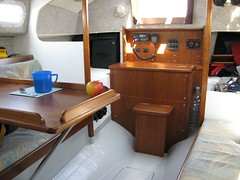
Or the new feel of spaciousness thanks to Robin Leach’s excellent finish to the repainting and retrimming.

Perhaps it’s because I have rethought the locker stowage so that more gear is to hand – gear that, in the past, had been ‘put away’ to be sorted out later.

It could be that, sitting here, with this excellent cup of tea, listening to Handel on the radio and watching people enjoy their Sunday on the water, I am mesmerised by the reflection of the sunlight on the water. In a boat with low freeboard you feel closer to the water- if you write about the sea, you are writing closer to the source!

It could also be that the rudder and tiller that have been bothering me for so long have been dealt with for the time being and I have the enjoyable prospect of sea trials ahead.

It’s all these things, of course, but, above all, it is the knowledge that every time I come aboard I won’t be looking around seeing all these jobs to do – jobs that in no way did I have the skills to complete to this standard. This bulk of unfinished business was getting in the way.

At my age, I have, in Jon Wainwright’s words, “only so many tides” to catch.

Blue Mistress now fits – and I feel freer to catch those tides.

~~~

This was my first post written on the boat – albeit with notebook and pencil to be copied later. I hadn’t realised how deep my ambition has been to do this comfortably.

No, I didn’t buy the boat to have a table to write at. I bought the boat to be able to sail. Writing about it has come out of owning it and given me the chance to find ways forward.

I shall continue to post. I wonder if my emphasis will change.

Stick at it, Bill

My namesake in his blog Knockabout Sloops says

“One of the things that I have noticed about in writing, and ranting, about my sailing ideals is how pointless it all seems. I seem to be championing an ideal of engineless sailing and beauty that is long gone. Buried in a sea of plastic, diesel and electronics. What I know is that the effort on my part takes time and energy and is seldom well received. So I have decided to stop ranting on Knockabout Sloops.”

I hope he doesn’t stop championing the ideal of engineless sailing and beauty. If he feels he is not well received then so be it – that goes with the territory.

For myself, I read his blog with envy and admiration. The boats he shows us are indeed beautiful. If he, in his conviction, doesn’t present them, who will?

However much I would like to, I could never live up to his ideal. For many reasons, I chose another way. There are plastic and diesel and electronics in my boat. And there is also the beauty that I appreciate. It comes in those moments when I am not using the diesel, or the electronics – the plastic just happens to be the form I choose to cross the water in.

For me, the real beauty is not the shape of the boat or the material it’s made of,  but the motion through the water under sail. And some shapes and some materials do it better than others – form and function matter.

In trying to accommodate the common denominators of comfort, convenience and profitable production lines, the majority has chosen a different path. Maybe they will come back in time – probably not. But that’s no reason to stop championing an ideal.

There are thousands of miles between us, Bill, but we share the same water.

And there are more ways than one to get your message across.  Stick at it.

Book sailing: coincidence

Furthering my interest in local craft (For love of a boat), I have been researching Greek inshore fishing boats. I contacted the library at the National Maritime Museum Cornwall and Denise Davey, one of the library volunteers, took up my request and was extremely helpful.

She came back with scanned copies of one of the appendices to H.R.Denham’s “The Aegean” – Inshore Craft. Here is one of the illustrations.

You will instantly recognise the hull shape from images in earlier posts to this blog.

This and more arrived earlier this week. I am very grateful to the NMMC. I had not heard of Denham’s book. I wondered when it was written, meaning to look it up on Google.

~~~

This evening I have been reading Hammond Innes’ “Sea and Islands”. published in 1967. Hammond Innes was one of the earliest authors I read – well before James Bond. In retrospect, I found his stories far more exciting, if less fashionable, than Ian Fleming’s.

The book was hidden on a shelf in my favourite used-book shop – Books by the Sea in Bude, Cornwall. Apart from the author and the subject, I was bowled over by the dated dust jacket. A whole different era.

In “Sea and Islands”, Innes describes various voyages in his Robert Clark designed, 42 foot, masthead cruiser-racer ‘Mary Deare’. He describes being dismasted in the RORC’s  North Sea Race; a cruise ‘rockhopping’ in Scandinavia and then taking the boat to the Mediterranean and exploring the Greek Islands.

It is when he starts to describe the islands and the sea between them that the book comes alive. I am only half way through the book but the islands themselves have brought life to it.

That’s not all: “Apart for the Mediterranean Pilot Vol. IV, our Bible throughout was Henry Denham’s “The Aegean”. This sea guide to the coasts and islands of Greece was most conveniently published the previous year (1963), and knowing that I was bound for his previous happy hunting ground, the author has kindly sent me a copy. It is the perfect introduction to island landfalls, for it not only gives the port information necessary before sailing in, but also geographical and historical details in conveniently concise form.”

So now I know. I must get hold of a copy.

On learning to row

“Watch carefully, Bill.”

Aged about 12. We were leaning against the rail  looking down at the water.

A small,  elderly man was descending the wooden steps from the quay next door. He was dressed in a blue fisherman’s jersey, baggy grey trousers and canvas shoes.

Half way down, he nodded a good morning to us, untied the end of the frape and gently hauled his dinghy to the tiny landing stage beneath him.

It must have been about half-tide to have exposed this platform. Along this side of the harbour, dinghies were moored on frapes to allow the boat to ride the considerable tides and also to prevent them going aground at low water –  (in all but the lowest of low spring tides), so that they were always ready for use.

He untied the boat from the frape, remoored it to the ladder and stepped neatly into the middle of the boat. It barely moved.

The thwarts were wet from the previous night’s rain. He found a cloth and dried them.

Then he raised a bottom board and bailed the small amount of water collected there. He sponged it dry.

Facing aft, he sat down on the middle thwart, shipped both rowlocks and then the outside oar.

Twisting round, he untied the painter, coiled it into the bow and gave the boat a gentle push. Now he had room to ship the other oar.

As the boat drifted further away from the ladder, he was able to pull on the port oar turning the boat towards its destination.

With barely a glance over his shoulder, he took the weight on both oars and glided effortlessly away to the quay across the water.

The oars dipped with barely a splash – an economy of movement that gave the sense of a single unit – man and boat.

Even I could see the natural focus, the self-possession and the strength of someone doing what they have been doing for decades – a master in his element.

This was Randolph Johns. He was probably in his late sixties. That seemed ancient then – I no longer think so.

Over the next two or three summers, there would be the occasional lesson in our pram dinghy or a few words on shore.

From watching and listening to him, I learnt how to row and how to handle a small dinghy.

There was never any formality in his teaching – just the passing on of knowledge and the acquiring of some skill by doing.

I will never forget Randolph Johns. I learnt from him what it meant to master an activity – to have reached a point where the movement itself ceases to be an aspiration and becomes part of your being. He wasn’t a man who went out for a row – rowing was part of how he lived. He didn’t think about it much.

Had I rowed every day since, I doubt if I would ever have been as capable of doing this deceptively simple task as well as him. Even in those days, outboard engines had taken the necessity out of rowing and were turning it into a leisure activity. There was now choice – the attitude behind it had changed. Most of the masters of rowing nowadays will have mastered a sport, not a means of transport.

At 12, of course I didn’t understand this. But I did begin to look at how other people did those things I wanted to do – and I did learn a little from doing this . . .  and then a little more  . . .

“Watch carefully, Bill.”

Fowey, circa 1959. I took the picture. See the number of moorings compared with today. The tug on the right is St Canute which later went to the Exeter Maritime Museum.

On sailing a Folksong – freeboard

Talking of freeboard, the following is from Jon Wainwright’s ‘Only So Many Tides’:

“We compared the two craft. Deva was less than a foot of freeboard astern, fine lined and low in superstructure. The cabin cruiser with twice the power, three times the freeboard and four times the superstructure appeared to her owners to be far safer; they couldn’t believe that freeboard at sea is like a chin held up to a punch.”

You better believe it.