Back from Crete with thoughts on local working boats. More on that later.
In the meantime, enjoy the colours on this boat.

These are from the Libyan Sea and bright sunshine.

Paleochora, Crete 2009
For the origins of this image series, here
Back from Crete with thoughts on local working boats. More on that later.
In the meantime, enjoy the colours on this boat.
These are from the Libyan Sea and bright sunshine.
Paleochora, Crete 2009
For the origins of this image series, here
I was climbing the path to Steeple Point.
Towards the top, the land falls steeply away, rapidly becoming a cliff face that drops vertically to the rocks below.
With the tide in, these rocks are covered by sea – Atlantic rollers reaching their nemesis on the Cornish coast.
From up here, you watch those big swells roll in.
They build, curl and crash forward in a welter of foam, sparkling in the sunshine. Piling over the back-tow of their predecessors, they waste themselves on the pebble ridge.
There are intricate patterns of foam, constantly changing, highlighting myriad currents and cross-currents.
That morning, there was nobody in sight.
I was enjoying the aloneness. . . the warmth of the sun . . . the smell of salt in the air. . . the sound of waves on rocks.
The sea was still heavy from an earlier gale
There was a slight breeze, I remember.
And then this guy appears below me on a surf board.

The waves were sweeping in from around the Point. He had been hidden out there as I climbed.
So, it wasn’t my sole world after all. There were two of us – the one holding a camera and idly watching, the other intently doing.
It was so totally unexpected. I felt a little shocked – a bit put-out.
Then I felt admiration – what a great ride in such a beautiful place.
And then a change of mood – sudden concern because of what I could see from my vantage point.

A moment of doubt burst into this memorable day.
The concern was all mine, of course.
Whatever I saw, whatever I thought might happen, was way beyond my control.
He didn’t care. He knew what he was doing. He was having a ball.
I could only watch, my concern pointless.
Let him get on with it.
He paddled out to catch another wave. I continued my walk.
Two separate lives enjoying the same space, viewing it through different eyes.
On 22nd April 1969, a third year student in London, I watched Robin Knox-Johnson return to Falmouth on television.
His feat made a lasting impression. Like Sir Francis Chichester, he represented a spirit of adventure born of individual skill and personal endeavour. The essence of the achievement? No large back-up team, no communication for much of the voyage, no modern navigational aids – one man running with the elements, (and often against them).
Nowadays, it is difficult to describe his achievement without dropping into the world of spin and hype. They have stolen all the superlatives. Too much has been attributed too often to lesser deeds.You have to read his story in his own words to understand the man and the task.
And, for the rest of us, whatever our sailing ambition, he will be one who went before.
Are there words that sign-post what he did that may work for us now?
Napoleon Hill showed a feel for it early last century when he wrote:
“Whatever you want, oh discontented man, step up. Pay the price – and take it.”
Sir Robin stepped up, paid the price with perseverance and stamina and took his prize – the first to sail non-stop solo round the world.
Because he showed the trip was possible, others have followed with increasing confidence – as well as with many, many more technical aids, and achieved successes of their own
Now, forty years on, general expectations are such that completing a solo navigation goes largely unmentioned – you have to be a record-breaker (or fail spectacularly) to get noticed.
But remember this: taking the prize may be the headline, but it’s the stepping-up and paying the price that’s the real challenge. And that’s the Knox-Johnson legacy.
All power to him this anniversary.
(Follow the links to see what others think – start here or here)
“Looks like a new boat” said the man in the marina who kindly walked me out of the berth.
Indeed, she does. Blue Mistress has finally become the boat I thought I glimpsed the first time I saw her four years ago almost to the day. Ever since that moment, I have been working towards this.
What she has become has more to do with ownership than anything specific. Instead of coping with someone else’s ideas, (however good they may have been), it comes down to owning a boat where all the positives and all the negatives are now the product of my own collaborations and my own final decisions. I guess everyone who sails a boat for any length of time will know what I mean.

For example, it could be because I am sitting at my new chart table, notebook open, pencil at the ready, able to make notes whenever I choose.
It could equally be because the galley has been cleaned up and I’ve bought a smaller kettle which comes to the boil more quickly.
 Or that the loo facilities have been thought through properly and, suitably primed, are now satisfactory.
Or the new feel of spaciousness thanks to Robin Leach’s excellent finish to the repainting and retrimming.
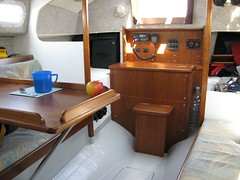 Perhaps it’s because I have rethought the locker stowage so that more gear is to hand – gear that, in the past, had been ‘put away’ to be sorted out later.
It could be that, sitting here, with this excellent cup of tea, listening to Handel on the radio and watching people enjoy their Sunday on the water, I am mesmerised by the reflection of the sunlight on the water. In a boat with low freeboard you feel closer to the water- if you write about the sea, you are writing closer to the source!
It could also be that the rudder and tiller that have been bothering me for so long have been dealt with for the time being and I have the enjoyable prospect of sea trials ahead.
It’s all these things, of course, but, above all, it is the knowledge that every time I come aboard I won’t be looking around seeing all these jobs to do – jobs that in no way did I have the skills to complete to this standard. This bulk of unfinished business was getting in the way.
At my age, I have, in Jon Wainwright’s words, “only so many tides” to catch.
Blue Mistress now fits – and I feel freer to catch those tides.
~~~
This was my first post written on the boat – albeit with notebook and pencil to be copied later. I hadn’t realised how deep my ambition has been to do this comfortably.
No, I didn’t buy the boat to have a table to write at. I bought the boat to be able to sail. Writing about it has come out of owning it and given me the chance to find ways forward.
I shall continue to post. I wonder if my emphasis will change.
My namesake in his blog Knockabout Sloops says
“One of the things that I have noticed about in writing, and ranting, about my sailing ideals is how pointless it all seems. I seem to be championing an ideal of engineless sailing and beauty that is long gone. Buried in a sea of plastic, diesel and electronics. What I know is that the effort on my part takes time and energy and is seldom well received. So I have decided to stop ranting on Knockabout Sloops.”
I hope he doesn’t stop championing the ideal of engineless sailing and beauty. If he feels he is not well received then so be it – that goes with the territory.
For myself, I read his blog with envy and admiration. The boats he shows us are indeed beautiful. If he, in his conviction, doesn’t present them, who will?
However much I would like to, I could never live up to his ideal. For many reasons, I chose another way. There are plastic and diesel and electronics in my boat. And there is also the beauty that I appreciate. It comes in those moments when I am not using the diesel, or the electronics – the plastic just happens to be the form I choose to cross the water in.
For me, the real beauty is not the shape of the boat or the material it’s made of, but the motion through the water under sail. And some shapes and some materials do it better than others – form and function matter.
In trying to accommodate the common denominators of comfort, convenience and profitable production lines, the majority has chosen a different path. Maybe they will come back in time – probably not. But that’s no reason to stop championing an ideal.
There are thousands of miles between us, Bill, but we share the same water.
And there are more ways than one to get your message across. Stick at it.
Talking of freeboard, the following is from Jon Wainwright’s ‘Only So Many Tides’:
“We compared the two craft. Deva was less than a foot of freeboard astern, fine lined and low in superstructure. The cabin cruiser with twice the power, three times the freeboard and four times the superstructure appeared to her owners to be far safer; they couldn’t believe that freeboard at sea is like a chin held up to a punch.”
You better believe it.

In book-sailor mode, I found the following – the first paragraph of the preface to Deep Sea Sailing, by Erroll Bruce:
In 1950 I enjoyed an exciting sailing race across the North Atlantic and was soon afterwards sent for by Lord Fraser of North Cape, then First Sea Lord at the Admiralty. He asked many questions about the handling of the yacht, and finished by saying, “What you have learnt of the sea in small craft is not your private property, so I trust you will pass it on to others.”
I warm to the phrase ‘pass it on to others.’
It stands back from ‘teach’ or ‘tell’ or ‘inform’. It somehow has less of the tinge of intention created by a modern trend that seeks to ‘improve’ everyone.
It says: “I have done such and such. This is what happened and this is what I learnt. You can pick it up and use it or you can leave it alone. Either way, our ideas meet for a short while and then move on.”
The importance is in the communication. The effect is up to the recipient.
We have been watching the rugby this afternoon – England losing to Wales, and the conversation got round to sporting academies and how young people seem to be protected these days and, as a consequence, are expected to survive major tests before they have built the practical experience they need to cope with them – before they know what it’s like in real life. At least the old-fashioned apprenticeship pitted the apprentice against the real world almost from the start.
My mother-in-law who comes from a farming family said that, when she was young, they used to describe people like that as “book-farmers”. They know everything on paper . . . but not much in reality.
I, like many other people who sail, devour books on sailing and the sea and could be described as a book-sailor by anyone with more experience than me. (I have just added yet another of my many books to the boatblog book shelf).
It has got me thinking: I wonder if people could be described as “blog-sailors” or “DVD-sailors”. I believe there are thousands of “virtual-sailors” currently ‘racing’ in the Vendee Globe. Perhaps they are “laptop-sailors”. or ‘pc-sailors’
Whatever . . . it is good to be interested – but the only real way to learn is to be out there on the water.
So, I wish you a favourable tide and a fair wind

Squall over Eddystone 2007
but not too favourable or too fair . . .
because how else will you learn?
I highly recommend the images from Warm Rain Ship’s log of Maori waka (canoes).
They were taken after the Waitangi Day celebration in the Bay of Islands, in New Zealand.
Follow the link from here.


 Beyond Steeple Point