On sailing a Folksong – a cautionary tale

We had a great sail – the perfect wind for Blue Mistress, a crew of four, and a sunny day.

Back on the mooring, everything cleared before going ashore . . .”Have you seen this, Bill?”

Ross had noticed the lifted plate – I had missed it. I wasn’t looking. I trusted the fitting. And that could have been a big mistake.

The inevitable questions: Was water getting in? Was the block beneath rotten? The bolts were obviously pulling through, would the forestay pull out of the deck? If so, would the mast go overboard? . . . Or onto the crew in the cockpit?

Yes, well . . . questions like that come up when you are taken by surprise . . . before standing back and sizing up the situation properly.

I had previously thought the forestay to be tight but it carried the hanked-on genoa well. Now I saw it as bar-taut and straining my mast. The mast bend suddenly seemed excessive.

Inspection in the chain-locker showed the forward bolts angled forward.

Removing the bolts released a  roughly-shaped offcut which looked as though it had been found in the boatshed bin . . . “That’ll do, George. It’ll just about fit.”

There would have been less of a problem if it had been cut with a little more care so that there was no overlap of the washers at the edge.

It would have been even better if more time had been spent and it had been carefully shaped and fitted. It’s one of those ‘out of sight, out of mind’ jobs. I have been writing about skilled craftsmanship for years now – I hold up my hands, I thought I had cleared up most of the problems on my own boat.

It wasn’t just the ply, of course, but the over-tight rigging that pushed it over its limit. Problems rarely come singly. They are part of a series – one thing leading to another leading to another leading to disaster.

How much strain is required to achieve this degree of distortion in a piece of marine ply?

In the event, there was no sign of water entering.  Nor was there any sign of rot. And it probably wouldn’t have pulled through. But that’s no consolation.

We have replaced the offcut with a stainless steel plate, cut to size, sandwiching a wooden block, cut to the same size, for compression. (Thanks, Richard).

The rigging has been re-set with less tension on the shrouds and a more gentle mastbend.

Now I’m going through the boat with a fine tooth-comb. Once bitten . . . . .

On Sailing a Folksong – Thank you

There are blogs written by those who are complete experts at designing, building and repairing their own boats with no other help than a forbearing partner and a seemingly infinite amount of time. I am not one of these.

~~~

In 2006, I bought a boat. It was the boat I had wanted for most of my life but never had the opportunity to own before. It took a little time to confirm what was right with it . . . and a little longer to find out all that was wrong with it. Fortunately, what was right outshone what was wrong.

That first season was good fun. We sailed a lot, even making a passage to Fowey and back. Unfortunately, there were some problems and I began to think of ways to fix them – and then ways to improve her, and so my ambition grew – (”What is possible? We are not trying to restore a classic boat to its original state. It’s not a wooden boat. Let’s see what modern materials can achieve”).  One thing was for sure: whatever I wanted done on the boat would be way beyond my then knowledge and still current skills. So I began to look for someone to help me.

Specifically, I wanted someone who would listen to what I wanted to do . . . and would recognise when I was being unrealistic and say so – and be prepared to come up with an alternative. Over the years, I have learnt how independent boat owners are . . .  and how proud of their boats, sometimes excessively so. It takes a diplomat to handle them.

During that summer, following an unfortunate incident with a crossed battery cable, we were in Plymouth Yacht Haven sorting it out. While trying to hide my embarrassment at the earlier mistake, I was explaining to Pete from Marine Systems what I wanted to do with Blue Mistress. He said, pointing to the Hangar across from the marina, ‘why don’t you try DickyB over there’.

A while later, Richard Banks sat in the cabin and looked around while I told him what I was wanting to do and how far back we would have to go before we could move forward – and there was no way of my affording the work in one leap.

I liked him immediately. He caught on to what I was saying, cut through the c**p and we began to work out what might be needed to start the project off. (Yes, I know I was a potential client so you would expect him to be enthusiastic, but there are ways and ways of handling clients – I liked his style).

And so the relationship with Dicky B Marine began. There have been three periods in the Hangar at Mount Batten. Each time, Blue Mistress has been returned to the water greatly improved. On the last occasion, she was a new boat.

~~~

Throughout, Richard has been excellent. I often arrived unannounced and, despite other work  on other boats, been enthusiastically shown what had been done and what was proposed. If I was in the way,  he and everyone else had the courtesy to keep it till I left! I took pictures of everything. I have sent strings of emails and attachments with ideas and changes. Believe me, it’s not the boat, it’s the owner!

It’s a team, of course. In this, our last session, Robin Leach’s skilled carpentry and work below decks have been especially appreciated – I haven’t forgotten the twenty locker lids laid out to paint.

He also made the smart  new tiller, one that no longer catches the lazarette locker lids.

At the same time, the stainless steel fittings were made in their workshop by Dave Willey. Andy Wilson worked on her too. That was another reason for choosing this firm. They have several strings to their bow.

And there was Pete Brian of Marine Systems – he of the original referral, who did the electrical work, Neil Gledhill of Hemisphere Rigging Services and the haulout crew of Plymouth Yacht Haven.

In a little under three years, we have gone from this:

2007

to this:

2009

From this:

2006

to this:

2009

From this:

Torpoint 2006

to this:

Oreston 2009

The Folksong hull was originally built for the DIY market. Blue Mistress was launched in 1988. She has changed owners two or three times since. Each one had their own ideas. Everyone brings their own personality to a boat. I don’t suppose any two people would agree on what the “correct” solution should be.

Well, this owner is older with a demanding day job, and with not so many tides ahead of him. He has enjoyed sharing the boat with the  surprisingly large number of people who have worked on her. (In a recession that can’t be a bad thing).

And he’s not finished yet. Over the next few years her intends to enjoy Blue Mistress, work on her and sail her as much as possible.

Thanks, Guys.

On Sailing a Folksong – back to the beginning

“Experience is not what happens to you, it’s what you do with what happens to you” – Aldous Huxley.

~~~

Well. it’s happened, as it was bound to. Having spent the past three years focusing on doing Blue Mistress up, all the feelings about it have changed. It’s as though, having reached the top of the junior school, we are now moving on to bottom of the senior school – from the top of one learning curve to the bottom of the next.

I “celebrated” this by arriving back at the mooring on Friday to find the engine and the inside of the engine housing covered in oil. More on that later.

~~~

Is the boat finished? No, but we have reached a level where I can enjoy doing all those small jobs that I haven’t been able to do up to now. It’s no longer a ‘this-is-what-it”ll-be-like-one-day’ dream. I am no longer letting jobs ride “because I will sort that out later when such-and-such has been done”.

Looking back over the past three years, there are, broadly speaking, four areas of owning a boat that I have been learning about. Although the headings were originally applied in a different context, they can be loosely described as:  health, comfort, function and appearance.

Health: The fundamental integrity of the hull and rigging. We had some major leaks to fix in the deck. But none in the hull itself. The rudder caused concern. Some of the rigging needed updating. The sails were ok. And, up to last Friday, the engine had given no trouble.

Comfort: Safety: I have gathered together the basic safety features (including learning how to stay on board). There are one or two extras still to go – that’ll be more money out. We can find out where we are –  there are no less than three different gps systems available – and now a chart table to lay out a chart on. The head is satisfactory. The galley works nicely too – we can boil a kettle quickly, cook up some soup or anything else should we feel inclined. Stowage has improved.

Function: This is where we go back to being bottom of the school. Experience up to now has been one of getting to know a boat as she was updated. What seemed like big adventures last year and the year before, seem like small ones now. Certainly the investment of time, energy and money require more use of Blue Mistress and I hope for plenty of sailing this year and next.

Appearance: Get form and function together and any boat is almost bound to look good – well, almost. I thought the appearance was good to start with, but it has got better as different problems and improvements have been tackled.

~~~

And the engine?

On Saturday, in light winds, we had a gentle sail to a couple of miles off the Mewstone. In the early afternoon, we watched Rame Head, then Cawsand, then the Breakwater disappear as a line of fog/low cloud drifted along the coast. We decided enough was enough and motored back to the mooring.

I asked Pete to close the seacock for the seawater coolant. He said he got oil on his hand doing it. I said that was not possible. We opened the lid of the engine housing . . .

We looked at it, and we looked at each other. We both knew we had no idea what had happened or how bad it might be.  We decided the engine was still too hot to work on. Silently, we closed the lid, rowed ashore and drove home.

Yesterday, I spent several hours upside down with my head in the bilge. The cause should have been immediately obvious, but it took me a while to find it because I wasn’t expecting it. Embarrassingly, it turned out to be a schoolboy error on my part. In my hurry to check the oil, I thought I had replaced the dip-stick correctly – but hadn’t. In my defence, the dip-stick is fairly long, the hole is flush with the casing and invisible from the front of the engine. It’s easily missed and the stick slides tightly alongside the engine casing – but that’s no excuse . . .

And now we have learnt a thing or two:

Do you know where oil goes if you leave the dip-stick out? . . . everywhere!

It completely coats the inside of your new engine housing (and I mean completely). It completely covers the engine (and I mean completely) – all those little screws and bolts and inaccessible corners where dirt builds up, between all those cables that have been cable-tied together, behind the engine where you have to do impossible contortions to reach  – and, of course, into the bilge.

I now know the outside of the engine intimately. I know how good the heavy duty oil remover is. I also know that, if you lay an oil-soak mat in the bilge, and settle back for lunch, by the time you have finished it will, remarkably, have soaked up most of the oil. I also found a short stainless steel strop that went missing during our first major refit two years ago. The bilge is the cleanest it has been for some years.

Luckily, not all the oil came out  – what was left came just above the minimum mark, and the engine (a Yanmar 1GM10) still runs remarkably smoothly.

Just as, when driving, I am constantly checking my rear view mirror because, thirty years ago, someone ran into the back of my car, I will never rush to check the oil again. I shall replace this particular dip-stick very, very carefully.

That’s experience.

On sailing a Folksong – update

“Looks like a new boat” said the man in the marina who kindly walked me out of the berth.

Indeed, she does. Blue Mistress has finally become the boat I thought I glimpsed the first time I saw her four years ago almost to the day. Ever since that moment, I have been working towards this.

What she has become has more to do with ownership than anything specific. Instead of coping with someone else’s ideas, (however good they may have been), it comes down to owning a boat where all the positives and all the negatives are now the product of my own collaborations and my own final decisions. I guess everyone who sails a boat for any length of time will know what I mean.

For example, it could be because I am sitting at my new chart table, notebook open, pencil at the ready, able to make notes whenever I choose.

It could equally be because the galley has been cleaned up and I’ve bought a smaller kettle which comes to the boil more quickly.

Or that the loo facilities have been thought through properly and, suitably primed, are now satisfactory.
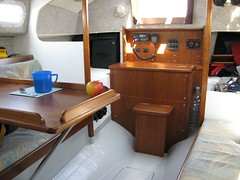
Or the new feel of spaciousness thanks to Robin Leach’s excellent finish to the repainting and retrimming.

Perhaps it’s because I have rethought the locker stowage so that more gear is to hand – gear that, in the past, had been ‘put away’ to be sorted out later.

It could be that, sitting here, with this excellent cup of tea, listening to Handel on the radio and watching people enjoy their Sunday on the water, I am mesmerised by the reflection of the sunlight on the water. In a boat with low freeboard you feel closer to the water- if you write about the sea, you are writing closer to the source!

It could also be that the rudder and tiller that have been bothering me for so long have been dealt with for the time being and I have the enjoyable prospect of sea trials ahead.

It’s all these things, of course, but, above all, it is the knowledge that every time I come aboard I won’t be looking around seeing all these jobs to do – jobs that in no way did I have the skills to complete to this standard. This bulk of unfinished business was getting in the way.

At my age, I have, in Jon Wainwright’s words, “only so many tides” to catch.

Blue Mistress now fits – and I feel freer to catch those tides.

~~~

This was my first post written on the boat – albeit with notebook and pencil to be copied later. I hadn’t realised how deep my ambition has been to do this comfortably.

No, I didn’t buy the boat to have a table to write at. I bought the boat to be able to sail. Writing about it has come out of owning it and given me the chance to find ways forward.

I shall continue to post. I wonder if my emphasis will change.

Stick at it, Bill

My namesake in his blog Knockabout Sloops says

“One of the things that I have noticed about in writing, and ranting, about my sailing ideals is how pointless it all seems. I seem to be championing an ideal of engineless sailing and beauty that is long gone. Buried in a sea of plastic, diesel and electronics. What I know is that the effort on my part takes time and energy and is seldom well received. So I have decided to stop ranting on Knockabout Sloops.”

I hope he doesn’t stop championing the ideal of engineless sailing and beauty. If he feels he is not well received then so be it – that goes with the territory.

For myself, I read his blog with envy and admiration. The boats he shows us are indeed beautiful. If he, in his conviction, doesn’t present them, who will?

However much I would like to, I could never live up to his ideal. For many reasons, I chose another way. There are plastic and diesel and electronics in my boat. And there is also the beauty that I appreciate. It comes in those moments when I am not using the diesel, or the electronics – the plastic just happens to be the form I choose to cross the water in.

For me, the real beauty is not the shape of the boat or the material it’s made of,  but the motion through the water under sail. And some shapes and some materials do it better than others – form and function matter.

In trying to accommodate the common denominators of comfort, convenience and profitable production lines, the majority has chosen a different path. Maybe they will come back in time – probably not. But that’s no reason to stop championing an ideal.

There are thousands of miles between us, Bill, but we share the same water.

And there are more ways than one to get your message across.  Stick at it.

On sailing a Folksong – update

Blue Mistress has twenty lockers with removable lids, twelve of them in the bunks. Laid out across a worktop and painted white, the lids looked surreal – bright islands in a dark sea.

There is a new folding lid across the stove as well as one above the portable loo. (Before, both these lids were a little tight to remove. There was a trick to it –  meaning that I could manage them fine because I knew how to do it, but the occasional crew didn’t. Therefore, they found the loo difficult to use . . . and said so.)

The varnished trim around the bunks has been matched along both sides, but is yet to be fitted.

The chart table has been revamped.  The old one was slightly too big to keep shipped all the time, although it was a very good dining table. Unfortunately, it also had a split in it. So it has been shortened, reworked with fiddles and, although still removable, will be fitted securely across-ships.

There is a concern that giving. the main cabin an eggshell white finish makes it look clinical. Well, not with all the gear I put in it it won’t! At the moment it looks stark but the cushions and trim will soften it. It’s a boat with a parlour in it, not a parlour with a boat around it.

But it is a boat of just under 26 foot with less than five foot headroom in the main cabin. We are not talking ‘large yacht’ we are talking ‘making a small space as comfortable as possible in circumstances that can be quite uncomfortable’.

Therefore, the art of stowage is magnified here. I have only a hazy idea how the long distance voyagers manage their stowage in boats of this size. A lot of gear must be piled on spare bunks, every nook and cranny filled. Single-handed, it must be tight; two of you must be very tight.

Stowage is not a static art – hiding things away in the bowels of the boat. It’s a dynamic art. Everything has to be accessible, able to be reached when needed and moved to wherever it’s used – sometimes in a hurry.  It’s about lockers that open easily (but not too easily in a sea). It’s about knowing where everything is, and having an instinctive ability to move around the boat to reach it.

It’s about establishing regular habits to be able to give measured responses to irregular events.

It’s about seamanship – handling yourself, handling the boat, handling the gear.

~~~

This week, I have noticed a sea-change in my thinking.

For the past four years, I have been concerned about the fabric of the boat – “should we do this or that, change this or that, keep this or that the same, or what?”  Each year, I have concentrated on one part of it. Each year I have taken countless images and studied them for this or that reason. I have sometimes followed outside advice, and sometimes followed my own intuition  and, with the help of Richard Banks at DickyB Marine, we have progressed.

There’s plenty still to do – it’s a boat, there’s always plenty to do . . . and even more to learn.

But the major work is over. From now on, “it is what it is – get on with it”.

I am looking to get Blue Mistress  back in the water and go sailing.

On sailing a Folksong – update

The removal of old trim, the rounding off of wooden edges and a first coat of white paint has transformed Blue Mistress’ main cabin.

So much so that she has become a different boat.

Up to now, I have gone along with the cosily unfinished state below decks. It was always going to need more work but, on the whole it was ok.

Now the work is being done, which means decisions have had to be made.

The first was whether or not to fit a proper sea toilet (Jabasco compact) instead of the portable loo which was boxed-in midships in the entrance to the fore cabin. The traditional bucket would have suited the skipper but he had to fall in with the expectations of those guests who prefer a more conventional approach. It did occur to him that one way of weeding out prospective crew would be to note their response to “By the way, you’ll have to use the bucket . . .” followed by a long pause. On the other hand, he remembered that he rather liked some of those who might turn their noses up at it so the least he could do would be to see whether something more formal was possible.

As there is little head room immediately forward of the bulkhead, the only feasible plan would be to shorten the port-hand bunk – (in effect, remove it), and install the device at the forward end, immediately this side of the bulkhead. He designed a box to contain it which would have a double hinged lid level with the shelf behind. This would be useful as a worktop – (and somewhere to put down a mug of coffee). Painted white with the rest of the cabin, it would only be slightly intrusive – even if we had lost the widest and most comfortable bunk.

At the same time, there is no chart table. The “thunderbox” lid could be used as one but would require the occasional removal of everything on it, whereas if we used the middle part of the bunk space for a regular chart table with chart storage and lockers beneath –  keeping it level with the aforesaid worktop and varnishing it as contrast, then we would add considerably to the facilities aboard.

By leaving space at the aft end for one person to sit facing across the cabin while being able to twist round to use the table –  (there would need to be some space beneath this end of the table to accommodate knees), it would still be possible to enjoy a convivial evening. The design also intended there to be a pull-out table for those sitting on the starboard bunk.

Moving the heads would have opened up the entrance to the fore cabin which had been tricky to enter because of the way the portaloo was boxed in and the lack of headroom just inside the forecabin.

But we’re not doing any of that.

Why? Cost mostly – and time. In doing the planning, I discovered where the limit lay. (This was before the economic crisis had taken hold. I’m even more sure now.)

What we are doing is less complex, and, by the look of the work completed so far, the result will be better for it.

More on this in a later post.