An extra headsail

There was no wind yesterday morning when we left the mooring, and we motored across the Sound and out through the Western Channel on a glassy sea. One hour, two mackerel and a pollock later, a light wind ruffled the surface. Just enough wind to try different sail arrangements.

Blue Mistress shows a slight but noticeable wetherhelm in certain wind conditions and I have been wondering what difference an extra headsail might make. If I used the spinnaker halyard – (we have a spinnaker which I haven’t got round to repairing yet), and the deck fitting I normally attach my jack lines to, this was a chance to try it out.
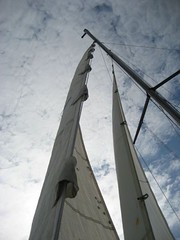
From the depth of sail bag, I dug out our smaller jib and set it flying. It set very well and we made a gentle knot under this sail alone. Then I added the no. 2 jib which is the relatively heavier sail I set when single-handed in stronger winds.

I was trying to match sail shapes. The smaller sail has a longer foot than the no.2 jib but otherwise the match wasn’t too bad. After lots of adjustments, we found a balance and, still without the mainsail, we were making an extra knot or two. I took these images when we were reaching and you can see how the light wind affects each sail.

I need to think this through some more and would be interested to hear other people’s experiences/thoughts on headsails and weatherhelm.

During all this, we looked up to see three short but steeply breaking waves coming towards us out of nowhere. The sea was flat, there were no vessels creating wash anywhere near us, and yet suddenly we found ourselves beam on to a breaking sea. There was just time to disengage the autohelm and turn stern to. The second wave just lapped over the stern and then they were gone – the sea flat again. I guess some disturbance hundreds of miles away . . . but a reminder not to be fooled by the conditions and to keep a good watch . . .

Why I like sailing

I realise I haven’t written about Blue Mistress for a while now – but I have been sailing as often as the weather allows.

For those who like clips, this is another one in the Why I like sailing series – here

I have been told by someone who doesn’t sail that nothing appears to be happening in the clip. My reply is that everything is happening . . . beautifully.

Enjoy.

For love of a boat – in Messinia, Greece

Ayios, Nikolaos, Messinia, Greece 2007

We walked down to the coast from Milia, a village high up in the hills behind Ayios Nikolaos.

In the heat of afternoon, the four of us sat in a taverna on the harbour wall, with four cold bottles of Mythos on the table before us.

One of us couldn’t take his eyes off the boats.

For the origin of this series – here

Enjoying the wait

The trapeze artist said: “Living is walking the wire. Everything else is waiting.”

The finest Sunday of the summer. The sun shone, the wind blew. A brilliant day for a sail.

But there was something wrong with the car. . . and, as I have damaged my thumb, sailing was out.

So we took the train to Exeter . . .

Teignmouth – Dawlish – Dawlish Warren – Starcross – Exeter St Thomas.

This is the coast-line – to be more exact, Isambard Kingdom Brunel‘s line, the line of his Atmospheric Railway.

The sea sparkled the way it does here when the wind blows from the west and stirs the calm surface to catch the morning sun.

A mile or so off the beach, a ketch, in full sail, was reaching across the bay. Each time we emerged from one of short tunnels through the cliffs, she had stretched away further south towards Hope’s Nose and Berry Head.

We stopped in Dawlish, then Dawlish Warren, (disembarking families carrying beach clothes and picnics), before we turned inland along the Exe estuary.

The tide was high and the Folkboat (I always notice her) was on her mooring. I had thought of keeping Blue Mistress here before settling on Plymouth.

It seemed that people were taking to the water wherever we looked.

In Exeter, they were enjoying the river, including the short crossing on Butts Ferry.

The ferry is left over from the wonderful and much lamented Exeter Maritime Museum.

The warehouse that housed the museum is still there. I have always thought, whimsically perhaps, of the boats moored along the canal as ganging up in sympathy for the small gem of a museum that has been lost forever.

We had come to Exeter to visit our son and spent the day doing ordinary things – walking and talking, greeting and eating, before returning to the train.

Along the Exe, the tide was now very low and the Folkboat closer to the shore – well, close to the bird flocked mud flats.

And in Teignmouth, in the late afternoon, there was gig racing. On shore, rowers were hurrying to their boats, busying themselves before the start of their race.

Offshore they were heaving on their oars, some boats flying, some labouring, all working to a common cause.

Today the rowers had been out ‘walking the wire’, while we were ashore ‘waiting’ and doing ordinary things – walking and talking, greeting and eating  . . .

and we were all having a thoroughly enjoyable time.

For love of a boat – in Northumberland, England

Seahouses, Northumberland, UK 2004

AA commented to my last post:

“I have often heard it be mentioned for aircraft “If it looks good it will fly good”.
I guess it applies to all things, boats included 🙂
Beauty, efficiency, utility, it all lies with the right proportions, maybe just the right mix of good and bad design (as nothing is perfect).”

I definitely agree with this. There is also the thought that “form follows function”.

When they reached the final design for the coble, they must have explored a whole seried of boat forms before they decided that this was the one that ideally suited the coast on which it was to be launched.

In the image above, there is the opportunity to compare the coble with the more recently designed Drascombe lugger – conceived and built in the south west of England.

This should also please Mr Boating who commented: “Looks good but I think you can add more photos from other sides, can you?”

Sometimes you take several images, sometimes you don’t.

For love of a boat – in Northumberland, England

Seahouses, Northumberland, UK 2004

For a Cornishman used to Atlantic swells and surf-swept beaches, inshore craft have always been a facination. As a teenager, I read Edgar March’s ‘Inshore Craft of Britain: in the Days of Sail and Oar’ and was hooked. The facination comes from the way boat design developed over the centuries to suit specific coastlines. Local conditions and local materials requred local solutions.

(WIth no apology for repeating myself) . . . as the world gets flatter, and commercial and political expediency blur the old boundaries, we have gradually (rapidly in many cases) lost the individuality in skills, knowledge and experience that go with it. You can still find it (as with this coble) – but you have to look hard.

The coble may work as a boat in Cornwall but it was shaped to deal with the tides of the North Sea and the beaches of the North East of England, no less than the boats of Southern Europe were shaped to deal with the relatively tideless Mediterranian.

Enjoy the difference and keep looking.

For the origin of this series – here