Inshore Craft 1

“We treat the past as a foreign country, when, in reality, it was occupied by the same people as us.”

I’ve forgotten who said that but I was reminded of it when I saw that Edgar March’s “Inshore Craft of Britain: In the Days of Sail and Oar” has just been republished.

It was first published in 1970, and covers small working boats of the Nineteenth and early Twentieth Centuries. Reading it, I was fascinated that an island as small Britain should have developed so many different shaped boats to perform more or less the same thing. Each locality had grown a different tradition. These working boats were, in effect, visual versions of regional accents. Thirty five years later, I am still fascinated.

Three reasons for liking this book:

1. For the boats themselves – as complex objects, with lines and detail, some more elegant than others, but all with a functional beauty that fitted their surroundings.

2. They were true examples of the the concept of ‘form following function’, made more substantial in that they were the livelihood of their owners and crew. Here were small boats constructed in local yards round the coastline of a small island. They varied in shape, in design and in size, not just from region to region but often from harbour to harbour, the only limitation being in the wood and materials used in their construction.

On the face of it, looking back from our mass-produced, communication-efficient world, it can be difficult to understand why this Falmouth Workboat, photographed off Polruan in Cornwall 

Falmouth Quay Punt

should differ so much from this Coble, photographed at Seahouses in Northumberland.

sea 062

After all, they were built for more or less the same purpose.

In fact, the answer isn’t so difficult. Take one island, facing north, south, east and west; take tides, currents, prevailing winds; take a long, varied coastline, some stretches steep and rugged, some shallow with sand and mud, some exposed to the weather, some with large safe deep harbours, some with just a rock or two for shelter. Add a function – fishing, trade, piloting, transport.

Even today, these factors would make a difference to shape and form, but think what centuries of experience of local conditions would do. Think about the materials that would be available in one part of the country that weren’t in another. Think about the traditions that would have grown up around a particular coastline. And to really understand what it was like, you need to take one other factor into account:

3. The owners and crew who sailed in them. They represented the way of life of countless small communities. This was a world where experience counted, where fathers passed their skills onto their sons and, less so in those days, their daughters. Here were local communities, not necessarily isolated from one another but certainly separated, who developed their own craft specifically for the coastal conditions in their area.

No different from us today – they faced the problems of the time and had to solve them. They laughed like us, they cried like us, they succeeded, they failed, they loved, they hated – just like us. They knew what hard work meant. Some did it well, some badly, a few brilliantly. Some were successful financially and went on to do more, some were less so. But their knowledge, skills and attitudes came from doing, from experiencing first-hand. It took longer to gain them, but the best results lasted as long, if not longer, than ours will today. Those hard-won abilities created individuals in a world that needed individuals.

There is one major difference between are ancestors and us today. We have access to more knowledge and more skills, and at a far younger age, than those who came before us could possibly imagine in their wildest dreams – (think Google, endless courses, books, journals and DVDs). But, despite this, our basic ability to absorb and use our new-found knowledge has not grown in line with our sources. In the end, we learn best by doing too – and it still takes time. All the rest of the stuff that comes our way is ‘on approval’ – and we are becoming increasingly swamped by it, struggling to be individuals in a sea of often irrelevant information.

So what’s your point, Bill?

I don’t have a romantic view of the past but I do have a respect for those who learn from experience – and I don’t care whether they were born in 2007 or 1007. (At this point, it would be easy to bang on about our not learning the lessons of the past, but that’s for others to do).

What I would like to do is to stay with boats and to use the concepts above – a) boats themselves, b) the fact of their form following their function, and c) the crews who sail in them, and, as I travel around the coasts not just of the UK but further afield, record, if I can, examples of craft that are being used today that represent this long line of experience. No doubt, some will exhibit a high quality of craftsmanship, some less so. But it isn’t the quality I want to pick out here. What interests me are the solutions to maritime problems that work in particular circumstances. Like this small fishing boat moored in Trikeri on the Pelion Peninsular, on the Aegean shores of Greece.

DSC00628

I do not pretend to be an expert. Inevitably, my efforts will be random observations and certainly not comprehensive. But, this is not an academic study, it is a record of small pleasures, pleasures I believe I share with many other people.

It is also a record of concern, a concern I also share with many others. Times are changing so fast that much hard-won, long-term experience is being sacrificed in the name of easily-found, short-term expediency. We badly need to hang on to some of that experience.

So, my entries to this blog over the next year or so will include an ‘Inshore Craft’ series of images. I hope they will be of interest to you. Please feel free to add your own if you wish.


The entrance to Bude Haven

DSCF5318

This the Barrel Rock at the entrance to Bude Haven, North Cornwall at 1445 this afternoon.

DSCF5331

High water was 1334, the wind is south west, force 6-7.

The entrance to Bude Haven January 2007

This coast stretches North-South. Due west is Newfoundland, Canada.

This is not a coast for a small boat on a day like today, but there was a time when the choices were different.

Entering Bude through the surf

This is one of a number of posts on the Ketch “Ceres”. They have been presented in a random order as and when I have found, or been given, new material. They represent steps in a personal quest to find out more about one branch of my family.

If you are interested in maritime history or would like to read more, please use the Search facility at the top right hand side of this page (‘Ceres’). If this is not available on your current screen, then click on ‘Bill’s Boat Blog’ – (or the title of this entry, then ‘Bill’s Boat Blog’), to be taken to the correct page.

Short Voyage – Continuing Story

Blue Mistress is now snug in her winter berth, very different from the exposed swing mooring of the past three months. She looks small among the high-sided yachts around her, like a new student in a strange school.

For me the short trip from mooring to berth, from one river to another, the Tamar to the Plym, held more than an Autumn afternoon jaunt.

The Tamar to the Sea 1

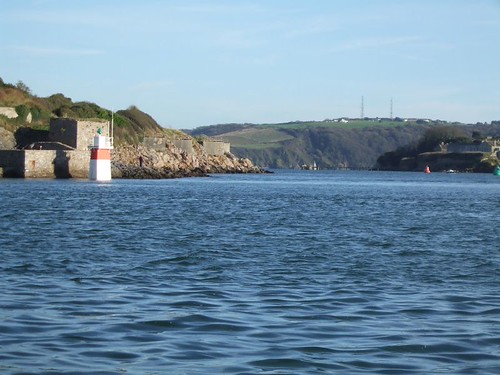
The gps reads 3.33 nautical miles, but that’s only distance. It took about an hour, but that’s only time. In terms of maritime history, distance and time, this stretch of water is endless.

It’s full of human stories – modern stories that has been going on for centuries. Stories of people setting out to explore their world using that most adventurous of ways to travel – on water.

Throughout the year, many thousands of holiday-makers, lorry drivers and business people cross the track I was taking. But long before the industrial age and ages of technology and information, people have left from here to explore the world, go to war, leave their home country for a life overseas, circumnavigate, trade and so on. They have lifted their faces to the same weather, smelt the same sea and felt that first lift of swell beneath them.

Many of the names have been with me since I was knee high. I don’t believe they were all paragons of virtue but they sure made an impact on the world.

In 1577, Francis Drake, started his circumnavigation in Golden Hind from Plymouth. Three years later, he moored off Drake’s Island (on the right of the picture) before heading up Channel for a triumphant return.

Drake's Island 1

On 19th July 1588, now Sir Francis Drake, he and the English fleet slipped out of Plymouth to tail the Spanish Armada up the Channel to meet them in battle off Gravelines on 29th July.

On 16th September 1620, the Pilgrim Fathers set off from Plymouth in the Mayflower, Captain Standish, landing in Provincetown, Massachusetts on 11th November (66 days at sea)

In 1768, the Endeavour, under Captain James Cook, left from Plymouth on the first of his three voyages of discovery. In 1772, on his second voyage, he was accompanied by Captain Furneax, who charted the coast of Tasmania and in 1773 was the first Englishman to land there, and Captain William Bligh of the mutiny on the Bounty fame (April 1789), who later became governor of New South Wales from 1806-1809. In 1776, Cook again left from Plymouth on his ill-fated third voyage.

On 13th March 1787, following heavy gales, (this was before the Breakwater was built, remember), the transport ships ‘Charlotte’ and ‘Friendship carrying men and women convicts left for Australia. On 28th January 1788, they landed with nine other ships at Port Jackson, later to be Sydney, New South Wales

In 1831, Charles Darwin on board the Beagle was delayed in Plymouth by bad weather

On 12th May 1839, the Tory sets sail for New Zealand with settlers.

Between the 19th November 1840 and the 3rd September 1842, six ships left Plymouth with settlers bound for New Plymouth, New Zealand – the William Bryant, the Amelia Thompson, Oriental, Timandra, Blenheim and Essex.

A plaque near the Mayflower Steps remembers the thousands of Cornish men and women who sailed from Plymouth, miners and farmers to settling in South Australia. Not only Australia. In 1973, near Russell, in the Bay of Islands, New Zealand, we came across a small cemetery with many graves of Cornish miners.

Between 1812 and 1841, Plymouth Breakwater was built to create one of the largest sheltered harbours in Europe. So , the Pilgrim Fathers, James Cook and the early transport ships would have set out into a bay into which a strong southerly swell could keep ships in port for days on end.

We passed Plymouth Hoe, with the prominent landmark of Smeaton’s Tower. This was the light on the Eddystone Rocks from 1756 to 1882 and would have been welcomed by the ships of the time, but the rocks were unlit in Drake and the Pilgrim Fathers’ time, a troubling navigational hazard some 14 miles off Plymouth.

1st May 1919, the American seaplane NC4 landed in Plymouth Sound after the hazardous first Transatlantic Flight

Drake's Island 2

The Naval Dockyard at the beginning of our short voyage was started in 1651. Before this, it was based in Cattewater, which was where we were headed. During every war since, and the peacetimes between, including the First and Second World Wars, sailors, (and soldiers on the troop carriers), have journeyed through this water to unknown fates – many outstanding heroes among them, and many who were never to return. Only last week, in Iraq, we sadly lost a young marine who would have known this stretch intimately.

In the late sixties both Francis Chichester and then Alec Rose refitted on the Cremyll bank of the Tamar at Mashfords.

For some reason, Chichester’s feat shrank the world far more than air travel. For generations, the sea had been a route to adventure and the unknown. Sailors had gone to sea not knowing whether they would return. They had used the best of modern technology (bigger ships, better sails, different rigs) and that technology had evolved to meet the needs of exploration, trade and war. Now it was possible for men to race round the world solo in small boats. Setting sail for exploration, battle and trade had been joined by challenges of a more personal, leisurely kind.

This was hugely innovative and, as with all innovation, the next stage is organisation, and so OSTAR – the Observer Single-Handed Trans Atlantic Race, which had started in the Royal Western Yacht Club in 1960, developed and grew.

Single-handed sailing has come a long way since Hasler and Chichester’s initial race across the Atlantic. As I write, eight purpose-built yachts are competing in the Velux 5 Oceans race around the world and no less than 74 started in the Route du Rhum across the Atlantic. Phil Sharp, a Brit from Jersey has just won the Classe 40. These boats are filled with equipment that Chichester and Rose could only dream about.

And we can now garner news of these yachtsman more or less instantly. Video links put us in the yachts in the Southern Ocean – we live through their crises as they happen.

Near Mount Batten, we passed through a small fleet of youngsters dinghy racing (actually they shot round me). Perhaps the same youngsters were in the picture I took the following Sunday morning, looking for wind in the calm November sunshine. No time for romantic illusion here, they have the technology, winning is what counts and the wind is for the taking.

Sunday Morning

These are the inheritors of the legacy that the generations above have left – plus some. This is the generation that will face global warming head on.

Maybe its effects will not be as dramatic as some forecast, it certainly won’t be as miniscule as others hope. The reality will be somewhere in between, and the effect will be seen on the sea and in weather patterns before its effect on land.

As sea levels rise, it is not just the volume of water but the weight of water that we need to be concerned about. The tides will continue to rise and fall, but there will be more water flowing and if when the weather patterns dictate low pressure the water height will rise further and the weightand speed of tidal flow, combined with intermittent storm surges, will try our sea defenses.

We will need those who can read the sea and make best use of the weather. On this stretch of water, as on other stretches of water around the globe, this is where it starts, this is the training ground. These young people will be the heroes of the future, working with new technologies but dealing with the same elements with the same respect as those who went before them.

Every generation leaves unfinished business for those who follow. When the philosopher wrote, ‘whatever, you want, oh, discontented man, stand up, pay the price and take it!’ he meant us not only to have the courage to take up the challenge but also to take notice of the price to be paid for doing so.

Naturally, we have taken, but unfortunately (and perhaps inevitably) we have paid little heed to the price. Man has stepped out to reach as high as he can. Amazing feats have been accomplished, and wonderful innovations created. As the momentum of that taking has steadily increased, we have built a powerful head of steam. Now it is imperative we pay attention to the price and deal with it. That price is high.

Technology carries a large part of the answer but not all of it. Unfortunately, the very success of technology, (some would say it’s glamour), has blinkered us, causing us to rely on it and to think of progress as a headlong technological rush forward. Nowadays, we seem to discount even the recent past.

It’s as if the past has become a foreign country. We have forgotten that it was inhabited by exactly the same people as us – also facing the unknown, also having to find solutions to overwhelming problems. Yes, we have to face the challenges ahead ourselves, but we would do well to look back and learn from the experience of those previous generations.

Every problem carries it’s own solution, but, in this case, technology alone is not the answer. We need to look further.

A Change in Direction

This blog is timed to finish after three months –  on 4th January.

When I started I was purely interested in finding owners of Folksong 25s, wherever they may be.
I had no idea whether anyone would respond.
What would be the likelihood of anyone a) searching on Folksong 25, and b) finding my blog?
Have you ever tried Googling ‘Folksong’?
In the event, I have been pleased that there is at least one owner – on the East coast. Thanks, John.

However, something else has happened in the meantime.
I have discovered how easy it is for blogging to take over from journal-keeping.
It’s a very public form of journaling and needs far more discipline than I imagined
It can lead in all sorts of unexpected directions.

I set out to talk about Blue Mistress – (don’t try Googling Blue Mistress!!).
I wanted to keep it light and merely create a link for other owners.

What emerged in the beginning was my enthusiasm for my boat – (looking back, a rather unqualified enthusiasm).
I found it has led to thoughts on the sea and on maritime history – both of which have threaded through my life.
And now I am about to add an even more thoughtful entry, which
a) started as plain description of a short voyage along a stretch of well-traveled water
b) became full of links which can lead the reader in all sorts of directions
c) ended up as a comment on the people involved with the sea and their value to a future that involves global warming.

This entry confirms my belief that writing things down helps you move forward, and I commend journaling to you.
In navigation terms, it is the equivalent of being in the middle of an ocean with nothing but the sea, the weather and the currents.
Where you head is entirely up to you, based on your own skills and present wishes.
I hope the entry itself, ‘A Short Voyage – An Unfinished Story’, works.

The Ceres

On Saturday, I was at Bude Museum to leave some old photographs of the town. These came from a time when the photographer would make a postcard out of his/her photographs in order to sell them. So he/she would  produce sets around a particular subject, e.g. a building or an event or whatever.

I am ashamed to say that it is over twenty years since I was last in the museum. The subjects are, of course, familiar (as Bude is the place I was born) and they brought back good memories.

Specifically, there is a display based around the Ceres.

The Ceres was originally an Azores smack, built in Salcombe in 1811. She was bought by the Pethericks in 1856 and was in our family for five generations. In 1868, she was lengthened to 64ft and converted into a ketch, registered as 52 tons. She traded in the Bristol Channel and beyond.

On 24th November, 1937, she sprang a leak and went down off Baggy Point in Bideford Bay. At the time, she was the oldest boat on Lloyds Register.

Now, imagine this. I am talking about a boat that began life during the Peninsular War -(she carried arms supplies to the troops in Spain); sailed while the Battle of Waterloo was being fought, was over twenty five years old when Victoria came to the throne; was trading through the Crimean War, the American Civil War, the First World War, the discovery of electricity, the first motor car, the first aeroplane,  the first film.

When I was a small boy, my grandfather, who sailed in her as owner and skipper whenever he could , would speak of the Ceres with unquenchable enthusiasm. I didn’t know what was happening at the time, but I learnt ‘enthusiasm’ from him.

It was the sailing, and the ports they entered under sail alone that made it for him. 

Entering Bude through the surf

Bude is one such case.  On the North Cornish coast, facing west towards Newfoundland, the Atlantic rollers piling onto its beaches, Bude has a difficult entrance in most weathers.

There is a painting by John Chancellor of the Ceres “Taking Bude After A Blow”. He has depicted her passing close to Barrel Rock, with a large wave passing under her, her bowsprit in the air. As in the image above, she is carrying main and mizzen sails and two foresails. The wind is from the South West, meaning she is on a broad reach, but it also means the surf is breaking on the rocks beside her. The sky is overcast. Her small crew are completely concentrated on every shift in movement of wind, boat and sea.

She is about to ’round the barrel’ and come under the shelter of Chapel Rock and the Breakwater, where the crew will downsails and her lines will be taken by men in rowing boats – the hobblers -who will lead her to a mooring in the river or to the sea lock at the entrance to Bude Canal.

Ceres

If she stays on the mooring, the tide will drop and leave her high and dry. Horse-drawn carts will come onto the beach, and the crew will crane her cargo onto the carts using the main boom as a crane. She may load a small cargo on this tide as well.

The tide will come in and, the weather being favourable and the sea reasonably flat, she will, with the help of the hobblers and her own sails, go back to sea and make up the Bristol Channel towards Swansea or perhaps down Channel towards Trevose Head and beyond.

Nowadays, we sail for pleasure and use our engines at will; and we avoid the conditions that, less than a hundred years ago, those who made an engineless living from the sea took on daily. They had no chart plotters, gps, weather forecasts – faxed, texted or otherwise, no DSC/VHF.

As I write this, I find that I have no nostalgia for their difficulties, or wish to repeat them, but I do have an unquenchable enthusiasm for the attitudes that drove them to take those challenges on in the first place.

This is one of a number of posts on the Ketch “Ceres”. They have been presented in a random order as and when I have found, or been given, new material. They represent steps in a personal quest to find out more about one branch of my family.

If you are interested in maritime history or would like to read more, please use the Search facility at the top right hand side of this page (‘Ceres’). If this is not available on your current screen, then click on ‘Bill’s Boat Blog’ – (or the title of this entry, then ‘Bill’s Boat Blog’), to be taken to the correct page.