On sailing a Folksong – Saturday morning

I went down to the boat on Friday evening to spend a few days on board.

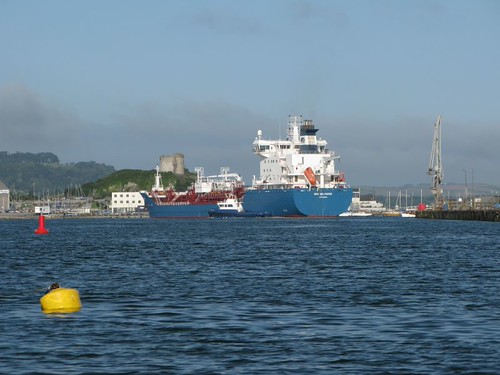
The following morning, having worked out the early routine, I made a cup of tea and sat with my head out of the hatch to enjoy the peace in the morning sunshine and watch the tide as it slackened towards high water. Today was the top of the spring tides – (0903, 5.4m; the still higher 5.7m due just after 2200). I cannot remember seeing the level so close to the top of the Cattedown Wharves (below).

A blast on a ship’s horn and the bow of Bro Deliverer, registered in Goteborg, appeared from behind the sheds – adding a different shade of blue to the scene and totally changing the perspective. A tug and the pilot boat tripped alongside her.

0756

She nosed into the turning area and came around stern first. The tug scurrying around while the pilot boat stood off with an air of dignified watchfulness.

A yacht motored briskly out of the Yacht Haven, promptly eased off and drifted gently, waiting for the ship to slip up river stern first.

0800

A few minutes later, a pleasure boat left its berth on the outside of the Yacht Haven pontoons and hurried around her bow to pick up its first passengers of the day.

Meanwhile, Bro Deliverer came level with the wharves and, with a little help from the tug, eased sideways into her berth. Lines were thrown and she came to a stop, dwarfing the cranes and sheds.

0815

All was over in 20 minutes or so – a well rehearsed routine, neatly accomplished by the ships crew, the crews of the tug and pilot boat as well as the shore crew.

My brother rang at this point to say he was five minutes away. Time to row ashore.

On Steeple Point – prevailing wind

AA comments:

It has been proved that the weather is unpredictable in the short term. One more reason for Britain lying directly below a jet stream delivering storms from the Atlantic. (If only Fitzroy knew that 🙂 )We can only establish some long term (seasonal) trends.
For example, in Greece it is known that “The ‘weather’ always comes from the West” whereas over here (UK) the direction is SW….There is evidence for this on the way that older trees are bent.

Do you mean bent like this? 🙂

Stowe Barton, Christmas 2009


On Steeple Point – two images from Duckpool

Two images from Duckpool.

The first taken last Christmas – the pebble ridge in winter:

This one taken in heavy rain at 1045 this morning – the pebble ridge in summer:

Lands End to St Davids Head including the Bristol Channel
Strong winds are forecast
Inshore waters forecast
24 hour forecast:    1900 Fri 17 Jul     1900 Sat 18 Jul
Wind     Westerly or northwesterly becoming cyclonic, 5 to 7, decreasing 4 in north.
Sea state     Moderate or rough, but slight in east.
Weather     Rain or showers.
Visibility     Moderate or good, occasionally poor.

This is this evening’s inshore waters forecast.  It was right for the whole day.

The heavy rain has swollen the river and once again altered the shape of the pebble ridge, the same ridge that presented such a peaceful scene last December.

This is the weather that makes this coast exciting and invigorating.

The only problem is that this is July. Why can’t it wait until the Autumn?

For love of a boat – keep them alive

Last week, I admired this boat in Padstow, Cornwall

and early last month, this one in Finikas, Crete

They are about the same size, both registered fishing boats.

One is built for fishing inshore in the Atlantic Ocean off Cornwall. the other in the Lybian Sea off Southwestern Crete.

To look at, these are totally different boats – but there are many similarities – similarities that come from their function and the work that is put into building, maintaining and running them.

Without a specific function and the people who use them, working boats become mere objects to look at (albeit very fine objects). Add in the people who built them and run them and they take on a life.

Someone decided to build them, lay the keel, add molds, timbers, planking, decking, an engine. Someone finished them. Perhaps the same people, perhaps someone else now takes them to sea, fishes from them, maintains them. These people have families, friends, fellow fisherman, customers – a community of people who know the boats.

Well, they have one other thing in common, they won’t last for ever. As time goes on, and fishing becomes more regulated, and plastic and metal construction finally takes over from wood, and universal design takes over from local design, and costs become more and more prohibitive, so these boats and those like them will disappear into history. Maybe this generation. And the skills that come with them will likely dissolve or resolve into some other field.

Celebrate them now, while you see them working.

Record them and share them

. . . and admire those who are working to keep those skills alive.

Try the boatbuildingacademy site – here, or Charlie Hussey’s marinecarpentry site – here.

Enjoy Mark Harris’ video on building the Isolde, then go to his woodenboatbuilding site – here.

On sailing a Folksong – those lazy jacks again

Saturday morning around 0930, heading towards Mount Batten Pier with a following wind.

All morning, Plymouth Longroom has been delivering a Mariners Notice of an impending powerboat race in Plymouth Sound, warning other boats to stay clear. There are few boats out. I am heading towards Mount Batten pier, preparing to downsails in the spot I usually use when solo so that I can motor back to the mooring.

I start to wonder if today woould be a good day to sail the nautical mile, if not onto the mooring, at least close to it. Could I sail single-handed in restricted waters without making a complete scallops of it?

This is a 25 foot boat with just me on board. There is a wide S bend to negotiate but enough width in a river that takes commercial shipping. The wind is southerly but will differ in the river. It will be heading me as I turn towards the Yacht Haven and it will be gusting in the river. The tide is still be dropping, and is towards the end of its run.  There’s certainly enough wind tot take me over it. Depth may or may not be an issue. The traffic is minimal . . .  And I would like the experience.

There would have been a time when I would have done it without asking the questions. The trouble is, the more I know . . .

So, now, decision taken, I am almost too far to the right of the end of the pier, the foresail is goosewinged and a gybe looks likely before I clear it. But as we get closer, the wind backs slightly, blowing along the pier, and we slip round the end with at least thirty yards to spare.

There are three or four boats emerging from Sutton Harbour and a racing yacht circling as the crew work on the mainsail.There’s is plenty of room for Blue Mistress if we keep to the right of the fairway.

The wind is now blowing downriver, more south easterly, with enough south in it to keep me outside the line of mooring buoys. Round the green fairway buoy, hardening onto the wind towards Victoria Wharves. A large yacht – (white, tall sides) is motoring downstream, passing swiftly astern. A fishing boat, closer to the Plymouth side, looks concerned, slows, turns to head us, (perhaps thinking I may tack early), realises I won’t, then passes well astern.

By now, I am adjacent to the entrance to the Wharves, and the wall is coming up. Still plenty of water below us. A glimpse of a man above, hosing equipment. Foresheet to hand, tiller hard over, Blue Mistress comes about, sails flap, I drop the port foresheet, haul in the starboard one quickly before the wind fills the sail . . . and we are bounding up and across river. I ease the foresheet slightly to give more belly. Hauling the sheet  in  just before the sail fills is very easy but, in my enthusiasm, I tend to flatten the sail.

The wind is coming in gusts now and we dinghy-sail, bringing her head up when the strength of the wind allows and noting the slight variations in direction. It comes across the Yacht Haven straight down this section of the river, and then begins to back a little as it draws across Turnchapel. We’re heading towards the moorings of boats of a similar size to Blue Mistress. There is plenty of depth of water here but I don’t want to get in among the moorings.

A strong gust, we heel, head up, and then go about. This time I am more gentle on the helm, deciding not to push it hard over but to see whether being less forceful will still bring her about but keep momentum up. It seems to work and Blue Mistress moves smoothly onto the next tack. Despite my concerns about the rudder, it does the job.

This is the narrowest section. We are head on to a corner of the river wall. It is approaching swiftly. At low springs, there is a rocky reef exposed off this point so, although there is probably enough water, I give it room, go about and head up towards what the chart designates as a ‘turning area’  for the larger commercial ships. Now Blue Mistress and I have navigated the S-bend in the river and have opened up the stretch towards Oreston and beyond.

In towards the seaward end of the Yacht Haven, and we are headed upstream, slowing as we head into a more sheltered stretch. It seems the tide is running a little stronger here.

When I put my head out of the hatch just after 0600 this morning, ‘Stability’ was docking at Cattedown Wharf. We pass along her starboard side.

I bring Blue Mistress head to wind. . .

and, just as I let go of the main, we get caught by a heavy shower of rain.

Roundly cursing having to stow wet sails, I notice the lazy jacks are still led forward. Not only are the sails wet and slippery, but the mainsail is now in an untidy heap. I have sail ties in my pocket, but, by the time I have gathered it into a fairly neat bundle, tied it, let the foresail drop to the deck, and stowed it (wet) into its bag through the forehatch, the tide has taken us back down the river the whole length of ‘Stability’. Engine on, motor back to where we were and finish cleaning up.

Then back to the mooring to complete the task.

Single-handed, a lot more forethought is needed – forethought comes from experience.

The lazy jacks should have been put back before we rounded Mount Batten Pier. I won’t forget again.

On sailing a Folksong – Lazy Jacks

Lyme Regis to Lands End including the Isles of Scilly
Outlook: Southwesterly 3 or 4 becoming variable 3, then southeasterly 4 or 5 later in west. Smooth or slight. Mainly fair. Moderate or good.

I think I’ve solved my lazy jacks problem.

I was pleased they were already fitted when I bought Blue Mistress.

They do have certain advantages:

  • when lowering the main, the sail folds relatively neatly onto the boom.
  • this is good when single-handed or with inexperienced crew. I can drop the sail without having to grab hold and furl it immediately.
  • also, when slab reefing, the loose sail is contained and need not necessarily be controlled with reef points.

But they have disadvantages too:

  • the primary one being that, with a battened mainsail, the first and often the second batten get caught during hoisting, especially in a hatful of wind. This means lowering the sail slightly to free it and start again. Single-handed this is very frustrating.
  • also, they have to be loosened after the sail is set and the topping lift released to a) allow the leach to take the weight of the sail and b) to release the full belly of the sail.
  • this means leaving the helm, going forward and making adjustments both sides of the mast.
  • and this means that they are loose and untidy during sailing.

To solve the problem, I have previously:

  • juggled with the wind and the heading of the boat, using the auto pilot to keep her head to wind. This gave only limited success. It kept the boat head to wind, but required more speed to do so, which, in turn increased the apparent wind, which, in turn, increased the sail flapping.
  • turned to head into the wind, to combine it with the boat almost stopped. Limited success again, needing a very swift hoist. If this failed, the half raised sail would allow the head to fall off the wind and jam the sail part way up. Back to the engine.
  • shortened the lazy jack lines, which had the effect of bringing the the blocks forward as well as  lowering their position. The idea here was to allow the battens to clear the confines of the lines lower in the hoist. This works better in light winds, but not in heavy ones.

The week before last I struggled for ten minutes or so to get the sail up and finally decided that I would get rid of them altogether if I couldn’t come up with a better solution.

I spent Friday night on the boat again and wanted to rig a stretch of canvas over the boom to make a tent over the companion way. The lazy jacks were in the way, so I loosened them off and led them to the mast, hooking them around their respective cleats before tightening the lines again – instant solution to the tent problem and instant solution to the sail raising problem.

In the clip above you can just make out the port lazy jack lines leading along the bottom of the boom and around the cleat.

On Saturday morning, the mainsail went up in one steady haul, the engine was stopped and we were sailing.

The next decision has to be taken at the end of a day’s sailing as to when to reinstate the lines.