From Steeple Point – the music of a gale

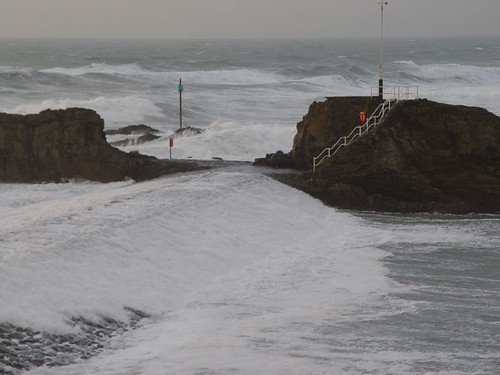
Following my last post,  let’s up the tempo and orchestrate a gale:

First, change the season to winter;

Then darken the light with heavy cloud;

Now add two, perhaps three major storms over the Atlantic, each in a different area, each several days previously;

Let’s have an onshore gale blowing – (the cameraman can barely stand upright);

And the first ebb of a high spring tide, the full flood just beginning to flow out of the river;

Add backwash to develop an undertow – the water has to go somewhere once it reaches the beach;

With cross-currents from a tide now heading down the coast;

And sound – the wind hammering in ears, the sea thundering and crashing, the snatched cry of seagulls.

Now we have music – a climactic moment in a symphony without a beginning or an end, composed by Nature and performed by The Elements.

.

But how to describe it for those who sail in small boats.

There is probably a scientific explanation, with each molecule of water predicted to a particular position with regard to every other molecule and the surrounding conditions.

Perhaps there is, but it is far too confusing, too complex for we mere mortals, so we rely on words.

And finding words is an art.

These days, we might try “Awesome“, but it is short-hand and doesn’t really express a storm  properly.

Some have described storms with first-hand reportage . . .

“The Spray neared Cap Pillar rapidly and, nothing loath, plunged into the Pacific Ocean at once, taking her first bath of it in the gathering storm. There was no turning back even had I wished to do so. for the land was now shut out by the darkness of light. The wind freshened and I took in a third reef. The sea was confused and treacherous. In such a time as this the old fisherman prayed, “Remember, Lord, my ship is small and thy sea is so wide.”  Joshua Slocum

Some with extreme drama . . .

“Poor naked wretches, where so’er are you / That hide the pelting of this pitiless storm.” William Shakespeare (King Lear).

Some with more rhythm . . .

“And large blue seas each other chased, / Cascading over down the waist.  / At every pitch he held his breath; / As if he saw the face of death. / “She’s pitched away a topmast, smash!” / All hands to clear away the wreck, / Were in an instant turned on deck; / From hammock starting out alert, / Up flew each seaman in his shirt! / And up the straining shrouds they swarm, / Growling and swearing at the storm.  / The wreck secured or cut away, / She snug beneath a trysail lay.” Capt J. Mitford RN, from Adventures of Johnny Newsome.

Of course, there are always those who see it in an entirely different way . . .

“At night came on a hurricane, the sea was mountains rolling / As Barney Buntline chewed his quid and spake to Billy Bowline: / “A strong nor’wester’s blowing, Bill, can’t ye hear it roar now? / Lor’ love me how I pities them unhappy folks ashore now. / As comfortably you and I upon the deck are lying, / Lord knows what tiles and chimney pots about their ears are flying.” Dibdin

~~~

And if poetry doesn’t work for you, then Adlard Coles’  “Heavy Weather Sailing” , now in its 30th edition, is the definitive work.

With acknowledgement to John Irving for the poetry, quoted by him in a Yachtsman’s Week-end Book, 1938.

From Steeple Point – a hatful of wind

The wind increases, the foam begins to streak, the Atlantic swell presses home.

Force 7: “In which a well-conditioned man-o’-war could just carry topsails, jib, etc in chase. And smacks remain in harbour, or, if at sea, lie to. And ashore, whole trees are in motion.” (Beaufort)

The North Cornwall coast, from Millook Haven

The images were taken in March and it’s not the “snowing gale” mentioned below but a fresh south easterly, blowing off this west-facing shore, the southern edge of a high pressure area, a low somewhere to the south, the wind funnelling between the two.

~~~

But how to describe weather?

Beaufort’s original description of Force 7 is one way – (and the accepted one when first introduced – and now modified), but the poets can be  more vivid.

For example, Stevenson’s few words on a gale bring life to the scene. I particularly like the “flash of sun” and “the passion of the gale”.

It blows a snowing gale in the winter of the year;

The boats are on the sea and the crews are on the pier.

The needle of the vane, it is veering to and fro,

A flash of sun is on the veering of the vane.

Autumn leaves and rain,

The passion of the gale.”

It Blows A Snowing Gale, by Robert Louis Stevenson

~~~

Previous posts on this – waves, waves (cont), a question of scale.

From Steeple Point – a question of scale

Talking of tides and waves (here and here):

The ebb tide is running fast leaving wakes trailing from both the buoy and the fixed mark.

The buoy is floating, attached only by its anchor line. The water is passing more or less unimpeded below it, leaving a clean wake; whereas the fixed mark totally disrupts the flow, resulting in very confused water downtide.

Between the two, you can see the wake from another buoy – dying down but still confusing both of the above wakes.

A short while later, the tide has built up enough to submerge the buoy.

In the foreground are eddies from the uneven bottom, causing smooth upwellings of water.

Should we be interested in this?

Aren’t the two images merely pictures of a spring tide ebbing?

Well, it’s a matter of scale. If we want to know more about the sea, this is a good place to be.

Now we move on.

Below is a an image of Ham Stone, between Bolt Head and Bolt Tail on the South Devon Coast.

The effect of the rock on the tide can clearly be seen. Although the tide is not running as fast as in the images above, the water will be confused here especially at the border with the main flow. However, for a small boat, there will be temporary shelter from the main flow of the tide.

In fact, this boat is fishing downtide of a wreck on the sea floor, the disturbing currents attracting food for the fish, the fish attracting the fishermen.

Ham Stone, South Devon

Compare this with another phenomenon – this time rocks interrupting the swell.

These are waves in motion over the surface of the sea rather than the sea itself being in motion.

Instead of causing the waves to spread outwards, the drag effect of the rocks causes them to slow down and swing inwards, so that the sea is confused on what might have been the sheltered side.

Even if the water was deep enough for a small boat, there would be no shelter from the swell here.

Rocks between St Ives and Zennor, Cornwall

In practice, what happens around the coast depends on the swell, the tide and the size of the various obstructions, whether above the surface of the sea or on the seabed – (not to mention the weather).

So, let’s up the scale again.

The fishing boat on the right has chosen to go between the headland and Godrevy Light, avoiding the long haul out round the off-lying reefs.

It’s about one hour after low water and the tide is running against him – the direction of the tidal stream can be seen to the right of the island

Godrevy Light, Cornwall

It’s running faster between the island and the mainland than further out to sea – but nowhere near fast enough to hold him up.

Although, as you can see, he is having to work at it.

At the western end, the swell is swinging round the end of the island against him, just as in the image of the rocks near Zennor.

He is keeping well over to the right to minimise the effects.

And when he leaves the local effect of the island he makes appreciably faster progress towards his home port.

It’s a matter of scale.

The sea is doing its thing on a vast scale – slopping around the planet under the firm but distant control of the moon and the sun and the vagaries of the weather.

For the most part, we see it locally – we watch it, we study it, often we eulogise it (as you will see in the next two posts), but in the end we have no control over it.

The fisherman chose his time according to the tide and the weather.

He could not choose the tide or the weather to suit his time.

From Steeple Point – waves (cont.)

The previous afternoon the weather was similar. . .

a light swell is coming off the Atlantic.

Waves are in motion, just visible, moving towards us across the surface of the water – at speed.

The actual water they pass through is barely changing position, describing small, slow, circular, vertical orbits.

Finally, almost at the last moment, a small section of a wave is cut off  by the rocks-  guided into a gully.

Forced into the tight space, it loses speed as it drags against the sides. But it retains its energy.

Thus gaining height, it trips over itself, breaking on some underwater obstruction.

And now it is the water itself  – (at a ton per cubic metre), that is surfing down the face of the wave, accelerating towards us.

In speeding up, it quickly reaches its end, dashing itself with abandon on the Breakwater – while, a few seconds later, the rest of the wave, still in the freedom of comparatively open water only a few feet away, rolls sedately up the stones.

And here, it is lifted by the swell above the surrounding sea, only to sluice downhill across the rocks, seeking balance with the main body of water.

From Steeple Point – waves

Last Saturday, browsing through my favourite second-hand bookshop – Books by the Sea in Bude, I found a book on seamanship by John Russell – The Shell Book of Seamanship, published in 1974.

I already have another book of his – Yachtmaster Offshore, published in 1977 for the RYA  Seamanship Foundation and bought around that time.

Note the publishing dates – before a lot of things that have happened since.

I like his attitude.

From the blurb inside the dust cover: ” . . . ‘safety equipment’ is a misnomer. It is emergency or survival equipment. True safety comes from good seamanship which minimises the incidence of accidents and that is what this book is all about. Examples of true safety equipment . . . are the humble electric fuse, the lifeline and the harness . . . and the pound or two of slush that every one of us carries around for life in his skull.”

It is the slush, of course, that is the problem.

~~~

Chapter 3 is entitled ‘The Sea’ and deals with waves.

Coincidentally, my photos of the weekend included waves and I have put some together with John Russell’s text to see how they fit.

The weather was governed by high pressure.

The sky was blue, with occasional light cloud.

Such wind that there was was north westerly as the Cornish flag on Chapel Rock shows.

The sea was flat – you would not expect any waves other than the residual swell from weather far out in the Atlantic.

And this is what we had – the chance to look at individual waves washing ashore.

~~~

“When the wind stops blowing or changes direction, the sea it caused continues to travel on as a swell . . . Without the energy of the wind to sustain them the waves of a swell gradually decrease in height, but their period and length continue to increase, although at a diminishing rate: thus they become less obvious but move faster as they travel away from the original area.”

“. . . When the wave enters water less deep than half the wave length it begins to feel the interference of the sea bed. Its length decreases without alteration in its period, so it goes more slowly, while its height, after an initial slight decrease, begins to increase rapidly with decreasing depth. This causes the swell to become shorter and steeper . . .”

“When the depth of water falls to one-tenth of the deep-water wave length the increase in height becomes very marked, the progressive deceleration causes crowding with steepening and narrowing of the crests, retardation of the troughs steepens the wave fronts more than their backs and the wave is ready to break at the least provocation. At a depth equal to one-twenty-fifth of the deep-water wave length the relationship between length and period disappears, the wave speed becomes dependent on depth alone and it breaks.”

“For a given speed the energy of a breaking wave depends on how much solid water, as opposed to air and water, it contains, but with sea water at a ton a cubic metre even a modest, well-aerated crest produces  a clout equivalent to collision with a small car.”

“It seldom happens that the fronts of advancing waves are parallel to the bottom contours, so one side reaches the critical depth and begins to slow down before the rest with a result similar to optical refraction. Refraction causes the swells to swing round and align themselves with the bottom contours.”

“Waves frequently cross and even when they travel in the same direction their different characteristics blend to give results that do not appear in either system alone. When the difference in length is pronounced, as commonly occurs when  a sea is meeting or being overtaken by an old swell, the two component waves retain their identities. But when waves of only slightly different period and length combine they produce groups of noticeably higher waves interspersed at intervals with groups of remarkably lower ones as the component waves move in and out of phase,”

~~~

It is worth concentrating on the extracts above. Even if not written in customary blog language, they are a very good description of an often ill-described phenomenon.

You might ask why a book on seamanship should include a section on waves. Well . . . that’s where the ‘slush’ comes in.

For love of a boat – The St Ives Jumbo Association

I have added a link to the St Ives Jumbo Association.

How I missed the Boats in the Bay events I don’t know – (head down – working I should think).

Anyway, this must satisfy just about every aspect of boats that the “Love of a boat” column represents:

  • A revival of working boats,
  • ‘Locally-built’, local materials,
  • ‘Close-to-the-sea’,
  • Preferably under sail,
  • And Cornish to round it off.

Fair winds to them.

(Sit back and enjoy Alban Roinard’s video)

We shall be in St Ives next month for a weekend. I hope to follow this up with a photo at least.

For the origins and full set of images in this series, here

On the Ceres – 73 years ago today – not forgotten

Ceres 1811 – 1936

As I write, I can hear the wind hammering the trees in front of the house.

The inshore waters forecast for here gives southwesterly 6 to gale 8.

For the Bristol Channel it gives:

Lands End to St Davids Head including the Bristol Channel

The outlook for the 24 hours following 1200 Tuesday 24th November

Strong winds are forecast

Wind: Southwesterly 6 to gale 8, increasing severe gale 9 at times, perhaps storm 10 later in west

Sea state: Rough or very rough, occasionally high in west

Weather: Squally showers.

Visibility: Moderate or good, occasionally poor in west.

I mention this because 73 years ago today, off Baggy Point on the north coast of Devon at the western end of the Bristol Channel, on a quieter, fog-ridden day, the Ceres foundered.

The report in the Bideford Weekly Gazette on 1st December 1936 is recorded below.

~~~

The following year, my grandfather commissioned Pelham Jones to commemorate her on canvas (above). The painting is a wonderfully optimistic depiction of a coasting ketch, albeit with her competition lurking in the background. It is a painting for her owner to enjoy.

I find John Chancellor’s painting of the Ceres to be equally optimistic. I suspect he painted her purely because he enjoyed painting ships and boats. This is a painting for the artist himself to enjoy.

Taking Bude After a Blow, by John Chancellor

~~~

Taken from an article in the Bideford Weekly Gazette dated December 1st.1936.

“FATE OF THE “CERES”

The 125 years old “Ceres”, veteran of the merchant service, her course now run, lies at the bottom of Bideford Bay, somewhere off Baggy Point.

The “Ceres” sprang a leak on Tuesday night while on a voyage from South Wales to Bude, and foundered after her crew had put off in her boat and had been picked up by the Appledore lifeboat. The Captain is Mr Oswald Jeffery, a married man, whose home is in Richmond Road, Appledore, and the mate Mr Walter Ford, a married man of Irsha Street,, Appledore. They reached Appledore in the lifeboat at about 11 o’clock, and on arrival the Rev Muller offered a short prayer of thanksgiving for their safety.

Captain Jeffery said,” We left Swansea on Tuesday bound for Bude with a cargo of slag. Because of the weather we intended to go in over the Bar for the night as it was to rough to venture on to Bude. At 8 o’clock I went below to rest for an hour, leaving the mate in charge. An hour later he told me there was water in the engine room. We manned the pumps. We tried to get the ship over the Bar, but the water made her roll badly, and I gave the order for the ship’s rowing boat to be launched. I fired two rockets, and we abandoned the vessel. We lay in the shelter of the “Ceres” which was sinking, and were taken onboard the lifeboat.

Dr. Valentine stood by in case medical assistance was needed, but although wet through, neither the captain nor his mate appeared any the worse for this ordeal.

The “Ceres” was owed by a Bude firm of coal merchants, and was built in Salcombe.

Ketch Ceres 1811 – 1936.

Built in Salcombe, Devon in 1811.She carried stores as a revitaling ship at the blockade of Brest during the Napoleonic wars. Was the oldest sea-going vessel afloat until she sank in Croyde Bay one November evening in 1936. My late father Walter Ford always maintained that she sank because the vessel had recently had a new timber set in, and this had swollen and had displaced the much older timbers which surrounded it.

The night she sank was flat calm and the sky clear.”

For further posts on the Ceres here.

On sailing a Folksong – wind over tide

“My second priority was performance – speed on all points of sail and the ability to keep going in a short steep sea where you’ve the combination of wind over tide in shallow water.” – Eric Bergqvist

“When waves run from an area of relatively slack water into an opposing stream they will bunch up in a way similar to when they run into shallow water. Likewise, if waves run into a stream flowing in the same direction, they will spread out.” from Weather to Sail, by Mike Brettle and Bridget Smith

~~~

After the Yealm trip, the crew went home and I spent the night on the boat – bacon, two eggs, beans followed by half a tin of pineapple chunks, then tea and chocolate, a Raymond Carver collection of short stories and the weather forecast – bliss.

Except the weather forecast was bleak – southerly winds, (force 7 was mentioned), rain, poor visibility.

The rain arrived in the middle of the night, beating an uneven tattoo on the deck, while the wind flogged a loose halyard against the mast of an unidentified boat nearby.

And in the morning? Well, what do you do? Stay in your bunk bemoaning the bad luck that brought inclement weather on the one weekend you had to spare for the boat – or do you do something?

OK. Going to sea in a 25 foot boat in poor visibility with the possibility of force 7 onshore winds is not sensible. How about gaining some experience with a motor/sail inside the Sound and up the Tamar to the Lynher River and back?

Not particularly sensible either. The challenge here would be heavy, possibly gusting winds opposing an ebbing spring tide – one of the highest of the year, meaning strong currents, broken water and short steep waves. In our first year with Blue Mistress, we had a swing mooring on the Tamar – on the Cornwall side of the river at Torpoint. I am more than aware of the effect of wind over tide here, and the way the wind can funnel up the river.

Blue Mistress at Torpoint 2006

On the other hand, this a boat designed with such conditions in mind.

And, if nothing else, it would be a chance to see whether my new flotation suit is waterproof!

~~~

The sail from the Plym to the Tamar is brisk – foresail only. The Sound is lumpy, the outgoing tide from two rivers meeting somewhere along the way and the wind blowing hard from the south. Dinghies are flying to and fro to the east of Drake’s Island preparing to race. RIBS full of stewards flitter everywhere.

The current flowing through the Narrows slow us to 1 knot – engine and sail. Sheltered from the full effect of the wind, the water is smooth here, but as we turn north into the wider expanse of the Tamar, the waves become more urgent. By now, there are three of us yachts running with the wind, occasionally surfing, but comfortably settled to the task, helmsmen concentrating.

The car ferries are still running. I commit to going astern of one ferry just leaving the Torpoint shore and have to alter course more than expected passing in close to the fixed moorings – carefully avoiding the ferry’s chain.

We meet one of two fishing boats, powering into the waves, throwing water aside. Towards the entrance to the Lynher, my companions keep straight on towards Saltash while I veer slightly to port looking for the red canister buoy that marks the entrance to the channel. Here there are Royal Naval moorings, with various barges attached.

At his point I am passed in very quick succession by four large RIBs each carrying perhaps a dozen or so helmeted young sailors making for HMS Raleigh. I get a few side-lnog glances but in the main each man clutches firmly the back of the seat in front, looking determinedly forward in the, by now, heavy rain. They must be looking forward to hot drinks and dry clothes a few minutes ahead. As they disappea down the line of bargees a naval launch scuttled past, an officer leaning nonchalantly against the cabin top. They show the way to the buoy and disappeared up river.

~~~

So, rounding the buoy into the Lynher, we (boat and I) are faced with a strong head wind, a strong out-flowing tide and smoother water.

Although we can manage the stretch to the next buoy close-hauled, the sail will have to come down. There follows a few minutes scramble as I point the boat into the wind, slight throttle on the engine to give some direction – (but wind and current too strong to keep that direction for long), let go the jib halyard, rush forward to catch the sail before it drops in the water, hurriedly make it fast to the lifelines, back to the tiller to bring her back into the wind – which requires more throttle than expected, forward again to tidy loose ends, and back to regain control. Thank goodness for the low cabin top and free movement forward on the Folksong.

I motor slowly past HMS Raleigh and turn across the wind towards Antony Passage, making the red canister buoy. At this stage, the prospect of an even slower plod straight into the full force of wind and current loses its thrill and I decided to turn for home.

A large (40 foot?) yacht is running downwind and passes me at speed, three older gentlemen on board, blue ensign flying. I follow her, travelling fast now with wind and tide. under engine only, knowing that all would change when we reach the Tamar again.

An even larger ketch motors across in front of us, seemingly heading for a quieter mooring in the lee on the North Wilcove side.

A white, wooden Folkboat motors upriver towards Saltash, towing a small pram dinghy.

The yacht ahead, heeled abruptly taking the full force of the wind and headed close-hauled to the Devon side on the river. I keep close in the slight lee on the Cornish side until there is no choice but to face the wind.

~~~

It would be possible to write an exciting adventure story around this – how we overcome wind, waves and repeated danger to triumph in the end. But the point is that the boat is up to the trip. All that is required of me is to make directional decisions – keep to a sensible course and speed and avoid taking a wave over the side.

We enter the main part of the river through two standing waves. They are quite steep and close together – or seemed to be as there isn’t time to think about them. Blue Mistress lifts to the first one and comes down onto the second one, slicing into it, throwing water aside – the long keel keeping a firm grip. Very little comes on deck, despite the low freeboard. This seems to be the pattern – spray will blow aboard, but green water very rarely. (As EB says, she was designed to take this).

The wind is strong and steady, throwing up plenty of wind-blown spray. This is the first time I have ever had to abandon my glasses – too salty of see through, too much rain and too much concentration on steering to clean them.

This length of the river is a little over two nautical miles long with a width varying between a quarter and a third nautical mile. Apart from the car ferries and the police patrol launches, there is no one ahead of me. The yacht that has been ahead is now behind and a little later she disappears into the Torpoint shore. The prospect is bleak – empty wharves, dockside buildings, moored yachts appearing and disappearing in the incessant rain.

As we progress, wet sails ready to set if the engine failed, it looks as though the water is slightly less rough over on the Devon side and I angle across. Looking back, I doubt if it was – it certainly didn’t feel it at the time. The waves are short, steep and some of them are breaking – not dangerously, but enough to want to avoid them. At no point am I concerned, but once or twice I remember something my grandfather used to say – “. . . no more – – – – – – sense than he was born with.”

At the end of the straight a much larger boat suddenly appears round the corner heading upriver and we get a friendly wave – then I saw him look upstream and then back across at Blue Mistress and give a thumbs-up. Actually, that’s what I thought, too.

The rest is straightforward. The current down to the entrance to the Narrows is still strong, but the water smooth. I cut the engine, set the foresail and we shoot back to the Plym, passing the Brittany Ferries’ ‘Pont Aven’ manoeuvring stern first into her berth. At the entrance to Sutton Harbour, a large white yacht appears, pauses while a conversation is held in the cockpit, turns and disappears back into the marina.

I lower the foresail off the Cattewater wharves and motor back to the mooring, picking up the trot rope easily in the now slackening tide.  The time is 1430.

Leaving the soaking sails on deck, the rest of the day is spent with Raymond Carver below – and the rain keeps falling!

For love of a boat – 40+ Fishing Boat Association

Last Thursday’s (6th August) edition of the Western Morning News had a centre spread entitled “One man’s love affair with old wooden boats.’

It featured historian Mike Smylie, whose book “Fishing Boats of Cornwall” has just been published by The History Press.

In the article he is quoted:

‘”For this book on Cornish fishing, I spent a lot of time in Newlyn talking to local fishermen and the people involved with the local fishing industry . . .

“Something which particularly saddens me is seeing boats being chopped up – there’s a photograph in the book of a perfectly good wooden fishing boat being demolished in Newlyn in 1998 with a JCB. This happened because of the European Union fishing policy which encouraged fisherman to take boats out of fishing and scrap them.”

In 1995, Mike co-founded the 40+ Fishing Boat Association to fight that policy and help preserve old, decommissioned fishing boats.’

I am ashamed to say I have not heard of this association up to now. However, those of you who have been following the For Love of a Boat series will know this is precisely my own view on what has happened as a result of the European policy. Captain George’s video shows a Greek fishing boat demolished in just the way mentioned above for exactly the same reason.

Looking at the 40+ website I have not discovered how to join the Association yet, but will pursue it and let you know how I get on. The link to the equivalent Greek website is here. (To translate into your own language, I find Babel Fish works reasonably well).

I have ordered Mr Smylie’s “Fishing the European Coast” and look forward to reading it. The Cornish book will come later.

In the meantime, I wish Mike Smylie well – and encourage him to keep up his good work.

On Steeple Point – prevailing wind

AA comments:

It has been proved that the weather is unpredictable in the short term. One more reason for Britain lying directly below a jet stream delivering storms from the Atlantic. (If only Fitzroy knew that 🙂 )We can only establish some long term (seasonal) trends.
For example, in Greece it is known that “The ‘weather’ always comes from the West” whereas over here (UK) the direction is SW….There is evidence for this on the way that older trees are bent.

Do you mean bent like this? 🙂

Stowe Barton, Christmas 2009