On sailing a Folksong – a spring tide sail

We sailed round to The Yealm thinking, if we got it right, we could have lunch in Newton Ferrers. I wasn’t familiar with the river and certainly not sure about the tide – a high spring tide which would still be ebbing when we got there. The wind was from the west.

Leaving Oreston just after the top of the tide, we made fast progress even though the wind was light.

There is a wind level – low Force 2-3, when Blue Mistress‘ weight and shape tell against her when compared with less heavily keeled boats. A couple of yachts passed us in style.

We enjoyed the sail, boiling the kettle and making tea, talking of this and that.

However, rounding Great Mew Stone with plenty to spare, we had to concentrate as we  headed into Wembury Bay on a dead run, the genoa goose-winged to port.

There seemed to be more wind here and we occasionally surfed as the sea and wind piled up against the tide pouring out of the Yealm.  The sun reflected off the tops of the waves and boats not too far away disappeared hull down, to rise immediately on the next wave. Several boats were motoring out from the river, lifting their bows and showing their keels, as they worked into wind and sea.

We followed a boat ahead who seemed to know where she was going and watched as the foresail came down and she disappeared into the narrow entrance.

Our turn next. Not wanting to risk any sail inside, we lowered the genoa first, Charles negotiating the tricky task of keeping it inboard. Then into the wind, momentary chaos and the main came down. Then, boom secured with mainsheet, a few minutes of  grabbing, rolling, hurriedly tying flogging canvas – a less than neat job (below) but good enough on a moving deck.

We motored past the bar, watching the tide flow round the two port hand buoys before following the leading marks across the river, then through the many moorings to the first pontoon.

Choosing the outside of the pontoon to avoid the possibility of rafting, we accepted the weight of the tide would hold us against it. I hadn’t bargained for just how strongly it would hold us. The direction and force of the outgoing tide can be seen in the image below. Mooring lines were almost superfluous. Getting off would obviously be interesting – but first thing first – lunch.

It was good too -:)

It was about 1400 when we got back. Low tide at The Yealm entrance was 1500, giving 0.8 m clearance above LAT, enough for us if we kept to the narrow channel.

As expected. the weight of the tide was still holding the boat against the pontoon, but it had slackened enough for the two of us to push the boat off and move our large round fender to the starboard quarter. Removing the mooring lines had no effect. A combination of heavy push with boat hook at the bow and gentle astern on the engine with the tiller to port, brought her quarter onto the fender and her bow away. Briskly forward on the throttle and we left the pontoon headed upstream looking for space to turn – briskly because there is a certain point when the tide will catch her and she turns downstream whatever I do – in this case it would have been into the cruiser moored astern of us.

The ferryman had mentioned that they would be playing cricket on the sand bar today to celebrate the particularly low spring tide. The short entrance to the river is very narrow, a few yards wide, rocks on one side, sand bar on the other. The light surf was clearly visible on the exposed sand bar as we crossed the river towards it.

Yealm sand bar – Great Mew Stone behind

There were yachts moored in Cellar Bay as well as many dinghies on the beach. People were on the sand bar – the whole area a hive of activity.

Yealm sand bar – exposed at low spring tide

A few minutes later we were through the entrance into an altogether different sea to the one we had met in the morning.

Yealm entrance – the extreme right hand yacht is in the channel.

Sailing close-hauled across the Bay towards Great Mew Stone, we noted the exposed Inner and Outer Slimers, tacked across to clear the Western Ebb Rocks, tacked again before we reached them, cleared Mewstone Ledge and eased away onto a close reach across to Cawsand. Then home on the incoming tide.

It was one of those days. No broken records, no prizes, just a great day sailing.

On sailing a Folksong – Saturday morning

I went down to the boat on Friday evening to spend a few days on board.

The following morning, having worked out the early routine, I made a cup of tea and sat with my head out of the hatch to enjoy the peace in the morning sunshine and watch the tide as it slackened towards high water. Today was the top of the spring tides – (0903, 5.4m; the still higher 5.7m due just after 2200). I cannot remember seeing the level so close to the top of the Cattedown Wharves (below).

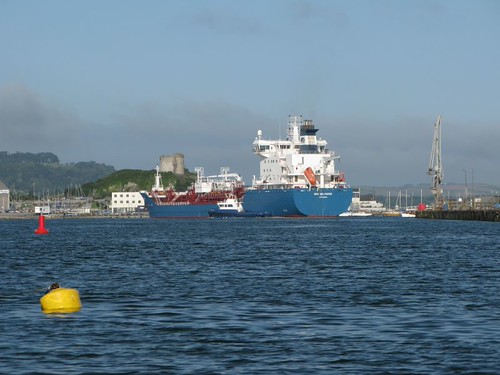
A blast on a ship’s horn and the bow of Bro Deliverer, registered in Goteborg, appeared from behind the sheds – adding a different shade of blue to the scene and totally changing the perspective. A tug and the pilot boat tripped alongside her.

0756

She nosed into the turning area and came around stern first. The tug scurrying around while the pilot boat stood off with an air of dignified watchfulness.

A yacht motored briskly out of the Yacht Haven, promptly eased off and drifted gently, waiting for the ship to slip up river stern first.

0800

A few minutes later, a pleasure boat left its berth on the outside of the Yacht Haven pontoons and hurried around her bow to pick up its first passengers of the day.

Meanwhile, Bro Deliverer came level with the wharves and, with a little help from the tug, eased sideways into her berth. Lines were thrown and she came to a stop, dwarfing the cranes and sheds.

0815

All was over in 20 minutes or so – a well rehearsed routine, neatly accomplished by the ships crew, the crews of the tug and pilot boat as well as the shore crew.

My brother rang at this point to say he was five minutes away. Time to row ashore.

On sailing a Folksong – those lazy jacks again

Saturday morning around 0930, heading towards Mount Batten Pier with a following wind.

All morning, Plymouth Longroom has been delivering a Mariners Notice of an impending powerboat race in Plymouth Sound, warning other boats to stay clear. There are few boats out. I am heading towards Mount Batten pier, preparing to downsails in the spot I usually use when solo so that I can motor back to the mooring.

I start to wonder if today woould be a good day to sail the nautical mile, if not onto the mooring, at least close to it. Could I sail single-handed in restricted waters without making a complete scallops of it?

This is a 25 foot boat with just me on board. There is a wide S bend to negotiate but enough width in a river that takes commercial shipping. The wind is southerly but will differ in the river. It will be heading me as I turn towards the Yacht Haven and it will be gusting in the river. The tide is still be dropping, and is towards the end of its run.  There’s certainly enough wind tot take me over it. Depth may or may not be an issue. The traffic is minimal . . .  And I would like the experience.

There would have been a time when I would have done it without asking the questions. The trouble is, the more I know . . .

So, now, decision taken, I am almost too far to the right of the end of the pier, the foresail is goosewinged and a gybe looks likely before I clear it. But as we get closer, the wind backs slightly, blowing along the pier, and we slip round the end with at least thirty yards to spare.

There are three or four boats emerging from Sutton Harbour and a racing yacht circling as the crew work on the mainsail.There’s is plenty of room for Blue Mistress if we keep to the right of the fairway.

The wind is now blowing downriver, more south easterly, with enough south in it to keep me outside the line of mooring buoys. Round the green fairway buoy, hardening onto the wind towards Victoria Wharves. A large yacht – (white, tall sides) is motoring downstream, passing swiftly astern. A fishing boat, closer to the Plymouth side, looks concerned, slows, turns to head us, (perhaps thinking I may tack early), realises I won’t, then passes well astern.

By now, I am adjacent to the entrance to the Wharves, and the wall is coming up. Still plenty of water below us. A glimpse of a man above, hosing equipment. Foresheet to hand, tiller hard over, Blue Mistress comes about, sails flap, I drop the port foresheet, haul in the starboard one quickly before the wind fills the sail . . . and we are bounding up and across river. I ease the foresheet slightly to give more belly. Hauling the sheet  in  just before the sail fills is very easy but, in my enthusiasm, I tend to flatten the sail.

The wind is coming in gusts now and we dinghy-sail, bringing her head up when the strength of the wind allows and noting the slight variations in direction. It comes across the Yacht Haven straight down this section of the river, and then begins to back a little as it draws across Turnchapel. We’re heading towards the moorings of boats of a similar size to Blue Mistress. There is plenty of depth of water here but I don’t want to get in among the moorings.

A strong gust, we heel, head up, and then go about. This time I am more gentle on the helm, deciding not to push it hard over but to see whether being less forceful will still bring her about but keep momentum up. It seems to work and Blue Mistress moves smoothly onto the next tack. Despite my concerns about the rudder, it does the job.

This is the narrowest section. We are head on to a corner of the river wall. It is approaching swiftly. At low springs, there is a rocky reef exposed off this point so, although there is probably enough water, I give it room, go about and head up towards what the chart designates as a ‘turning area’  for the larger commercial ships. Now Blue Mistress and I have navigated the S-bend in the river and have opened up the stretch towards Oreston and beyond.

In towards the seaward end of the Yacht Haven, and we are headed upstream, slowing as we head into a more sheltered stretch. It seems the tide is running a little stronger here.

When I put my head out of the hatch just after 0600 this morning, ‘Stability’ was docking at Cattedown Wharf. We pass along her starboard side.

I bring Blue Mistress head to wind. . .

and, just as I let go of the main, we get caught by a heavy shower of rain.

Roundly cursing having to stow wet sails, I notice the lazy jacks are still led forward. Not only are the sails wet and slippery, but the mainsail is now in an untidy heap. I have sail ties in my pocket, but, by the time I have gathered it into a fairly neat bundle, tied it, let the foresail drop to the deck, and stowed it (wet) into its bag through the forehatch, the tide has taken us back down the river the whole length of ‘Stability’. Engine on, motor back to where we were and finish cleaning up.

Then back to the mooring to complete the task.

Single-handed, a lot more forethought is needed – forethought comes from experience.

The lazy jacks should have been put back before we rounded Mount Batten Pier. I won’t forget again.

On sailing a Folksong – Lazy Jacks

Lyme Regis to Lands End including the Isles of Scilly
Outlook: Southwesterly 3 or 4 becoming variable 3, then southeasterly 4 or 5 later in west. Smooth or slight. Mainly fair. Moderate or good.

I think I’ve solved my lazy jacks problem.

I was pleased they were already fitted when I bought Blue Mistress.

They do have certain advantages:

  • when lowering the main, the sail folds relatively neatly onto the boom.
  • this is good when single-handed or with inexperienced crew. I can drop the sail without having to grab hold and furl it immediately.
  • also, when slab reefing, the loose sail is contained and need not necessarily be controlled with reef points.

But they have disadvantages too:

  • the primary one being that, with a battened mainsail, the first and often the second batten get caught during hoisting, especially in a hatful of wind. This means lowering the sail slightly to free it and start again. Single-handed this is very frustrating.
  • also, they have to be loosened after the sail is set and the topping lift released to a) allow the leach to take the weight of the sail and b) to release the full belly of the sail.
  • this means leaving the helm, going forward and making adjustments both sides of the mast.
  • and this means that they are loose and untidy during sailing.

To solve the problem, I have previously:

  • juggled with the wind and the heading of the boat, using the auto pilot to keep her head to wind. This gave only limited success. It kept the boat head to wind, but required more speed to do so, which, in turn increased the apparent wind, which, in turn, increased the sail flapping.
  • turned to head into the wind, to combine it with the boat almost stopped. Limited success again, needing a very swift hoist. If this failed, the half raised sail would allow the head to fall off the wind and jam the sail part way up. Back to the engine.
  • shortened the lazy jack lines, which had the effect of bringing the the blocks forward as well as  lowering their position. The idea here was to allow the battens to clear the confines of the lines lower in the hoist. This works better in light winds, but not in heavy ones.

The week before last I struggled for ten minutes or so to get the sail up and finally decided that I would get rid of them altogether if I couldn’t come up with a better solution.

I spent Friday night on the boat again and wanted to rig a stretch of canvas over the boom to make a tent over the companion way. The lazy jacks were in the way, so I loosened them off and led them to the mast, hooking them around their respective cleats before tightening the lines again – instant solution to the tent problem and instant solution to the sail raising problem.

In the clip above you can just make out the port lazy jack lines leading along the bottom of the boom and around the cleat.

On Saturday morning, the mainsail went up in one steady haul, the engine was stopped and we were sailing.

The next decision has to be taken at the end of a day’s sailing as to when to reinstate the lines.

On sailing a Folksong – one nautical mile

I woke on the boat on Saturday morning to a slowly clearing sky and little wind. By the time I had prepared for a morning’s solo sail, the sun was emerging.

The spring tide had been flooding fast when I had my first cup of tea but was now less fierce.

Leaving a fore and aft trot mooring single-handed can be tricky. The tide makes all the difference.

Blue mistress, like all the others on the trot, is moored looking downstream. She has two stern lines – one to each quarter and  two bow lines over the bow roller.

This morning, the incoming tide allowed me loosen the port quarter line and drop the starboard one. This let the stern drift to starboard away from the trot line but still stay attached to the buoy. Lightly lashing the tiller to port caused the bow to want to turn to starboard, away from the forward buoy. Engaging the throttle very lightly to hold her against the tide, I went forward, dropped the bow line to port, releasing the bow to swing slowly (the long keel helps here) out to starboard. I returned aft, dropped the stern line and pushed the throttle gently forward.

~~~

Now that Blue Mistress is more or less as planned (always more to do, of course), I have time to look around and enjoy the surroundings as well as the boat. The early morning was crisp and clear, so, camera in one hand, tiller in the other, I motored down to the Sound enjoying the ride. There was nobody around. I had the water more or less to myself.

What follows is that early morning trip down the Plym – from the mooring to Plymouth Sound, a little over one nautical mile, highlighting some of what I saw:

The entrance to Hooe Lake

Astern, the sky was still heavy with cloud over Oreston and Plymstock.

Cattedown Wharves. The previous evening, I had watched a ship enter Plymouth Sound via the western entrance. She was busy unloading when I returned to the mooring later. She left silently in the night.

The entrance to Plymouth Yacht Haven. Little movement there.

Further downstream, through the moorings, the buildings on Plymouth Hoe were catching the sun.

The Hangars that were a part of RAF Mount Batten and are now boatyards. The Mount Batten Centre is this side of them.

Victoria Wharves.

Queen Anne’s Battery with the Royal Western Yacht Club, the home of OSTAR, on the far right. The National Marine Aquarium is in the centre.

The austere ramparts of the Royal Citadel

The entrance to Sutton Harbour and the Barbican.

Smeaton’s Tower and the Hoe with Tinside Pool beneath and the Royal Plymouth Corinthian Yacht Club on the right

And, round the end of Mount Batten Pier, the Sound itself, with the Royal Navy much in evidence.

A lone fishing boat scuttled past, in a hurry to get to sea, her wake underlining Drake’s Island with the Mount Edgcumbe Estate in the background.

~~~

The mainsail set without the battens snagging the lazy jacks. I’d had a hard time of it the previous afternoon, but there was less wind today. Then the genoa – and we made a starboard tack in under Jennycliff where the wind was stronger as it hugged the short Fort Bovisand to Ramscliff Point stretch of coast

Tacking onto a close reach, it took an hour and a half  to cross the 3 nm of the Sound from Jennycliff to Cawsand –  a patient and gentle 2 knots.

Close to the top of the tide, the Breakwater was washed by the slight swell, the western end bathed in the morning light.

There was even less swell in the Sound and Blue Mistress sailed upright and silent.

In towards Cawsand, the wind increased from around Penlee Point, and we made 4 knots right up to the trees that come down to the water here.

A nod and a wave to a man on his boat anchored close in, and then the second tack of the day to look along the outside of the Breakwater.

But by then the wind was dropping away further and my 1.5 knots (and falling) would not get me back to the mooring in time.

Stowing the genoa, I motored back across the Sound and up the Plym again.

This was not sailing as sport – but sailing as therapy, the cares of the week blown away.

~~~

An hour later and barely three miles away, I was stationary in the car, caught in two impatient lanes of holiday traffic waiting for an accident to be cleared. Hey, ho . . .

On sailing a Folksong – a cautionary tale

We had a great sail – the perfect wind for Blue Mistress, a crew of four, and a sunny day.

Back on the mooring, everything cleared before going ashore . . .”Have you seen this, Bill?”

Ross had noticed the lifted plate – I had missed it. I wasn’t looking. I trusted the fitting. And that could have been a big mistake.

The inevitable questions: Was water getting in? Was the block beneath rotten? The bolts were obviously pulling through, would the forestay pull out of the deck? If so, would the mast go overboard? . . . Or onto the crew in the cockpit?

Yes, well . . . questions like that come up when you are taken by surprise . . . before standing back and sizing up the situation properly.

I had previously thought the forestay to be tight but it carried the hanked-on genoa well. Now I saw it as bar-taut and straining my mast. The mast bend suddenly seemed excessive.

Inspection in the chain-locker showed the forward bolts angled forward.

Removing the bolts released a  roughly-shaped offcut which looked as though it had been found in the boatshed bin . . . “That’ll do, George. It’ll just about fit.”

There would have been less of a problem if it had been cut with a little more care so that there was no overlap of the washers at the edge.

It would have been even better if more time had been spent and it had been carefully shaped and fitted. It’s one of those ‘out of sight, out of mind’ jobs. I have been writing about skilled craftsmanship for years now – I hold up my hands, I thought I had cleared up most of the problems on my own boat.

It wasn’t just the ply, of course, but the over-tight rigging that pushed it over its limit. Problems rarely come singly. They are part of a series – one thing leading to another leading to another leading to disaster.

How much strain is required to achieve this degree of distortion in a piece of marine ply?

In the event, there was no sign of water entering.  Nor was there any sign of rot. And it probably wouldn’t have pulled through. But that’s no consolation.

We have replaced the offcut with a stainless steel plate, cut to size, sandwiching a wooden block, cut to the same size, for compression. (Thanks, Richard).

The rigging has been re-set with less tension on the shrouds and a more gentle mastbend.

Now I’m going through the boat with a fine tooth-comb. Once bitten . . . . .

On Sailing a Folksong – Thank you

There are blogs written by those who are complete experts at designing, building and repairing their own boats with no other help than a forbearing partner and a seemingly infinite amount of time. I am not one of these.

~~~

In 2006, I bought a boat. It was the boat I had wanted for most of my life but never had the opportunity to own before. It took a little time to confirm what was right with it . . . and a little longer to find out all that was wrong with it. Fortunately, what was right outshone what was wrong.

That first season was good fun. We sailed a lot, even making a passage to Fowey and back. Unfortunately, there were some problems and I began to think of ways to fix them – and then ways to improve her, and so my ambition grew – (”What is possible? We are not trying to restore a classic boat to its original state. It’s not a wooden boat. Let’s see what modern materials can achieve”).  One thing was for sure: whatever I wanted done on the boat would be way beyond my then knowledge and still current skills. So I began to look for someone to help me.

Specifically, I wanted someone who would listen to what I wanted to do . . . and would recognise when I was being unrealistic and say so – and be prepared to come up with an alternative. Over the years, I have learnt how independent boat owners are . . .  and how proud of their boats, sometimes excessively so. It takes a diplomat to handle them.

During that summer, following an unfortunate incident with a crossed battery cable, we were in Plymouth Yacht Haven sorting it out. While trying to hide my embarrassment at the earlier mistake, I was explaining to Pete from Marine Systems what I wanted to do with Blue Mistress. He said, pointing to the Hangar across from the marina, ‘why don’t you try DickyB over there’.

A while later, Richard Banks sat in the cabin and looked around while I told him what I was wanting to do and how far back we would have to go before we could move forward – and there was no way of my affording the work in one leap.

I liked him immediately. He caught on to what I was saying, cut through the c**p and we began to work out what might be needed to start the project off. (Yes, I know I was a potential client so you would expect him to be enthusiastic, but there are ways and ways of handling clients – I liked his style).

And so the relationship with Dicky B Marine began. There have been three periods in the Hangar at Mount Batten. Each time, Blue Mistress has been returned to the water greatly improved. On the last occasion, she was a new boat.

~~~

Throughout, Richard has been excellent. I often arrived unannounced and, despite other work  on other boats, been enthusiastically shown what had been done and what was proposed. If I was in the way,  he and everyone else had the courtesy to keep it till I left! I took pictures of everything. I have sent strings of emails and attachments with ideas and changes. Believe me, it’s not the boat, it’s the owner!

It’s a team, of course. In this, our last session, Robin Leach’s skilled carpentry and work below decks have been especially appreciated – I haven’t forgotten the twenty locker lids laid out to paint.

He also made the smart  new tiller, one that no longer catches the lazarette locker lids.

At the same time, the stainless steel fittings were made in their workshop by Dave Willey. Andy Wilson worked on her too. That was another reason for choosing this firm. They have several strings to their bow.

And there was Pete Brian of Marine Systems – he of the original referral, who did the electrical work, Neil Gledhill of Hemisphere Rigging Services and the haulout crew of Plymouth Yacht Haven.

In a little under three years, we have gone from this:

2007

to this:

2009

From this:

2006

to this:

2009

From this:

Torpoint 2006

to this:

Oreston 2009

The Folksong hull was originally built for the DIY market. Blue Mistress was launched in 1988. She has changed owners two or three times since. Each one had their own ideas. Everyone brings their own personality to a boat. I don’t suppose any two people would agree on what the “correct” solution should be.

Well, this owner is older with a demanding day job, and with not so many tides ahead of him. He has enjoyed sharing the boat with the  surprisingly large number of people who have worked on her. (In a recession that can’t be a bad thing).

And he’s not finished yet. Over the next few years her intends to enjoy Blue Mistress, work on her and sail her as much as possible.

Thanks, Guys.

On Sailing a Folksong – back to the beginning

“Experience is not what happens to you, it’s what you do with what happens to you” – Aldous Huxley.

~~~

Well. it’s happened, as it was bound to. Having spent the past three years focusing on doing Blue Mistress up, all the feelings about it have changed. It’s as though, having reached the top of the junior school, we are now moving on to bottom of the senior school – from the top of one learning curve to the bottom of the next.

I “celebrated” this by arriving back at the mooring on Friday to find the engine and the inside of the engine housing covered in oil. More on that later.

~~~

Is the boat finished? No, but we have reached a level where I can enjoy doing all those small jobs that I haven’t been able to do up to now. It’s no longer a ‘this-is-what-it”ll-be-like-one-day’ dream. I am no longer letting jobs ride “because I will sort that out later when such-and-such has been done”.

Looking back over the past three years, there are, broadly speaking, four areas of owning a boat that I have been learning about. Although the headings were originally applied in a different context, they can be loosely described as:  health, comfort, function and appearance.

Health: The fundamental integrity of the hull and rigging. We had some major leaks to fix in the deck. But none in the hull itself. The rudder caused concern. Some of the rigging needed updating. The sails were ok. And, up to last Friday, the engine had given no trouble.

Comfort: Safety: I have gathered together the basic safety features (including learning how to stay on board). There are one or two extras still to go – that’ll be more money out. We can find out where we are –  there are no less than three different gps systems available – and now a chart table to lay out a chart on. The head is satisfactory. The galley works nicely too – we can boil a kettle quickly, cook up some soup or anything else should we feel inclined. Stowage has improved.

Function: This is where we go back to being bottom of the school. Experience up to now has been one of getting to know a boat as she was updated. What seemed like big adventures last year and the year before, seem like small ones now. Certainly the investment of time, energy and money require more use of Blue Mistress and I hope for plenty of sailing this year and next.

Appearance: Get form and function together and any boat is almost bound to look good – well, almost. I thought the appearance was good to start with, but it has got better as different problems and improvements have been tackled.

~~~

And the engine?

On Saturday, in light winds, we had a gentle sail to a couple of miles off the Mewstone. In the early afternoon, we watched Rame Head, then Cawsand, then the Breakwater disappear as a line of fog/low cloud drifted along the coast. We decided enough was enough and motored back to the mooring.

I asked Pete to close the seacock for the seawater coolant. He said he got oil on his hand doing it. I said that was not possible. We opened the lid of the engine housing . . .

We looked at it, and we looked at each other. We both knew we had no idea what had happened or how bad it might be.  We decided the engine was still too hot to work on. Silently, we closed the lid, rowed ashore and drove home.

Yesterday, I spent several hours upside down with my head in the bilge. The cause should have been immediately obvious, but it took me a while to find it because I wasn’t expecting it. Embarrassingly, it turned out to be a schoolboy error on my part. In my hurry to check the oil, I thought I had replaced the dip-stick correctly – but hadn’t. In my defence, the dip-stick is fairly long, the hole is flush with the casing and invisible from the front of the engine. It’s easily missed and the stick slides tightly alongside the engine casing – but that’s no excuse . . .

And now we have learnt a thing or two:

Do you know where oil goes if you leave the dip-stick out? . . . everywhere!

It completely coats the inside of your new engine housing (and I mean completely). It completely covers the engine (and I mean completely) – all those little screws and bolts and inaccessible corners where dirt builds up, between all those cables that have been cable-tied together, behind the engine where you have to do impossible contortions to reach  – and, of course, into the bilge.

I now know the outside of the engine intimately. I know how good the heavy duty oil remover is. I also know that, if you lay an oil-soak mat in the bilge, and settle back for lunch, by the time you have finished it will, remarkably, have soaked up most of the oil. I also found a short stainless steel strop that went missing during our first major refit two years ago. The bilge is the cleanest it has been for some years.

Luckily, not all the oil came out  – what was left came just above the minimum mark, and the engine (a Yanmar 1GM10) still runs remarkably smoothly.

Just as, when driving, I am constantly checking my rear view mirror because, thirty years ago, someone ran into the back of my car, I will never rush to check the oil again. I shall replace this particular dip-stick very, very carefully.

That’s experience.