On sailing a Folksong – update

“Looks like a new boat” said the man in the marina who kindly walked me out of the berth.

Indeed, she does. Blue Mistress has finally become the boat I thought I glimpsed the first time I saw her four years ago almost to the day. Ever since that moment, I have been working towards this.

What she has become has more to do with ownership than anything specific. Instead of coping with someone else’s ideas, (however good they may have been), it comes down to owning a boat where all the positives and all the negatives are now the product of my own collaborations and my own final decisions. I guess everyone who sails a boat for any length of time will know what I mean.

For example, it could be because I am sitting at my new chart table, notebook open, pencil at the ready, able to make notes whenever I choose.

It could equally be because the galley has been cleaned up and I’ve bought a smaller kettle which comes to the boil more quickly.

Or that the loo facilities have been thought through properly and, suitably primed, are now satisfactory.

Or the new feel of spaciousness thanks to Robin Leach’s excellent finish to the repainting and retrimming.
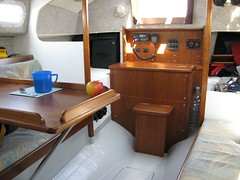
Perhaps it’s because I have rethought the locker stowage so that more gear is to hand – gear that, in the past, had been ‘put away’ to be sorted out later.

It could be that, sitting here, with this excellent cup of tea, listening to Handel on the radio and watching people enjoy their Sunday on the water, I am mesmerised by the reflection of the sunlight on the water. In a boat with low freeboard you feel closer to the water- if you write about the sea, you are writing closer to the source!

It could also be that the rudder and tiller that have been bothering me for so long have been dealt with for the time being and I have the enjoyable prospect of sea trials ahead.

It’s all these things, of course, but, above all, it is the knowledge that every time I come aboard I won’t be looking around seeing all these jobs to do – jobs that in no way did I have the skills to complete to this standard. This bulk of unfinished business was getting in the way.

At my age, I have, in Jon Wainwright’s words, “only so many tides” to catch.

Blue Mistress now fits – and I feel freer to catch those tides.

~~~

This was my first post written on the boat – albeit with notebook and pencil to be copied later. I hadn’t realised how deep my ambition has been to do this comfortably.

No, I didn’t buy the boat to have a table to write at. I bought the boat to be able to sail. Writing about it has come out of owning it and given me the chance to find ways forward.

I shall continue to post. I wonder if my emphasis will change.

Stick at it, Bill

My namesake in his blog Knockabout Sloops says

“One of the things that I have noticed about in writing, and ranting, about my sailing ideals is how pointless it all seems. I seem to be championing an ideal of engineless sailing and beauty that is long gone. Buried in a sea of plastic, diesel and electronics. What I know is that the effort on my part takes time and energy and is seldom well received. So I have decided to stop ranting on Knockabout Sloops.”

I hope he doesn’t stop championing the ideal of engineless sailing and beauty. If he feels he is not well received then so be it – that goes with the territory.

For myself, I read his blog with envy and admiration. The boats he shows us are indeed beautiful. If he, in his conviction, doesn’t present them, who will?

However much I would like to, I could never live up to his ideal. For many reasons, I chose another way. There are plastic and diesel and electronics in my boat. And there is also the beauty that I appreciate. It comes in those moments when I am not using the diesel, or the electronics – the plastic just happens to be the form I choose to cross the water in.

For me, the real beauty is not the shape of the boat or the material it’s made of,  but the motion through the water under sail. And some shapes and some materials do it better than others – form and function matter.

In trying to accommodate the common denominators of comfort, convenience and profitable production lines, the majority has chosen a different path. Maybe they will come back in time – probably not. But that’s no reason to stop championing an ideal.

There are thousands of miles between us, Bill, but we share the same water.

And there are more ways than one to get your message across.  Stick at it.

On sailing a Folksong – update

Blue Mistress has twenty lockers with removable lids, twelve of them in the bunks. Laid out across a worktop and painted white, the lids looked surreal – bright islands in a dark sea.

There is a new folding lid across the stove as well as one above the portable loo. (Before, both these lids were a little tight to remove. There was a trick to it –  meaning that I could manage them fine because I knew how to do it, but the occasional crew didn’t. Therefore, they found the loo difficult to use . . . and said so.)

The varnished trim around the bunks has been matched along both sides, but is yet to be fitted.

The chart table has been revamped.  The old one was slightly too big to keep shipped all the time, although it was a very good dining table. Unfortunately, it also had a split in it. So it has been shortened, reworked with fiddles and, although still removable, will be fitted securely across-ships.

There is a concern that giving. the main cabin an eggshell white finish makes it look clinical. Well, not with all the gear I put in it it won’t! At the moment it looks stark but the cushions and trim will soften it. It’s a boat with a parlour in it, not a parlour with a boat around it.

But it is a boat of just under 26 foot with less than five foot headroom in the main cabin. We are not talking ‘large yacht’ we are talking ‘making a small space as comfortable as possible in circumstances that can be quite uncomfortable’.

Therefore, the art of stowage is magnified here. I have only a hazy idea how the long distance voyagers manage their stowage in boats of this size. A lot of gear must be piled on spare bunks, every nook and cranny filled. Single-handed, it must be tight; two of you must be very tight.

Stowage is not a static art – hiding things away in the bowels of the boat. It’s a dynamic art. Everything has to be accessible, able to be reached when needed and moved to wherever it’s used – sometimes in a hurry.  It’s about lockers that open easily (but not too easily in a sea). It’s about knowing where everything is, and having an instinctive ability to move around the boat to reach it.

It’s about establishing regular habits to be able to give measured responses to irregular events.

It’s about seamanship – handling yourself, handling the boat, handling the gear.

~~~

This week, I have noticed a sea-change in my thinking.

For the past four years, I have been concerned about the fabric of the boat – “should we do this or that, change this or that, keep this or that the same, or what?”  Each year, I have concentrated on one part of it. Each year I have taken countless images and studied them for this or that reason. I have sometimes followed outside advice, and sometimes followed my own intuition  and, with the help of Richard Banks at DickyB Marine, we have progressed.

There’s plenty still to do – it’s a boat, there’s always plenty to do . . . and even more to learn.

But the major work is over. From now on, “it is what it is – get on with it”.

I am looking to get Blue Mistress  back in the water and go sailing.

On sailing a Folksong – update

The removal of old trim, the rounding off of wooden edges and a first coat of white paint has transformed Blue Mistress’ main cabin.

So much so that she has become a different boat.

Up to now, I have gone along with the cosily unfinished state below decks. It was always going to need more work but, on the whole it was ok.

Now the work is being done, which means decisions have had to be made.

The first was whether or not to fit a proper sea toilet (Jabasco compact) instead of the portable loo which was boxed-in midships in the entrance to the fore cabin. The traditional bucket would have suited the skipper but he had to fall in with the expectations of those guests who prefer a more conventional approach. It did occur to him that one way of weeding out prospective crew would be to note their response to “By the way, you’ll have to use the bucket . . .” followed by a long pause. On the other hand, he remembered that he rather liked some of those who might turn their noses up at it so the least he could do would be to see whether something more formal was possible.

As there is little head room immediately forward of the bulkhead, the only feasible plan would be to shorten the port-hand bunk – (in effect, remove it), and install the device at the forward end, immediately this side of the bulkhead. He designed a box to contain it which would have a double hinged lid level with the shelf behind. This would be useful as a worktop – (and somewhere to put down a mug of coffee). Painted white with the rest of the cabin, it would only be slightly intrusive – even if we had lost the widest and most comfortable bunk.

At the same time, there is no chart table. The “thunderbox” lid could be used as one but would require the occasional removal of everything on it, whereas if we used the middle part of the bunk space for a regular chart table with chart storage and lockers beneath –  keeping it level with the aforesaid worktop and varnishing it as contrast, then we would add considerably to the facilities aboard.

By leaving space at the aft end for one person to sit facing across the cabin while being able to twist round to use the table –  (there would need to be some space beneath this end of the table to accommodate knees), it would still be possible to enjoy a convivial evening. The design also intended there to be a pull-out table for those sitting on the starboard bunk.

Moving the heads would have opened up the entrance to the fore cabin which had been tricky to enter because of the way the portaloo was boxed in and the lack of headroom just inside the forecabin.

But we’re not doing any of that.

Why? Cost mostly – and time. In doing the planning, I discovered where the limit lay. (This was before the economic crisis had taken hold. I’m even more sure now.)

What we are doing is less complex, and, by the look of the work completed so far, the result will be better for it.

More on this in a later post.

Book sailing – “Only So Many Tides”

I have been reading and enjoying Jon Wainwright’s book. He spent nearly four decades sailing a traditional wooden boat – locally referred to as a nobby (although he wasn’t totally convinced) from the north west, which he brought through the canals across England to the east coast and down to Felixstowe and the south east.

Aged forty he found himself getting excessively tired and discovered he had a heart condition. This had the prospect of slowing him up considerably. Nevertheless he kept sailing – both cruising and racing with the Old Gaffers.

A particular passage resonated:

“Obviously, time was not on my side, and it made me realise that there were only so many tides that Deva and I were going to catch. That is the problem of having a real concept of mortality. I see so many people who embark bravely on big rebuilds of smacks and other larger vessels, reckoning to take five years and often taking ten or more. I could not conceive of that possibility. Even if I survived the effort of rebuilding a boat, how fit would I be to sail for much longer afterwards? Some of the rebuilders who are fit when they start probably are not so when they finish; the broker’s advertisements feature vessels from such situations. But they do not see it in that way. They laugh about being knocked down by a bus, but do not believe it will happen to them.

So my situation meant that work on Deva is not a cabinet-maker’s standard. It is fit for purpose, not built for posterity. The decks are painted, not laid teak. Some jobs are neglected . . .”

I know how he felt.

Time and tide . . .

On sailing a Folksong – March refit

When you buy a boat (or a house), you see it as you want it to be  rather than as it is.

It is rare that it is complete at the point of sale – you set out to put a bit (or a lot) of yourself into it.

So it was with Blue Mistress.

This is the third stage of the work that I thought we would need to do when I first saw her in 2006.

I’m not such a visionary that I could have said then ‘right, we’re going to do this in three stages’, but I could see where we would need to go and, now that I’ve learnt a few ropes, this is how it has worked out.

Broadly speaking, in stage one, we worked on the deck – reseating fittings, sorting out leaks, recoating it in to a finish that is hard and durable.

Stage two, involved a new engine housing, installing  a new fuel tank and moving the batteries to a locker of their own, as well as upgrading the electrics and installing a new VHF/DSC unit.

Now, in stage three, the top sides are getting repainted (five layers of epoxy primer so far),and the rudder rehung, to include a new upper pintle.

Down below, the main cabin is being upgraded, detail seen to, edges rounded off, surfaces smoothed and repainted, a couple of locker lids reworked  and so on.

So is this a totally rebuilt boat? No, all good boats have a character that can be encouraged and brought out.

A little bit here a little bit there transforms them. In keeping them up to scratch, they gain a new lease of life.

On sailing a Folksong – for fellow Folksong owners

Blue Mistress was lifted out of the water last Wednesday. While waiting for the lift, she was stripped of everything aboard (except for the cqr and anchor rode).

The boom was also unshipped.

Although that was not the  intention, it meant I got a picture of her motoring light.

So, we’ve got the much-talked-about ‘heavy’ rudder, two large riggers, and a Yanmar engine placed fairly far towards the stern – (the front of it stretches approximately 6 inches into the main cabin).

In the event, she is only slightly down at the stern. Normally, there is heavy gear (inc. spare water containers) in the fore cabin lockers to counteract this.

They removed the mast and rigging – the boom and spinnaker pole are lashed on deck.

The deck has grown green patches over the past few months thanks to the weather. The lines of the halyards over the cabin top are clearly visible. I will remember to clean here more often.

The bottom was fairly clean. Weed is on the anode, propeller (not enough use his winter), and the edges of the keel and rudder.

The Raymarine log has not been working this winter. There was a small colony of barnacles around the ‘propeller’ housing in the bow which was stopping it turning.

The strop is only just on the keel, showing how difficult it is to judge the rake of the stern from above.

A last look at the cheeks on the rudder and the hull shape from the stern.

There is more growth on the starboard waterline. Moored fore and aft, this is the part of the hull that faces away from the sun for most of the time. Earlier in the year, I spent some time in the water trying to clean this off – with little success.