I haven’t forgotten this series
(Click image to enlarge)


I haven’t forgotten this series
(Click image to enlarge)
It has been well over a year since I last posted here. There are reasons for this and I will talk about them in time.
But now that I am ready to start again, I find that the title ‘bill’s boatblog’ does not adequately cover what I want to say. I want to reflect wider horizons. However, I don’t want to start a new blog – life’s too short. Hence the new title.
I have changed the font but kept the general layout – there is a lot of historical material that I have posted over the past six or seven years that I would like to keep and one or two readers may find the book references useful.
WordPress has developed into a much more sophisticated software package since my first timid attempts at posting. This is a good thing – we all like to move forward. My first thoughts were that more sophistication means more complication – the process taking over the content. In fact, the changes have made it easier to post on this site. I look forward to more posts.
~~~
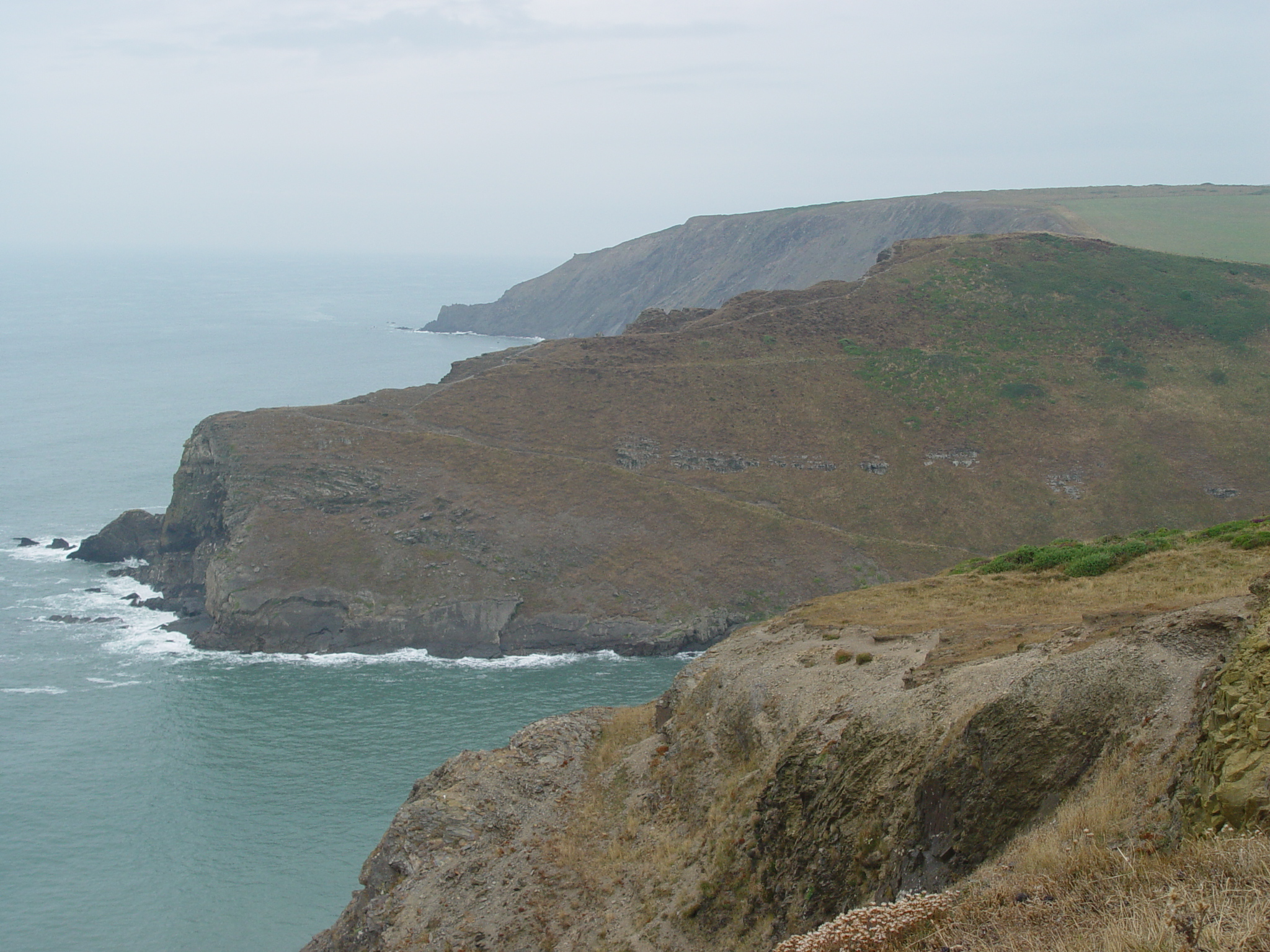
I have chosen Steeple Point – a place I have mentioned often. It plays an important part in my story and now that I am moving on from my day job, I want to have a physical base with a long personal connection from which to develop the blog. I could have used a street we have lived in – Belle Vue or Cavendish Road or South Pallant or Martins Lane or Clonbern Road or Nayland Rd South or Stockbridge Gardens or Paradise Road or others. Yes, there are more but none have the nautical connection I am looking for. Steeple Point stretches into the sea. I knew this place before I was old enough to know I knew it.
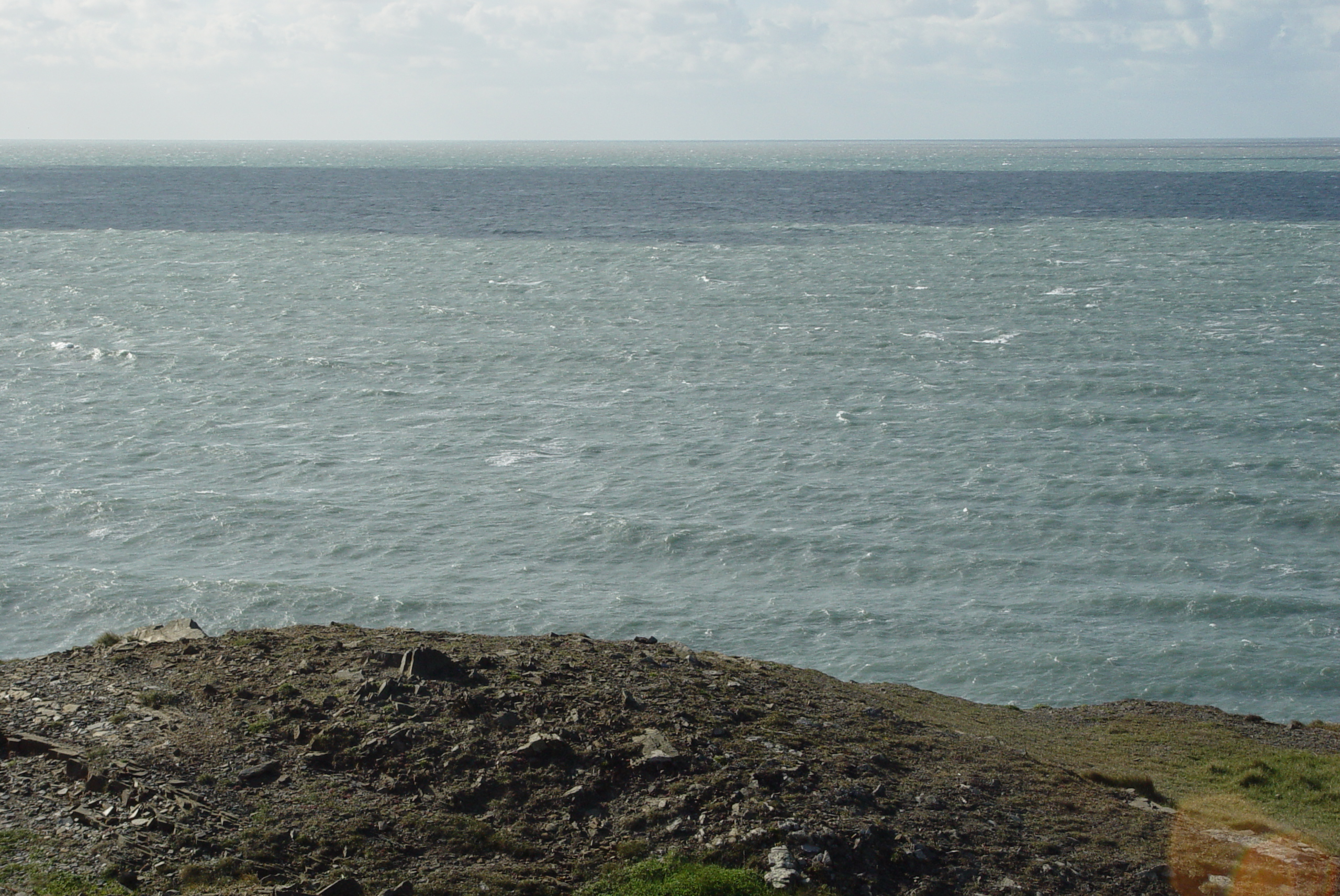
And there’s more. If the Earth were flat and your eye a perfect instrument, you could stand on Steeple Point, look due west, and see, first of all, very slightly to the north, Cape Clear Island and Fastnet Rock and then, on the southern tip of Ireland, Mizen Head , followed by no land at all until Quirpon Island with L’Anse aux Meadows beyond on the very northern tip of Newfoundland some 1,900 nautical miles away. All between is sea and ocean, wide horizons swept by wind and weather,
~~~
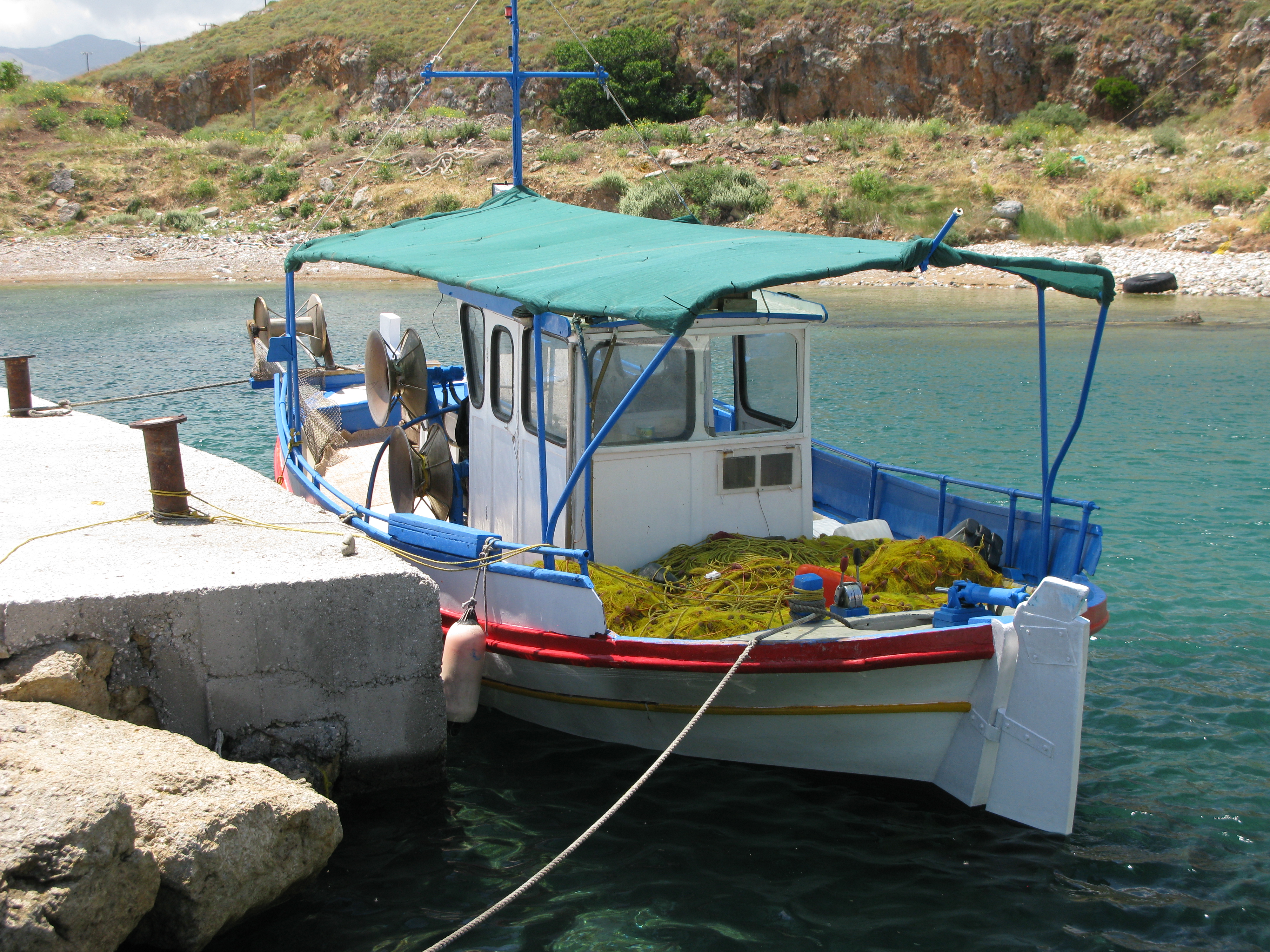
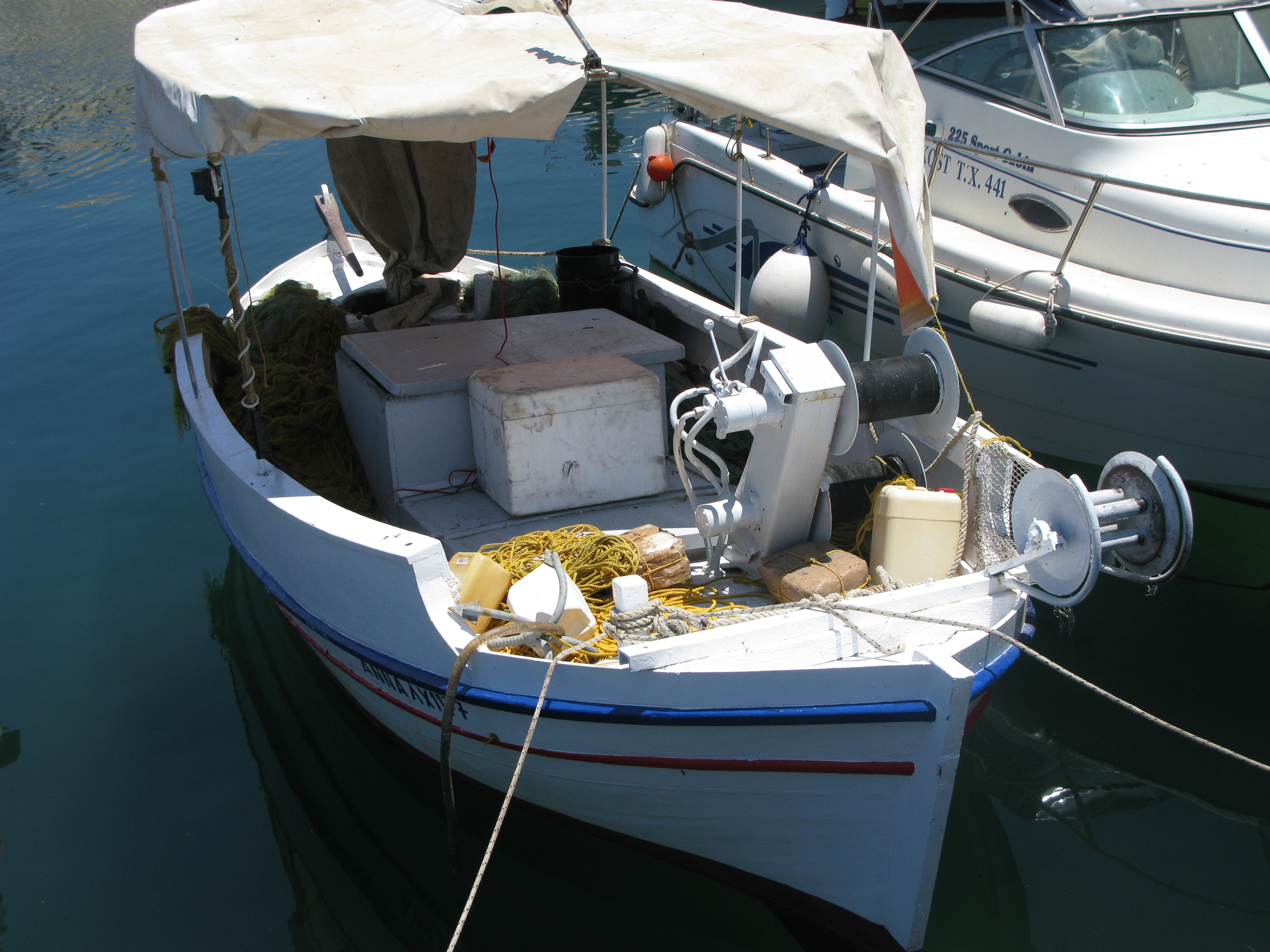
I will still talk about the boat, and I still have an eye for Greek fishing boats particularly those in Crete. They will feature, as will the past, especially the trading ketches of North Cornwall and the Bristol Channel. But there will also be occasional notes about what is going on around me as a I age in an increasingly complex world. Like it or not, all our horizons are changing. We need to recognise those changes.
Bude, Sunday, cloudy skies, low tide
Beginning of the season, the RNLI out in force
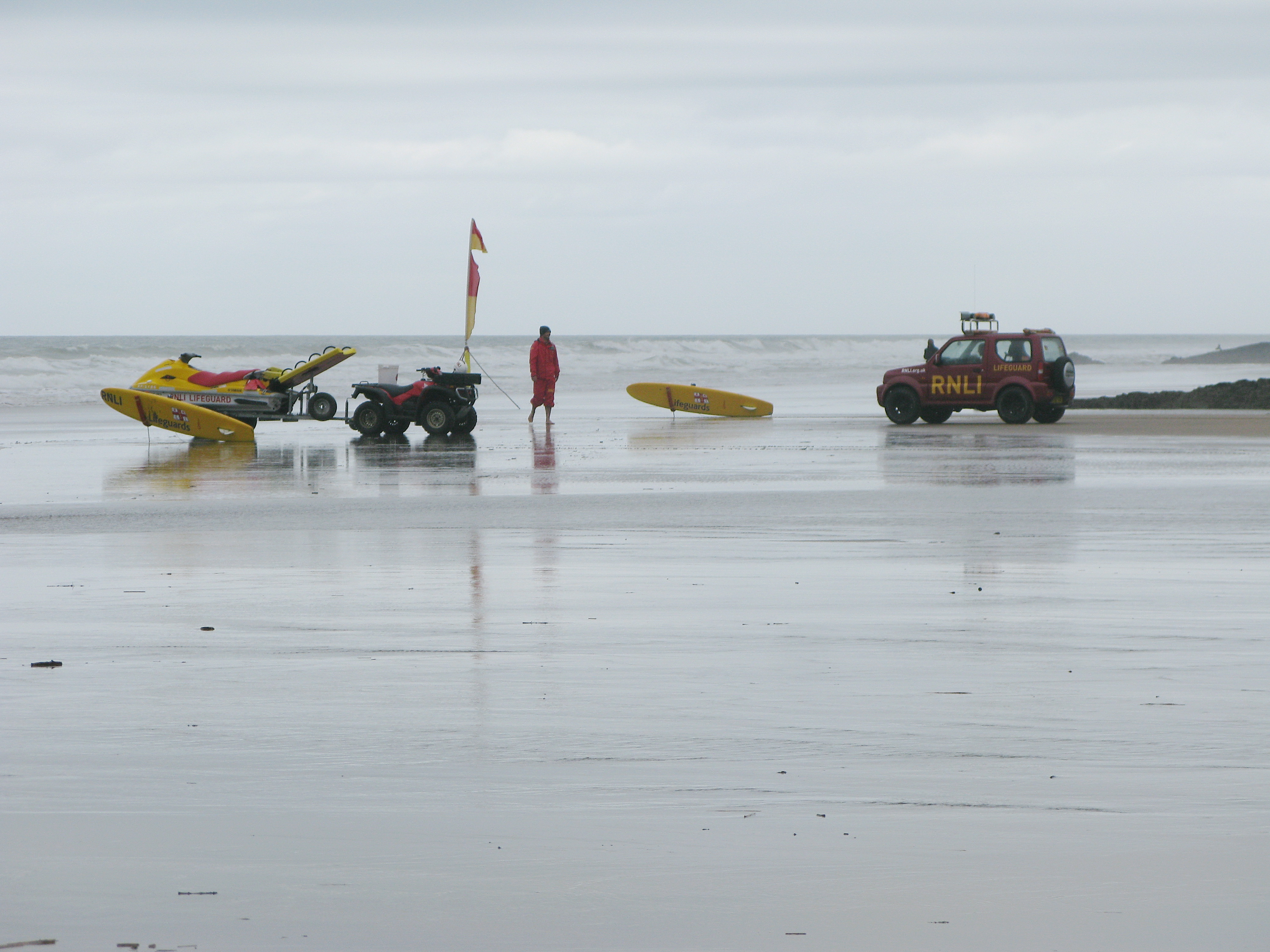
The beach crew were checking their gear

The lifeboat crew were about to launch on exercise.

Elsewhere, the surf school was in full swing.
~~~
I had just been to my favourite bookshop, Books by the Sea, which was fatal. I was walking across a beach carrying two books having narrowly avoided buying a third.
The first was a good copy of Eric Hiscock’s Voyaging Under Sail, a 1977 edition of a book originally published in 1959. It is a companion to Cruising Under Sail which I bought many years ago.
Eye-brows are usually raised when I return home with more ‘boat books’. The question has even been asked, “Why buy books when you can get most of the information for free in easily digested packages via Google?” Well, maybe you can, but you don’t get the author.
Even if the technology is outdated,( and it certainly is in the chapters on electrics and photography), Eric and Susan Hiscock’s books reflect their day-to-day learning from their own experience and their continual application of other ideas that they have picked up in their travels. The knowledge, skills and attitudes reflected here are hard won,
Put glibly, their’s is on-the-job learning. Those of us who spend a lot of time book learning a) should get out more, and b), as importantly, should very carefully pick the authors we learn from. With that in mind, the Hiscock’s books should be compulsory reading for anyone who wishes to put their nose beyond the breakwater.
~~~
I was dubious about the second book, then bought it anyway – The Design of Sailing Yachts, by Pierre Gutelle.
This is technical stuff. “The author first considers the air, wind, water and wave and then goes on to the theory of aero- abnd hydro-dynamics and such topics as friction, form-drag, cavitation and viscosity. There follow chapters on the equilibrium of both transverse and longitudinal stability of sailing yachts . . .”
It is full of diagrams, graphs and formulae, a combination that I would normally run a mile to avoid. However, I made myself comfortable in my mother-in-law’s front room, ignored the football on the television and had a go. A while later, I realised I was absorbed. This was physics at a much higher level than I normally tackle, put in a way that I can understand. Extraordinary!
Sailing Blue Mistress has taken on a new dimension.
Sunday: the sun shining, the air warm, just a little wind. A day for airing the boat, clearing out and re-stowing the fore-cabin. I added eye-bolts for extra anchorage. The oars are strapped off the cabin sole; the bin for the anchor rode will now stay put.
The engine turned over and started after a shaky few minutes. Actually, it didn’t start first time. I left it. When I tried again, it started – (why not the first time?). It needed a run and I wanted an excuse to motor down river to the Sound.
There was hardly a boat to be seen – a classic yacht in the distance, too far away to photograph.
Plymouth was looking . . . well, iconic.
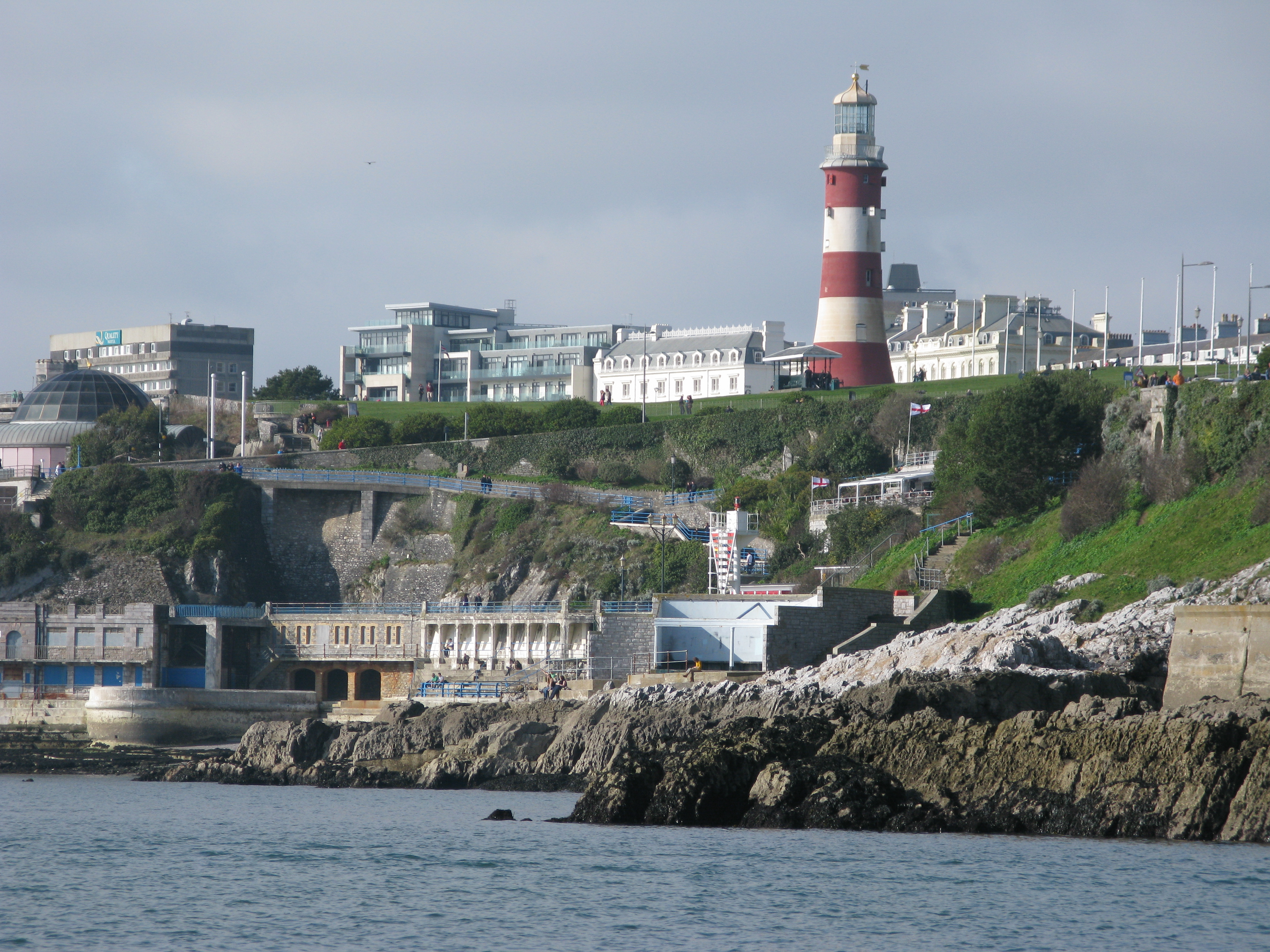

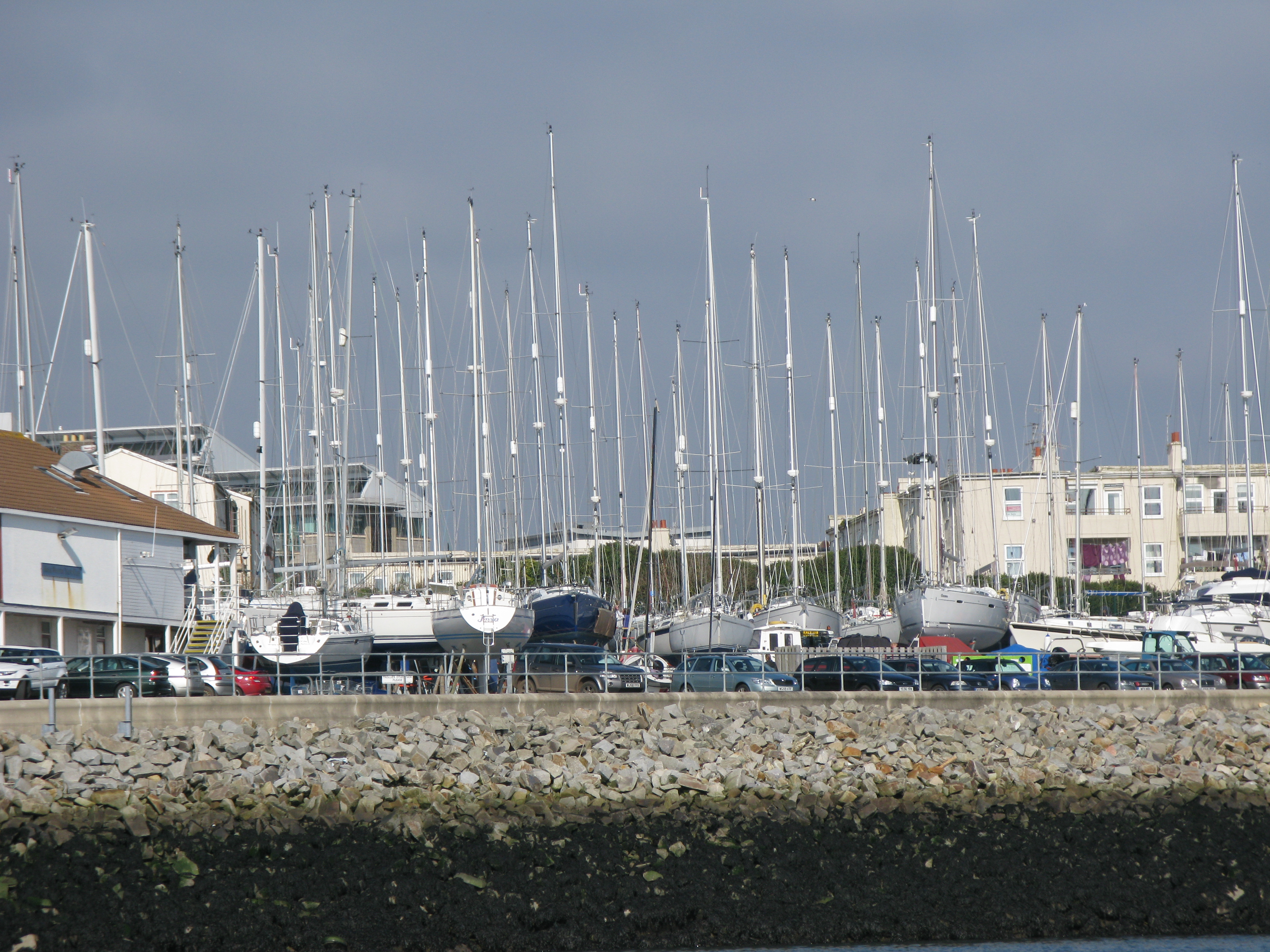
The yachts were stacked away.

The identically liveried Bro Gemini and Luhnau – the one empty, the other loaded, lay quietly against the wharf.


Not a lot happening – but great to be alive and on the water.
Saturday Feb 04, 2012 UT/GMT
▲ 02:40 4.6m
▼ 08:50 2.3m
▲ 15:20 4.6m
▼ 21:20 2.1m
0600 UTC Sat 04 Feb – 0600 UTC Sun 05 Feb
Wind Variable, becoming south or southwest, 3 or 4, increasing 5 to 7, veering north later.
Sea state Moderate or rough, but slight for a time in east.
Weather Rain and drizzle for a time.
Visibility Moderate or good, becoming poor for a time.
~~~
On the road to Plymouth, a large neon sign “Heavy Weather Warning. Drive Carefully.”
OK, drive carefully – but ‘Heavy Weather Warning’? Not really. It was going to snow overnight in the east of the UK, but not here.
If we overstate every inkling of every risk, who will ever pay attention to the warning? And if we do pay attention every time to every organisation – organisations whose very existence require that they constantly warn us how much danger we are in, aren’t on a fast track to mediocrity?
~~~
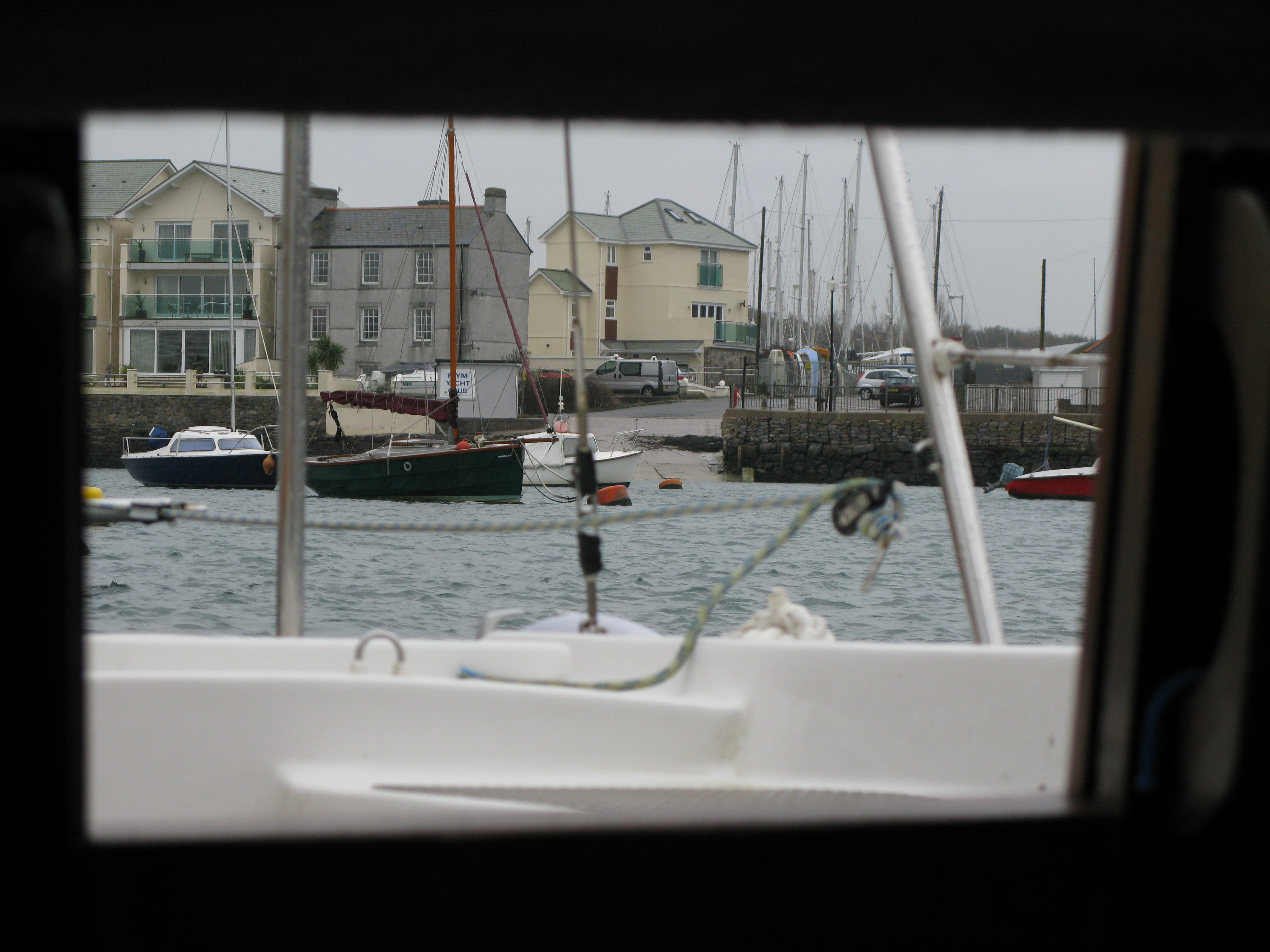
The rain started as I climbed aboard. It set in for the rest of the morning – light rain.
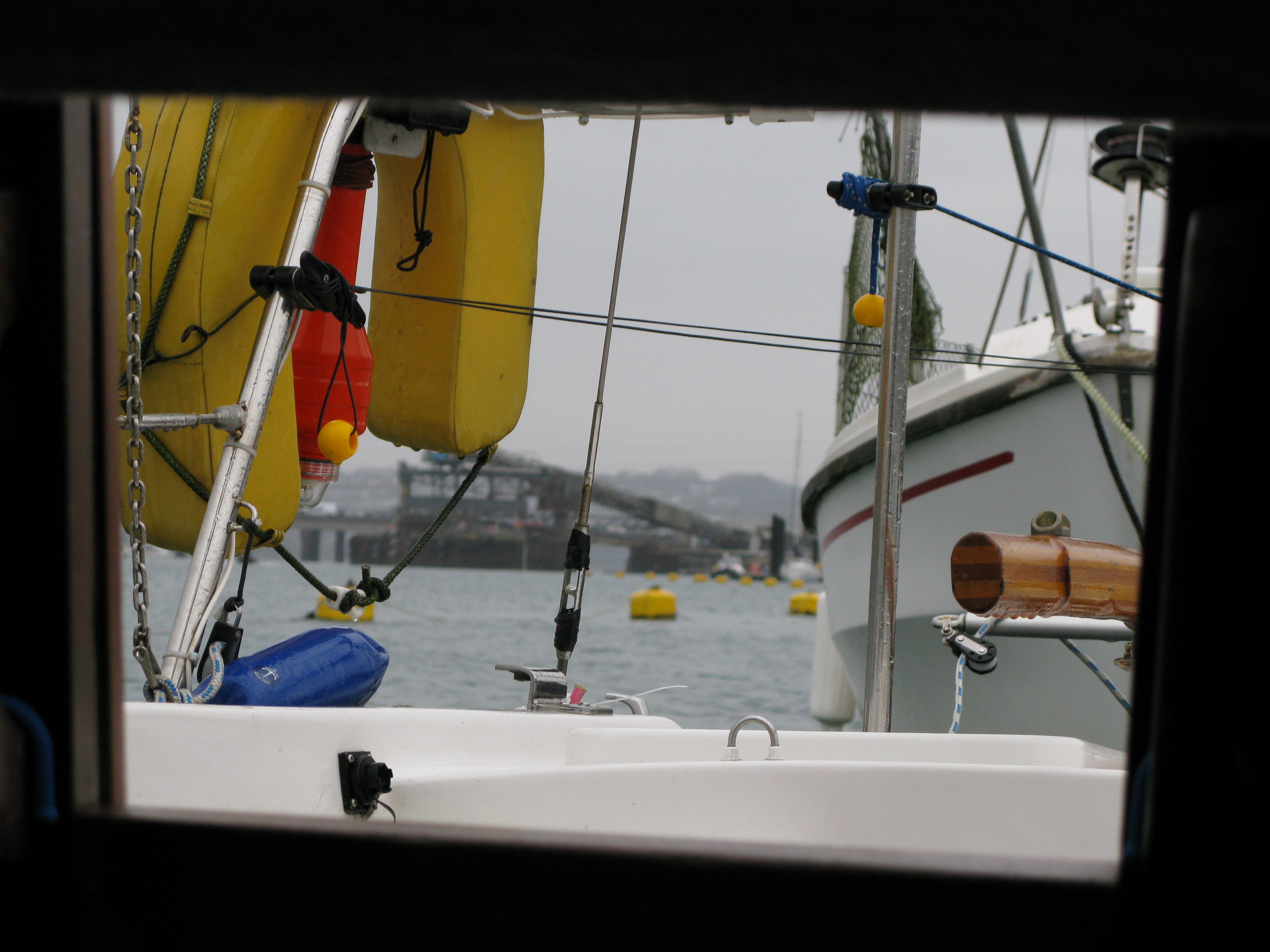
A morning of short jobs.
Both batteries were well down but the engine started first time – not always the case. I refilled the greaser for the stern gland. Grease travels!
The pair of oars I bought aboard needed stowage space. I am looking for a sweep for sculling but these are definitely too short for that.
Also, the chain locker is too small. Feeding the rode back down the narrow hawspipe, I find the chain blocking the pipe and I am left with a length on deck. (Too much chain? Not enough locker). I have to go below and clear it. That works in a flat calm but it’s no fun having chain flaying around the deck in a sea while I struggle below. It also takes time to re-stow the anchor and rode; plus I want to keep the anchor off the deck. So I am trying out plastic bins of varying sizes (including a flexible laundry basket). We’ll see what works best.
I fixed two brass hooks. Everything gets stowed away at sea, but at anchor you need somewhere to hang things.
And then there was time to write.
~~~
A quiet morning – or so I thought . . .


. . . then 60 plus rowers appeared from nowhere.
No wind yesterday but a fine day to run the engine.
I removed the sail cover and attached the halyard but left the lazy jacks in place as I didn’t expect to set the sail. As the Sound opened up it, it was almost empty – two vessels in sight, one trying to set a sail. A little later he had given up.

It was also a perfect day to anchor and run out the rode. I dropped anchor around 1300 close to Jennycliff near the Withyhedge beacon.

Then time for lunch, and, as I had bought the dinghy with me, time for some photography.

There were three naval vessels at anchor. The village of Cawsand can be seen in the sunshine on the far side of Plymouth Sound – (just aft of the pulpit).
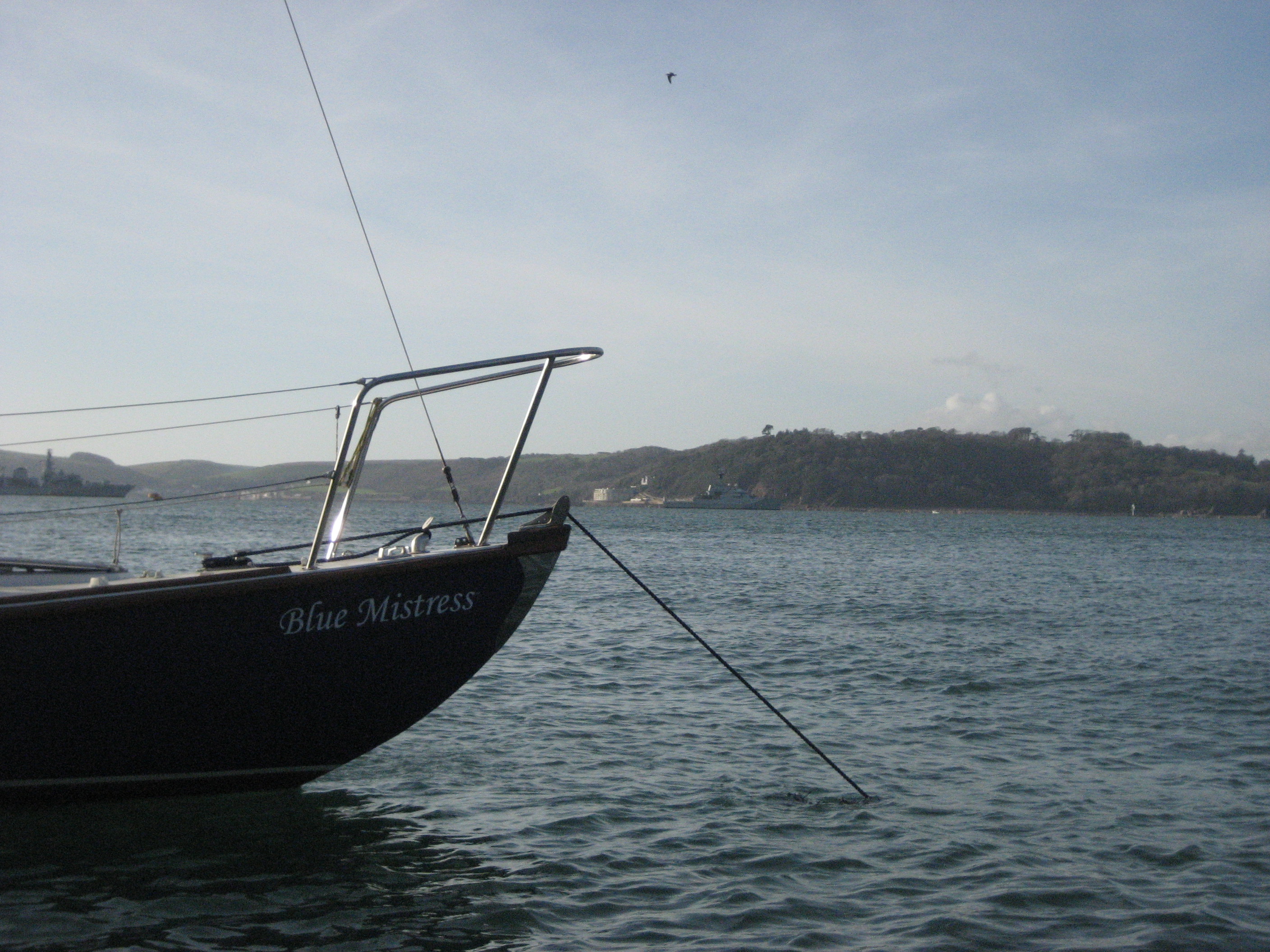
All the metal work makes Blue Mistress look positively industrial. The depth is 7.7 metres – it had dropped from 8.4 metres in the 3/4 hour I had been at anchor.
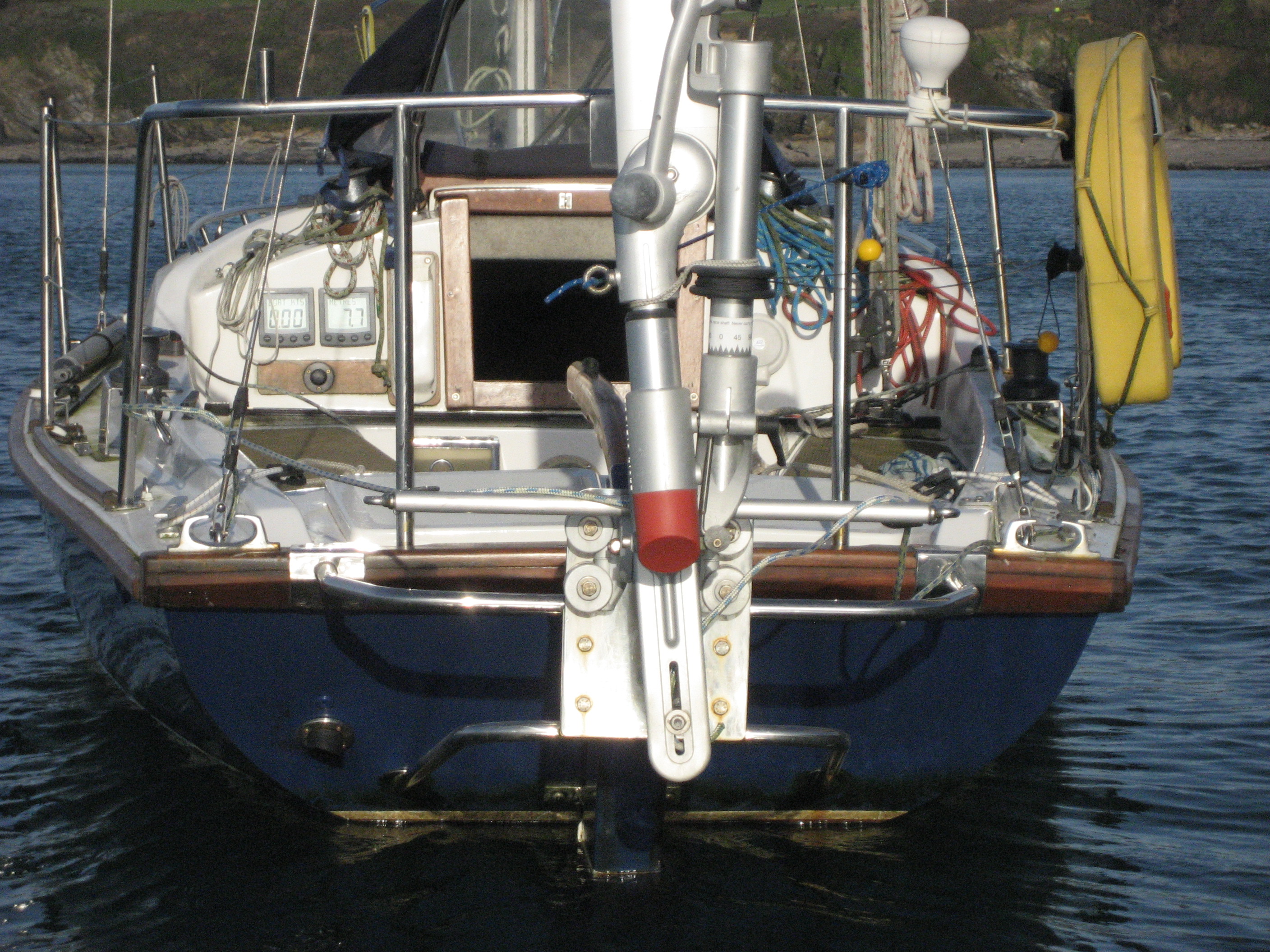
The washed-out colours of January.
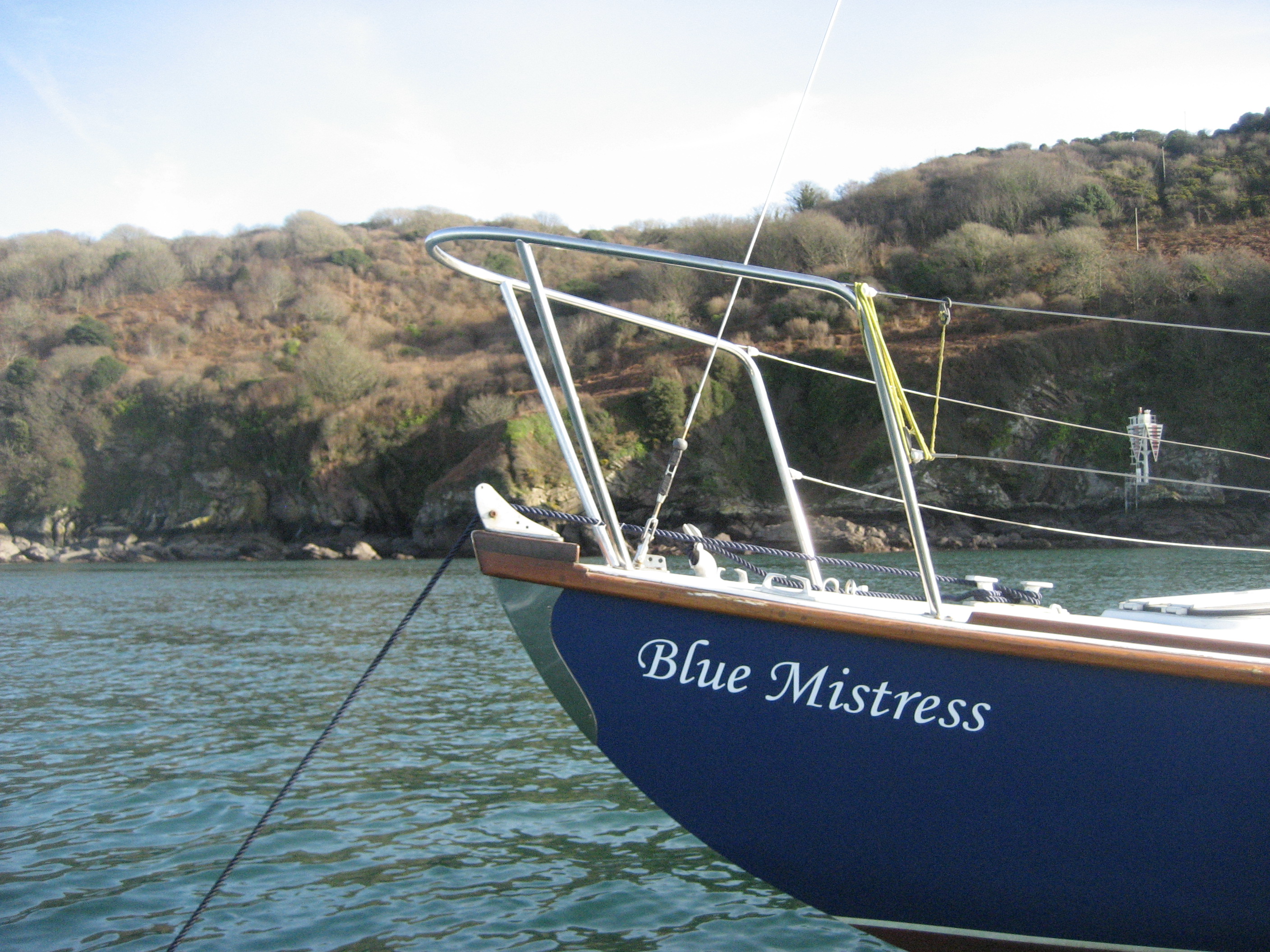
This simple rig holds the course giving plenty of time to go fetch something from below. It works just as well under sail..

The tide was low and the water slack as I passed the Cattewater Wharves.

Flinterlinge, registered out of Groningen, was busy unloading.

More on lazy jacks – here and here.
Dear George
I know you are looking forward to getting your new boat – and that amazing experience when you finally hoist the mainsail on your own boat. I had that moment on Blue Mistress in the summer of 2006
Full of excitement and anticipation, we left the mooring on the Tamar and motored a short way downstream to be free of the boats around us. We turned into the wind and I hauled on the halyard and up went the sail . . . and promptly jammed about half way up. Yes – you guessed it, lazy jacks again. The upper sail batten had caught beneath the upper block. So I let the sail down a little, and tried again. It got caught again. Tried again, this time more cunningly – watch . . . wait for the moment . . . up she goes!
What happened next? The engine was killed, the bow fell away, the sail caught the wind and we discovered that blissful, heart-lifting moment when wind and water and boat blend together. Did we think about lazy jacks then. Of course not. As a result, over the next few months, we went through the same circus every time we raised the mainsail – watch . . . wait for the moment . . . up she goes. Until I began to think about how unhandy it was, particularly if I was sailing solo.
When alone, I would release the halyard clutch, bring the boat into the wind, ease off the throttle, go to the fore end of the cockpit and hurriedly haul on the halyard to get the sail aloft before the bow fell away on the wind – inevitably the top batten got caught and, as the bow fell away, we would start to sail with the mainsail half set. Then it was back and forward, juggling between using the engine to bring the boat back into the wind and going forward to lower the sail, release the batten, and raise it before the batten danced yet again behind the lazy jack and we had to start the whole process all over again.
I thought of several possible ways round it:
And then, no less than three years after I bought the boat, it suddenly occurred to me that all I had to do was to stow the lines against the mast when I removed the sail cover and I would never have to worry about raising the sail again, and that’s how it has remained – (and only the once did I forget to re-rig them before lowering the sail!)
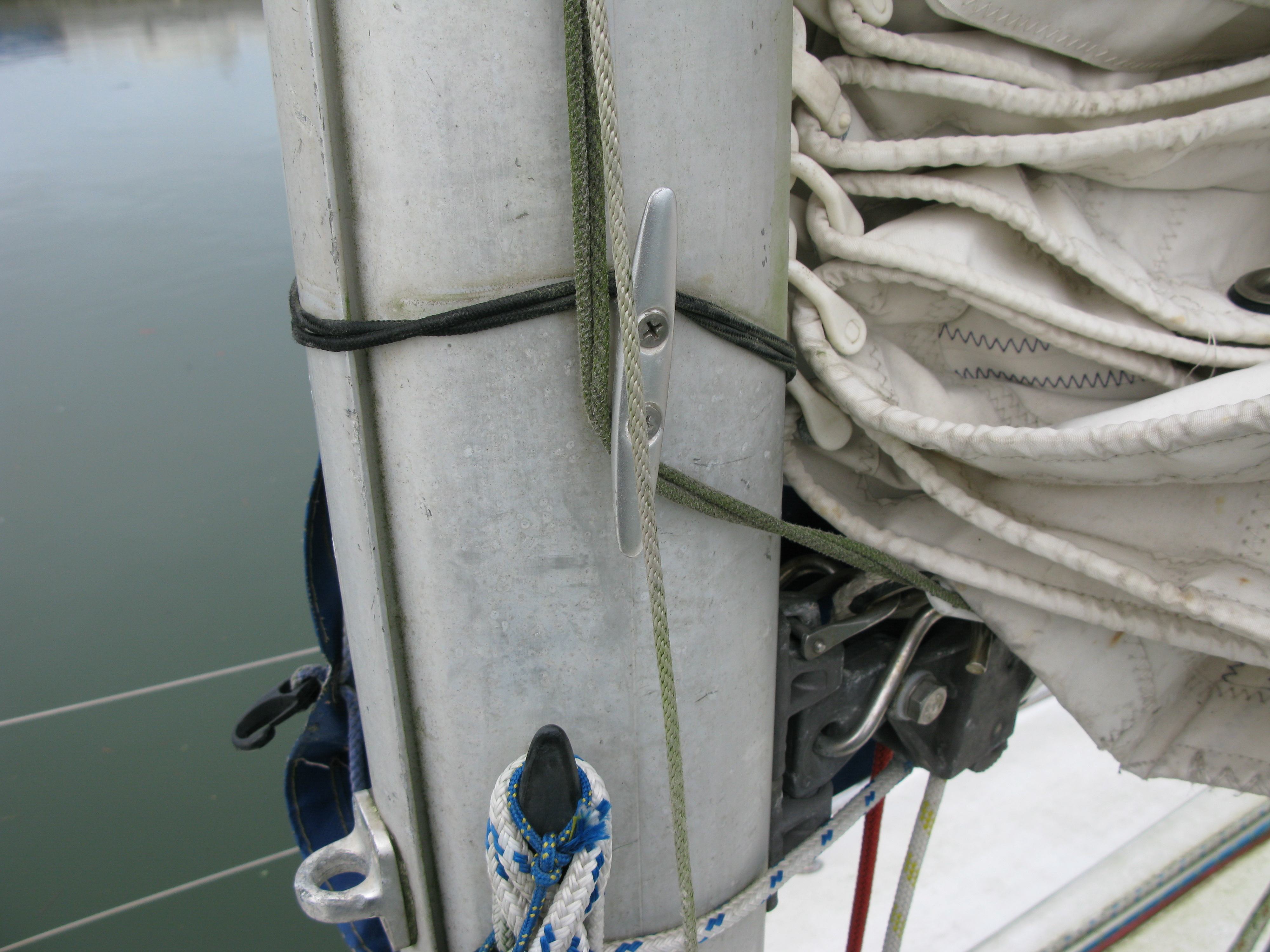
I have just read in the February 2012 issue of Sailing Today a letter from a reader, Tony Waldeck, advocating lazy jacks as a good way of containing the bunt of a reefed mainsail. Yes, that’s a good idea, although I have yet to use it. He states. “Lazy jacks are the answer – but not the off-the-shelf kits that incorporate blocks. All-string arrangements will not chafe the mainsail.” (An off-the-shelf kit is rigged on Blue Mistress. You can see the blocks on the sail below).

There, George, you have it – almost everything I know about lazy jacks.
Judging by the amount of time and energy they have cost me, ‘lazy’ is a pretty poor description.
Good luck with your new boat.
Bill
~~~
p.s. This is where I look back and wonder why it took so long to reach such a simple solution. Maybe this is the most useful lesson.
The world’s full of experts and no doubt every one of them could have told me the answer. Solutions are simple, especially in the evening around the bar – it’s getting to them that’s the problem. It has to be the experience of solving problems that makes all solutions worth pursuing.
Over the years, I have read many, many ‘boat books’ and I use a lot of what I have found in them, but the most enjoyable aspects of sailing, and certainly the parts I’m best at, are those I have had to work out for myself.
The first sentence in A C Stock’s introduction to his book ‘Sailing Just For Fun’ reads: “This book is for the man who has read all the ‘How-to’ books and still finds that he cannot.” Well, the more I know, the more I find I cannot. I used to worry about this, but no longer – I’m having too good a time finding out.
. . . End
Dear George
Back to lazy jacks. You say you want lots of detail, so this is what I do on Blue Mistress to lower and stow the sails before returning to the mooring where I would restow everything that needed restowing.
On the radio the other day, I heard Colin Dexter, who wrote the Inspector Morse series for television, say that, when writing a book, he definitely knew the beginning and the end of the story but the middle was always a muddle. Manoeuvres on the boat are the same – they have a beginning, a muddle and an end. It’s your job to manage the muddle – and to do that, you need to think your moves through first:
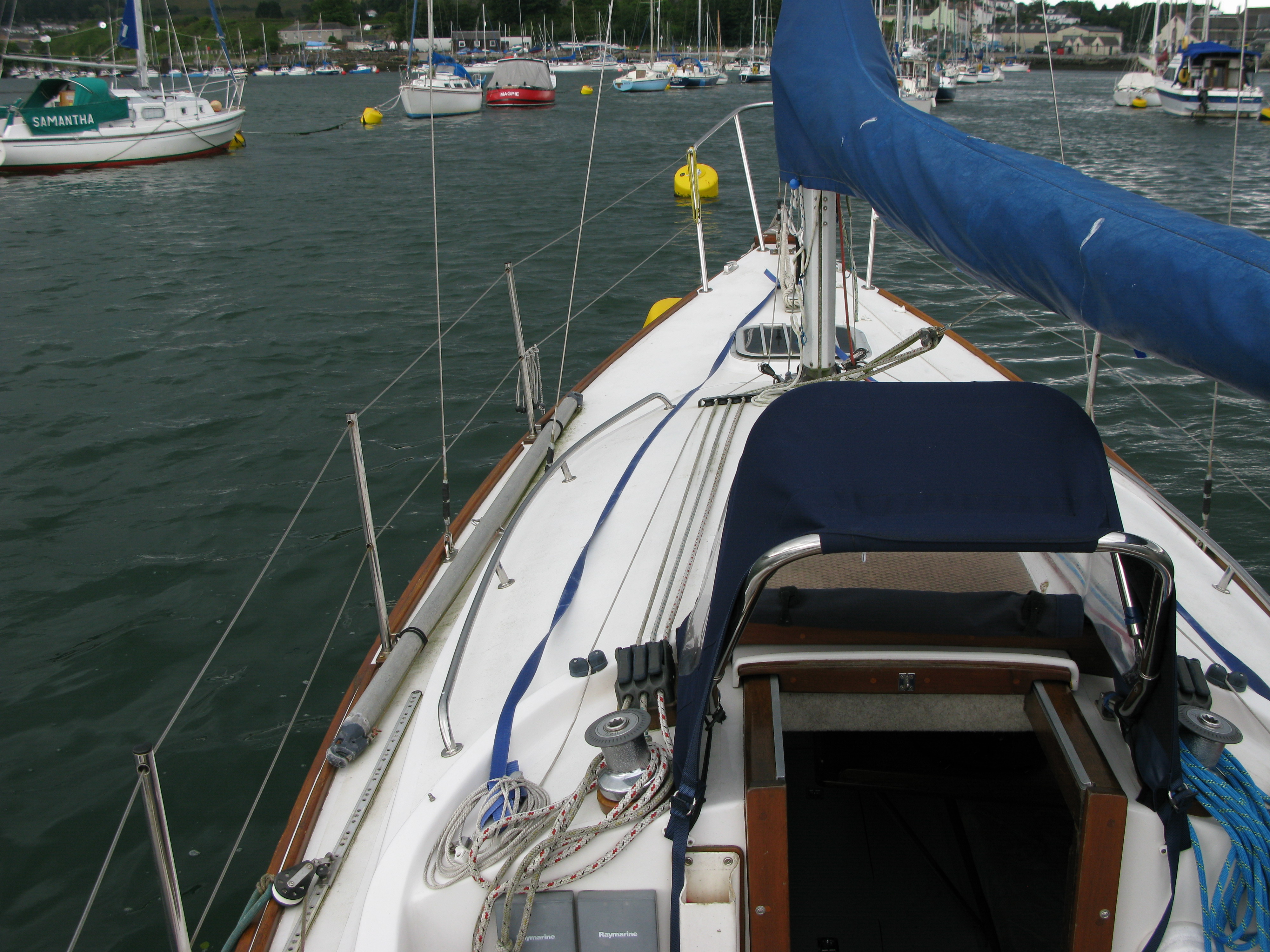


At this stage, the boat should be lying quietly and the sail can be carefully furled. Make sure the sail folds of the sail formed by the slides are all on the same side, then, working from the mast along the length of the boom, take a two foot wide section of the foot of the sail – (hammock-like), and fold it over the bulk of the sail, aligning the battens and tucking the reefing lines into the folds as you go. The sail ties are turned round the bundle with the loose-end tucked under the turn so that they can be easily released if the engine fails and you need to sail again before you get to the mooring. It also leaves them ready for the next time you sail.
And all the above assumes that you know the engine is going to start so that you can motor back to the mooring. The one time I didn’t check before stowing the sails, the engine refused to start . . . that’s another story.
That’s all there is to it, George. If your eyes have glazed over, I’m sorry, but you did ask for detail. Have I got images of each stage? You’ve got to be joking!
I’ll tell you the few problems I have had next time.
Dear George
Now you’re asking about lazy jacks and wanting detail, detail, detail. OK, you asked for it.
As you know, lazy jacks stretch from two or three anchor points along either side of the boom up to a high point on the sides of the mast to form a cradle for the mainsail when it is dropped. They keep the lowered sail from flapping in the wind and spilling over the side.

They have their good points and their bad.
When I first saw Blue Mistress, I was pleased they were fitted because I too wanted to sail single-handed and this was among the gear I thought I would need. (Like everyone else who has never owned a boat before, I dreamt of all sorts of gear I would need and all sorts of ways I would sail in her. Some happened – most didn’t).
Firstly, in a boat this size (or bigger boats like the one below), lazy jacks are unnecessary if you have a crew aboard. With someone on the tiller to bring the boat into the wind, control the boom and let the halyard go, a crew of one or two can easily drop the sail, control it and furl it – and you can all be ashore in time for tea.

But single-handing is different. That period between your boat gracefully sailing with sails neatly trimmed and everything under control, and your boat peacefully lying-to with sails neatly furled and everything under control needs some thought. There are a series of moves that need to be made in the right order, or, and I speak from experience, a series of foul-ups, each foul-up leading to a bigger foul-up and so on. It helps to see the whole process before you start – that way you know where you are and where you’re going.
So, ‘single-handed’ means forethought. There will always be moments of chaos – pitching boat, flapping sails, swinging boom. Better that it’s organised chaos. The well-crewed boat manages all this with ease, the rest of us have to work at it.
As I say, lazy jacks have their good and their bad points. The good points are when they are being used for what they were designed for – a manoeuvre that lasts just a few minutes. The bad points are their potential for getting in the way the rest of the time.
I’ll tell you about their usefulness and how they work on Blue Mistress next time. After that, we’ll have a look at their nuisance-value.
 Beyond Steeple Point