For love of a boat – one year on.

A year ago, I started the Love of a Boat series following a holiday in Croatia.

I had seen an old boat arranged ‘tastefully’ on the sand as a piece of beach furniture for tourists. I was saddened that something as complex and special as a wooden boat should be left as a casual prop for those who probably wouldn’t care whether it was there or not.

This was slightly naive of me but, as it turns out, a good basis for learning.

Since then I have shared some of my collection of boat images on a weekly basis. These are images that I take, firstly, for the pleasure of looking at boats and, secondly, because I have always been interested in how the design of working boats varies according to their location – (form following function).

In sharing them, I have found that:

  • There are many people all over the world who share my enthusiasm and care very deeply about wooden boats – (and not just wooden boats).
  • Some confine their interests to particular types of craft, interests which they pursue intensely and exclusively.
  • Thanks to blogging, it is possible to follow what they are doing and thinking, and watch new ideas emerging

Above all, I note in this group a genuine desire to learn from the past and to build the best of the past into new projects.

This may sound self-evident to you – of course we learn from the past, don’t we?  The older I get, the less sure I am.

I have banged on about this before. The way modern technology advances in leaps and bounds seems to have created a rather blinkered environment, one in which we look intently forward hoping for solutions to our problems, often ignoring the fact that man has been facing many of the same problems for generations and the core solutions are already there. Yes, technology gives us new ways to deal with them, and, yes, technology is a source of new creativity – (excitingly so!), allowing us to enter areas we have never entered before.

But for some solutions we don’t need technology . . .  just a way of dealing with them at a more human level.

to be continued . . .

On Steeple Point – a shared world

I was climbing the path to Steeple Point.

Towards the top, the land falls steeply away, rapidly becoming a cliff face that drops vertically to the rocks below.

With the tide in, these rocks are covered by sea – Atlantic rollers reaching their nemesis on the Cornish coast.

From up here, you watch those big swells roll in.

They build, curl and crash forward in a welter of foam, sparkling in the sunshine. Piling over the back-tow of their predecessors, they waste themselves on the pebble ridge.

There are intricate patterns of foam, constantly changing, highlighting myriad currents and cross-currents.

That morning, there was nobody in sight.

I was enjoying the aloneness. . . the warmth of the sun . . . the smell of salt in the air. . .  the sound of waves on rocks.

The sea was still heavy from an earlier gale

There was a slight breeze, I remember.

And then this guy appears below me on a surf board.

The waves were sweeping in from around the Point. He had been hidden out there as I climbed.

So, it wasn’t my sole world after all. There were two of us – the one holding a camera and idly watching, the other intently doing.

It was so totally unexpected. I felt a little shocked – a bit put-out.

Then I felt admiration – what a great ride in such a beautiful place.

And then a change of mood –  sudden concern because of what I could see from my vantage point.

A moment of doubt burst into this memorable day.

The concern was all mine, of course.

Whatever I saw, whatever I thought might happen, was way beyond my control.

He didn’t care. He knew what he was doing. He was having a ball.

I could only watch, my concern pointless.

Let him get on with it.

He paddled out to catch another wave. I continued my walk.

Two separate lives enjoying  the same space, viewing it through different eyes.

On Sailing a Folksong – Thank you

There are blogs written by those who are complete experts at designing, building and repairing their own boats with no other help than a forbearing partner and a seemingly infinite amount of time. I am not one of these.

~~~

In 2006, I bought a boat. It was the boat I had wanted for most of my life but never had the opportunity to own before. It took a little time to confirm what was right with it . . . and a little longer to find out all that was wrong with it. Fortunately, what was right outshone what was wrong.

That first season was good fun. We sailed a lot, even making a passage to Fowey and back. Unfortunately, there were some problems and I began to think of ways to fix them – and then ways to improve her, and so my ambition grew – (”What is possible? We are not trying to restore a classic boat to its original state. It’s not a wooden boat. Let’s see what modern materials can achieve”).  One thing was for sure: whatever I wanted done on the boat would be way beyond my then knowledge and still current skills. So I began to look for someone to help me.

Specifically, I wanted someone who would listen to what I wanted to do . . . and would recognise when I was being unrealistic and say so – and be prepared to come up with an alternative. Over the years, I have learnt how independent boat owners are . . .  and how proud of their boats, sometimes excessively so. It takes a diplomat to handle them.

During that summer, following an unfortunate incident with a crossed battery cable, we were in Plymouth Yacht Haven sorting it out. While trying to hide my embarrassment at the earlier mistake, I was explaining to Pete from Marine Systems what I wanted to do with Blue Mistress. He said, pointing to the Hangar across from the marina, ‘why don’t you try DickyB over there’.

A while later, Richard Banks sat in the cabin and looked around while I told him what I was wanting to do and how far back we would have to go before we could move forward – and there was no way of my affording the work in one leap.

I liked him immediately. He caught on to what I was saying, cut through the c**p and we began to work out what might be needed to start the project off. (Yes, I know I was a potential client so you would expect him to be enthusiastic, but there are ways and ways of handling clients – I liked his style).

And so the relationship with Dicky B Marine began. There have been three periods in the Hangar at Mount Batten. Each time, Blue Mistress has been returned to the water greatly improved. On the last occasion, she was a new boat.

~~~

Throughout, Richard has been excellent. I often arrived unannounced and, despite other work  on other boats, been enthusiastically shown what had been done and what was proposed. If I was in the way,  he and everyone else had the courtesy to keep it till I left! I took pictures of everything. I have sent strings of emails and attachments with ideas and changes. Believe me, it’s not the boat, it’s the owner!

It’s a team, of course. In this, our last session, Robin Leach’s skilled carpentry and work below decks have been especially appreciated – I haven’t forgotten the twenty locker lids laid out to paint.

He also made the smart  new tiller, one that no longer catches the lazarette locker lids.

At the same time, the stainless steel fittings were made in their workshop by Dave Willey. Andy Wilson worked on her too. That was another reason for choosing this firm. They have several strings to their bow.

And there was Pete Brian of Marine Systems – he of the original referral, who did the electrical work, Neil Gledhill of Hemisphere Rigging Services and the haulout crew of Plymouth Yacht Haven.

In a little under three years, we have gone from this:

2007

to this:

2009

From this:

2006

to this:

2009

From this:

Torpoint 2006

to this:

Oreston 2009

The Folksong hull was originally built for the DIY market. Blue Mistress was launched in 1988. She has changed owners two or three times since. Each one had their own ideas. Everyone brings their own personality to a boat. I don’t suppose any two people would agree on what the “correct” solution should be.

Well, this owner is older with a demanding day job, and with not so many tides ahead of him. He has enjoyed sharing the boat with the  surprisingly large number of people who have worked on her. (In a recession that can’t be a bad thing).

And he’s not finished yet. Over the next few years her intends to enjoy Blue Mistress, work on her and sail her as much as possible.

Thanks, Guys.

On Sailing a Folksong – back to the beginning

“Experience is not what happens to you, it’s what you do with what happens to you” – Aldous Huxley.

~~~

Well. it’s happened, as it was bound to. Having spent the past three years focusing on doing Blue Mistress up, all the feelings about it have changed. It’s as though, having reached the top of the junior school, we are now moving on to bottom of the senior school – from the top of one learning curve to the bottom of the next.

I “celebrated” this by arriving back at the mooring on Friday to find the engine and the inside of the engine housing covered in oil. More on that later.

~~~

Is the boat finished? No, but we have reached a level where I can enjoy doing all those small jobs that I haven’t been able to do up to now. It’s no longer a ‘this-is-what-it”ll-be-like-one-day’ dream. I am no longer letting jobs ride “because I will sort that out later when such-and-such has been done”.

Looking back over the past three years, there are, broadly speaking, four areas of owning a boat that I have been learning about. Although the headings were originally applied in a different context, they can be loosely described as:  health, comfort, function and appearance.

Health: The fundamental integrity of the hull and rigging. We had some major leaks to fix in the deck. But none in the hull itself. The rudder caused concern. Some of the rigging needed updating. The sails were ok. And, up to last Friday, the engine had given no trouble.

Comfort: Safety: I have gathered together the basic safety features (including learning how to stay on board). There are one or two extras still to go – that’ll be more money out. We can find out where we are –  there are no less than three different gps systems available – and now a chart table to lay out a chart on. The head is satisfactory. The galley works nicely too – we can boil a kettle quickly, cook up some soup or anything else should we feel inclined. Stowage has improved.

Function: This is where we go back to being bottom of the school. Experience up to now has been one of getting to know a boat as she was updated. What seemed like big adventures last year and the year before, seem like small ones now. Certainly the investment of time, energy and money require more use of Blue Mistress and I hope for plenty of sailing this year and next.

Appearance: Get form and function together and any boat is almost bound to look good – well, almost. I thought the appearance was good to start with, but it has got better as different problems and improvements have been tackled.

~~~

And the engine?

On Saturday, in light winds, we had a gentle sail to a couple of miles off the Mewstone. In the early afternoon, we watched Rame Head, then Cawsand, then the Breakwater disappear as a line of fog/low cloud drifted along the coast. We decided enough was enough and motored back to the mooring.

I asked Pete to close the seacock for the seawater coolant. He said he got oil on his hand doing it. I said that was not possible. We opened the lid of the engine housing . . .

We looked at it, and we looked at each other. We both knew we had no idea what had happened or how bad it might be.  We decided the engine was still too hot to work on. Silently, we closed the lid, rowed ashore and drove home.

Yesterday, I spent several hours upside down with my head in the bilge. The cause should have been immediately obvious, but it took me a while to find it because I wasn’t expecting it. Embarrassingly, it turned out to be a schoolboy error on my part. In my hurry to check the oil, I thought I had replaced the dip-stick correctly – but hadn’t. In my defence, the dip-stick is fairly long, the hole is flush with the casing and invisible from the front of the engine. It’s easily missed and the stick slides tightly alongside the engine casing – but that’s no excuse . . .

And now we have learnt a thing or two:

Do you know where oil goes if you leave the dip-stick out? . . . everywhere!

It completely coats the inside of your new engine housing (and I mean completely). It completely covers the engine (and I mean completely) – all those little screws and bolts and inaccessible corners where dirt builds up, between all those cables that have been cable-tied together, behind the engine where you have to do impossible contortions to reach  – and, of course, into the bilge.

I now know the outside of the engine intimately. I know how good the heavy duty oil remover is. I also know that, if you lay an oil-soak mat in the bilge, and settle back for lunch, by the time you have finished it will, remarkably, have soaked up most of the oil. I also found a short stainless steel strop that went missing during our first major refit two years ago. The bilge is the cleanest it has been for some years.

Luckily, not all the oil came out  – what was left came just above the minimum mark, and the engine (a Yanmar 1GM10) still runs remarkably smoothly.

Just as, when driving, I am constantly checking my rear view mirror because, thirty years ago, someone ran into the back of my car, I will never rush to check the oil again. I shall replace this particular dip-stick very, very carefully.

That’s experience.

A World Of His Own

On 22nd April 1969, a third year student in London, I watched Robin Knox-Johnson return to Falmouth on television.

His feat made a lasting impression. Like Sir Francis Chichester, he represented a spirit of adventure born of individual skill and personal endeavour. The essence of the achievement? No large back-up team, no communication for much of the voyage, no modern navigational aids – one man running with the elements, (and often against them).

Nowadays, it is difficult to describe his achievement without dropping into the world of spin and hype. They have stolen all the superlatives. Too much has been attributed too often to lesser deeds.You have to read his story in his own words to understand the man and the task.

And, for the rest of us, whatever our sailing ambition, he will be one who went before.

Are there words that sign-post what he did that may work for us now?

Napoleon Hill showed a feel for it early last century when he wrote:

“Whatever you want, oh discontented man, step up. Pay the price – and take it.”

Sir Robin stepped up, paid the price with perseverance and stamina and took his prize – the first to sail non-stop solo round the world.

Because he showed the trip was possible, others have followed with increasing confidence  – as well as with many, many more technical aids, and achieved successes of their own

Now, forty years on, general expectations are such that completing a solo navigation goes largely unmentioned – you have to be a record-breaker (or fail spectacularly) to get noticed.

But remember this: taking the prize may be the headline, but it’s the stepping-up and paying the price that’s the real challenge. And that’s the Knox-Johnson legacy.

All power to him this anniversary.

(Follow the links to see what others think – start here or here)

On sailing a Folksong – update

“Looks like a new boat” said the man in the marina who kindly walked me out of the berth.

Indeed, she does. Blue Mistress has finally become the boat I thought I glimpsed the first time I saw her four years ago almost to the day. Ever since that moment, I have been working towards this.

What she has become has more to do with ownership than anything specific. Instead of coping with someone else’s ideas, (however good they may have been), it comes down to owning a boat where all the positives and all the negatives are now the product of my own collaborations and my own final decisions. I guess everyone who sails a boat for any length of time will know what I mean.

For example, it could be because I am sitting at my new chart table, notebook open, pencil at the ready, able to make notes whenever I choose.

It could equally be because the galley has been cleaned up and I’ve bought a smaller kettle which comes to the boil more quickly.

Or that the loo facilities have been thought through properly and, suitably primed, are now satisfactory.
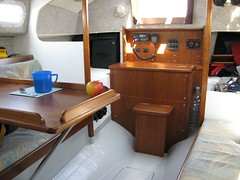
Or the new feel of spaciousness thanks to Robin Leach’s excellent finish to the repainting and retrimming.

Perhaps it’s because I have rethought the locker stowage so that more gear is to hand – gear that, in the past, had been ‘put away’ to be sorted out later.

It could be that, sitting here, with this excellent cup of tea, listening to Handel on the radio and watching people enjoy their Sunday on the water, I am mesmerised by the reflection of the sunlight on the water. In a boat with low freeboard you feel closer to the water- if you write about the sea, you are writing closer to the source!

It could also be that the rudder and tiller that have been bothering me for so long have been dealt with for the time being and I have the enjoyable prospect of sea trials ahead.

It’s all these things, of course, but, above all, it is the knowledge that every time I come aboard I won’t be looking around seeing all these jobs to do – jobs that in no way did I have the skills to complete to this standard. This bulk of unfinished business was getting in the way.

At my age, I have, in Jon Wainwright’s words, “only so many tides” to catch.

Blue Mistress now fits – and I feel freer to catch those tides.

~~~

This was my first post written on the boat – albeit with notebook and pencil to be copied later. I hadn’t realised how deep my ambition has been to do this comfortably.

No, I didn’t buy the boat to have a table to write at. I bought the boat to be able to sail. Writing about it has come out of owning it and given me the chance to find ways forward.

I shall continue to post. I wonder if my emphasis will change.