For love of a boat – Trechandiri follow-up

AA comments on my Trechandiri post:

“The word Trehandiri (Τρεχαντήρι) is loosely translated to ‘A fast boat’ which is kind of obvious for the first picture (a long and narrow boat that does not upset the water around it too much, a bit like the rowing skiffs) but not so obvious for the boats in the second picture that look more stable (wide) than fast. So perhaps they were termed ‘Fast Boats’ because they were also powered by motors.

The designers had to strike this balance between speed / stability / useful volume (after all you still need space for all the fish harvest 😀 )…These dimensions and other design elements were defined (or rather homed in) without mathematical models and simulations in different sea states at expensive experimental facilities.

I think that this is a good reason to preserve the boats and relevant pieces of the art from that era…(and of course not only the Greek fishing boats).”

~~~

I think AA has got it exactly right – “These dimensions and other design elements were defined without mathematical models and simulations in different sea states at expensive experimental facilities.

Boat-building was an art before it became a science.

Men looked at the sea, applied their common sense and, using tools that they created themselves, turned local materials into craft that had value and beauty by virtue of their function.

Did they get it right first time? Probably not. But they learnt by doing. Shapes and designs evolved . . .  and kept on evolving, handed on from generation to generation.

It is the vessels that are the results of this process that are being lost today. (Yes, there are still people building in this way in some parts of the world. But they are getting fewer and fewer).

Science has created a different process. The generation thing is not necessary any more – at least in the sense of person-to-person. It is more technical advance-to-technical advance. This may be spelt out in days or weeks rather than years. For example, every year new advances in technology create new products which lead to new fashions that can be seen everywhere. This year seems to be the year of the small RIB, the sit-on kayak and some very fast boats – as well as touch-screen monitors and AIS sets.

That’s great. As someone, who taps at a keyboard, posting yet more words on the internet, I like technology – and use it more and more.

But, in posting the ‘love of a boat’ series, I have noticed how technology is occluding this one important aspect of our lives: our respect for the deeper layer of human endeavour born of past generations, that lives in the present and will hopefully be passed on to our children.

It isn’t that we do not have the ability to be creative nor the willingness to gain skills, nor even that we do not care, it is that we are being hurried along a certain path that requires us to follow rather than to lead. We barely have time to assimilate one advance before the next one leapfrogs it. The pace of change is increasing.

The price of this is in many, many small losses that individually can be dismissed but in the end will add up to an impoverished society.

The demise of the ‘traditional’ craft is one of these losses.

This:

becomes this:

by doing nothing.

When AA says “I think this is a good reason to preserve the boats and relevant pieces of the art from that era”, I absolutely agree with him.

For love of a boat – Trechandiri

Paleochora, Crete 2009

I have started reading Mike Smylie’s ‘Fishing the European Coast’.

In 153 pages, he has written a comprehensive series of notes and reminiscences on the very wide range of boats found around the European coast.

It is the perfect overview for someone who enjoys differences in boat design  from port to port, from local conditions to local conditions, from culture to culture . . . as well as for someone interested in the evolution of craft.

For example, over the past year, I have posted many images of Greek trechandiri. Smylie writes:

“The trechandiri is the workhorse of Greek coastal fishers . . . . . The advent of motors in the 1920s simply produced a fatter, fuller body section, while in profile they were unchanged. Once the rig was removed, superstructures were added! They are ubiquitous throughout the Aegean – that sea of thousands of islands, and have one thing in common, a length/beam/depth ratio of round about 9:3:1. There are two schools of thought on their origins. Some say they developed from a particular type of caique, first built in Hydra in 1658, while others suggest they evolved from the trabaccolo, a type of sailing vessel used for trading in the Adriatic.”

Agios Nikolaos, The Mani, Greece 2007

Length/beam/depth ratios have taken on a new meaning :-).

Mr Smylie adds to what I learnt from the National Maritime Museum in Falmouth earlier in the year and from Denham’s book on ‘The Aegean’.

And the images have taken on a new meaning too.

For the origins of this image series, here


On sailing a Folksong – Interview with Eric Bergqvist (continued) . . .

Here is the the continuation of the interview with Eric Bergqvist by Ted Bradbury, who, at the time, was looking for a seaworthy cruiser to sail to the Azores – (with thanks to Mike Burns). I guess this would have been sometime around 1982/83:

Ted: I do appreciate how reasonable your prices are – (hull and deck mouldings £1750 +VAT – ed.), but doesn’t that mean that the boat has been designed to its limits – minimum bulkheads and thin laminates etc?

Eric: Not at all. The long low profile of the Folksong uses less materials as well as contributing to the boats sailing performance. The laminate is of chopped strand mat construction resulting in a thick hull which, although hand laid, is quick and easy to make. The deck is an economical one-piece moulding and the bulkheads and other interior fit-out all wood.

Ted: Why is the wood interior economical? It must take a lot of time to fit and finish.

Eric: It will take longer to fit than the kit of moulded and pre-finished parts that you would have to buy to complete a modern production yacht but these kits are expensive because you are paying for someone else’s labour and overheads. Such kits also offer very little, if any, flexibility or freedom of design. Our basic interior kit is simple and straightforward because it’s been designed specifically for the home-builder who can keep the layout as it is or add his own ideas and innovations as he goes along. We sell bare hulls and decks to customers who want to do it all themselves, or part or fully finished boats to those who haven’t the time or inclination for fitting out. Admittedly the finish we use, painted plywood with varnished hardwood trims, is time-consuming, but it is also relatively inexpensive. It has a warm classic look and can be smartened up each spring with a fresh coat of paint.

Ted: I think I see now why you haven’t attempted to give the Folksong standing headroom, but surely this is unacceptable to most prospective buyers.

Eric: I agree that the lack of standing room is a drawback but a box cabin high enough to allow for this would ruin her lines and performance and increase the cost. There are plenty of 25 footers to choose from with standing headroom but few that can be built as economically as the Folksong or perform as well. In fact the Folksong’s headroom rarely concerns my serious customers because the Folksong design appeals principally to experienced sailors. Like you and I they have the ultimate ambition of making that long ocean passage and are confident that the Folksong can help them accomplish such a dream.

Ted: Finally, Eric, have you made any improvements to the Folksong in the three years you’ve been producing her?

Eric: Of course. The design is constantly developing. From the fifty or so boats built we’ve had a lot of customer feedback and each year a new interior is planned for a customer’s own specific requirements. Recently a new cockpit layout was added with an outboard well, and the Folksong hull has been successfully used for other hone designed cruisers. At the moment, two customers are building Chinese junk rigged Folksongs. One of these is a replica of Blondie Hasler’s Folkboat, Jester, that made so many single-handed transatlantic crossings. And what better recommendation for a Folkboat than that!

~~~

Well, there you have it from the designer himself. He wanted the Folksong to be good-looking, economical in its simplicity, have a good performance – hence the low profile, be flexible in its design and be capable of ocean voyages by the ambitious and the experienced.

That’s what I saw the day I first saw Blue Mistress. What about you?


On sailing a Folksong – Fram and Eric Bergqvist

I am not the only one owning a Folksong. In fact, compared to some, I am very much the novice – (as anyone who has read this blog for a while can testify). However, I have learnt a thing or two and I know a gem when I see it.

Kite gybe

This is Fram. The picture speaks for itself.

Mike Burns wrote at the end of last month:

“I home completed a Folksong in 1984 . . . and still have her . . .

“Maiden voyage in 1985 was circumnavigation of the north of Scotland, ie. clockwise Fortrose to Fortrose via the Caledonian Canal.

“Raced her last weekend single handed, flew spinnaker & also had to anchor up when wind dropped & strong tide, only came third out of 8 mixed handicap boats. Had to winch up the anchor with the genoa winch!!”

He has kindly sent images of Fram and copies of his original documents, and has given me permission to publish them here which I am delighted to do. Thank you, Mike. I hope we will exchange more details as time goes on.

~ ~ ~

Among the documents is an interview with the Folksong designer – Eric Bergqvist.

In it, he says: “I wanted a yacht fit for sailing single-handed in the Irish Sea.

“The first of my three requirements was that she had to be attractive. Pride of ownership is always a top priority and a gentle evening’s sail followed by a few pints and a chat at the club can be just as rewarding as a landfall after a long passage.

Fortrose Harbour

“My second priority was performance – speed on all points of sail and the ability to keep going in a short steep sea where you’ve the combination of wind over tide in shallow water. Self-steering is, in my opinion, the best aid to navigation, enabling the skipper to keep dry, warm and alert. The Folksong’s long keel gives good directional stability and suits the construction of a very simple self-steering device.

“My third requirement was ease of construction. Simplicity is the essence of both good design and economy, and I’m not in the position of having a lot of money tied up in a yacht.

These three requirements: looks, performance and economy all add up to a fibreglass Folkboat.”

With dolphins

That sums it up for me. Even though I have spent more money than planned on Blue Mistress – (yeah, well . . .), she is still more economical than many similar boats from the more well-known classes. She performs well and looks good.

~~~

Now, some detail. In the extract above, he talks of “the construction of a very simple self-steering device.” Do any Folksong (or Folkboat, Folkdancer or similar long-keeled boat) owners know which one from the early eighties he may have been referring to?

For love of a boat – 40+ Fishing Boat Association

Last Thursday’s (6th August) edition of the Western Morning News had a centre spread entitled “One man’s love affair with old wooden boats.’

It featured historian Mike Smylie, whose book “Fishing Boats of Cornwall” has just been published by The History Press.

In the article he is quoted:

‘”For this book on Cornish fishing, I spent a lot of time in Newlyn talking to local fishermen and the people involved with the local fishing industry . . .

“Something which particularly saddens me is seeing boats being chopped up – there’s a photograph in the book of a perfectly good wooden fishing boat being demolished in Newlyn in 1998 with a JCB. This happened because of the European Union fishing policy which encouraged fisherman to take boats out of fishing and scrap them.”

In 1995, Mike co-founded the 40+ Fishing Boat Association to fight that policy and help preserve old, decommissioned fishing boats.’

I am ashamed to say I have not heard of this association up to now. However, those of you who have been following the For Love of a Boat series will know this is precisely my own view on what has happened as a result of the European policy. Captain George’s video shows a Greek fishing boat demolished in just the way mentioned above for exactly the same reason.

Looking at the 40+ website I have not discovered how to join the Association yet, but will pursue it and let you know how I get on. The link to the equivalent Greek website is here. (To translate into your own language, I find Babel Fish works reasonably well).

I have ordered Mr Smylie’s “Fishing the European Coast” and look forward to reading it. The Cornish book will come later.

In the meantime, I wish Mike Smylie well – and encourage him to keep up his good work.

On sailing a Folksong – a spring tide sail

We sailed round to The Yealm thinking, if we got it right, we could have lunch in Newton Ferrers. I wasn’t familiar with the river and certainly not sure about the tide – a high spring tide which would still be ebbing when we got there. The wind was from the west.

Leaving Oreston just after the top of the tide, we made fast progress even though the wind was light.

There is a wind level – low Force 2-3, when Blue Mistress‘ weight and shape tell against her when compared with less heavily keeled boats. A couple of yachts passed us in style.

We enjoyed the sail, boiling the kettle and making tea, talking of this and that.

However, rounding Great Mew Stone with plenty to spare, we had to concentrate as we  headed into Wembury Bay on a dead run, the genoa goose-winged to port.

There seemed to be more wind here and we occasionally surfed as the sea and wind piled up against the tide pouring out of the Yealm.  The sun reflected off the tops of the waves and boats not too far away disappeared hull down, to rise immediately on the next wave. Several boats were motoring out from the river, lifting their bows and showing their keels, as they worked into wind and sea.

We followed a boat ahead who seemed to know where she was going and watched as the foresail came down and she disappeared into the narrow entrance.

Our turn next. Not wanting to risk any sail inside, we lowered the genoa first, Charles negotiating the tricky task of keeping it inboard. Then into the wind, momentary chaos and the main came down. Then, boom secured with mainsheet, a few minutes of  grabbing, rolling, hurriedly tying flogging canvas – a less than neat job (below) but good enough on a moving deck.

We motored past the bar, watching the tide flow round the two port hand buoys before following the leading marks across the river, then through the many moorings to the first pontoon.

Choosing the outside of the pontoon to avoid the possibility of rafting, we accepted the weight of the tide would hold us against it. I hadn’t bargained for just how strongly it would hold us. The direction and force of the outgoing tide can be seen in the image below. Mooring lines were almost superfluous. Getting off would obviously be interesting – but first thing first – lunch.

It was good too -:)

It was about 1400 when we got back. Low tide at The Yealm entrance was 1500, giving 0.8 m clearance above LAT, enough for us if we kept to the narrow channel.

As expected. the weight of the tide was still holding the boat against the pontoon, but it had slackened enough for the two of us to push the boat off and move our large round fender to the starboard quarter. Removing the mooring lines had no effect. A combination of heavy push with boat hook at the bow and gentle astern on the engine with the tiller to port, brought her quarter onto the fender and her bow away. Briskly forward on the throttle and we left the pontoon headed upstream looking for space to turn – briskly because there is a certain point when the tide will catch her and she turns downstream whatever I do – in this case it would have been into the cruiser moored astern of us.

The ferryman had mentioned that they would be playing cricket on the sand bar today to celebrate the particularly low spring tide. The short entrance to the river is very narrow, a few yards wide, rocks on one side, sand bar on the other. The light surf was clearly visible on the exposed sand bar as we crossed the river towards it.

Yealm sand bar – Great Mew Stone behind

There were yachts moored in Cellar Bay as well as many dinghies on the beach. People were on the sand bar – the whole area a hive of activity.

Yealm sand bar – exposed at low spring tide

A few minutes later we were through the entrance into an altogether different sea to the one we had met in the morning.

Yealm entrance – the extreme right hand yacht is in the channel.

Sailing close-hauled across the Bay towards Great Mew Stone, we noted the exposed Inner and Outer Slimers, tacked across to clear the Western Ebb Rocks, tacked again before we reached them, cleared Mewstone Ledge and eased away onto a close reach across to Cawsand. Then home on the incoming tide.

It was one of those days. No broken records, no prizes, just a great day sailing.

On sailing a Folksong – Saturday morning

I went down to the boat on Friday evening to spend a few days on board.

The following morning, having worked out the early routine, I made a cup of tea and sat with my head out of the hatch to enjoy the peace in the morning sunshine and watch the tide as it slackened towards high water. Today was the top of the spring tides – (0903, 5.4m; the still higher 5.7m due just after 2200). I cannot remember seeing the level so close to the top of the Cattedown Wharves (below).

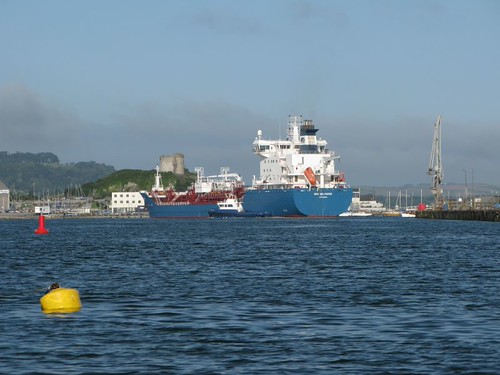
A blast on a ship’s horn and the bow of Bro Deliverer, registered in Goteborg, appeared from behind the sheds – adding a different shade of blue to the scene and totally changing the perspective. A tug and the pilot boat tripped alongside her.

0756

She nosed into the turning area and came around stern first. The tug scurrying around while the pilot boat stood off with an air of dignified watchfulness.

A yacht motored briskly out of the Yacht Haven, promptly eased off and drifted gently, waiting for the ship to slip up river stern first.

0800

A few minutes later, a pleasure boat left its berth on the outside of the Yacht Haven pontoons and hurried around her bow to pick up its first passengers of the day.

Meanwhile, Bro Deliverer came level with the wharves and, with a little help from the tug, eased sideways into her berth. Lines were thrown and she came to a stop, dwarfing the cranes and sheds.

0815

All was over in 20 minutes or so – a well rehearsed routine, neatly accomplished by the ships crew, the crews of the tug and pilot boat as well as the shore crew.

My brother rang at this point to say he was five minutes away. Time to row ashore.

On Steeple Point – prevailing wind

AA comments:

It has been proved that the weather is unpredictable in the short term. One more reason for Britain lying directly below a jet stream delivering storms from the Atlantic. (If only Fitzroy knew that 🙂 )We can only establish some long term (seasonal) trends.
For example, in Greece it is known that “The ‘weather’ always comes from the West” whereas over here (UK) the direction is SW….There is evidence for this on the way that older trees are bent.

Do you mean bent like this? 🙂

Stowe Barton, Christmas 2009


On Steeple Point – two images from Duckpool

Two images from Duckpool.

The first taken last Christmas – the pebble ridge in winter:

This one taken in heavy rain at 1045 this morning – the pebble ridge in summer:

Lands End to St Davids Head including the Bristol Channel
Strong winds are forecast
Inshore waters forecast
24 hour forecast:    1900 Fri 17 Jul     1900 Sat 18 Jul
Wind     Westerly or northwesterly becoming cyclonic, 5 to 7, decreasing 4 in north.
Sea state     Moderate or rough, but slight in east.
Weather     Rain or showers.
Visibility     Moderate or good, occasionally poor.

This is this evening’s inshore waters forecast.  It was right for the whole day.

The heavy rain has swollen the river and once again altered the shape of the pebble ridge, the same ridge that presented such a peaceful scene last December.

This is the weather that makes this coast exciting and invigorating.

The only problem is that this is July. Why can’t it wait until the Autumn?

For love of a boat – keep them alive

Last week, I admired this boat in Padstow, Cornwall

and early last month, this one in Finikas, Crete

They are about the same size, both registered fishing boats.

One is built for fishing inshore in the Atlantic Ocean off Cornwall. the other in the Lybian Sea off Southwestern Crete.

To look at, these are totally different boats – but there are many similarities – similarities that come from their function and the work that is put into building, maintaining and running them.

Without a specific function and the people who use them, working boats become mere objects to look at (albeit very fine objects). Add in the people who built them and run them and they take on a life.

Someone decided to build them, lay the keel, add molds, timbers, planking, decking, an engine. Someone finished them. Perhaps the same people, perhaps someone else now takes them to sea, fishes from them, maintains them. These people have families, friends, fellow fisherman, customers – a community of people who know the boats.

Well, they have one other thing in common, they won’t last for ever. As time goes on, and fishing becomes more regulated, and plastic and metal construction finally takes over from wood, and universal design takes over from local design, and costs become more and more prohibitive, so these boats and those like them will disappear into history. Maybe this generation. And the skills that come with them will likely dissolve or resolve into some other field.

Celebrate them now, while you see them working.

Record them and share them

. . . and admire those who are working to keep those skills alive.

Try the boatbuildingacademy site – here, or Charlie Hussey’s marinecarpentry site – here.

Enjoy Mark Harris’ video on building the Isolde, then go to his woodenboatbuilding site – here.