On Becoming a Skipper

“Make a list. Then work through it.”  

Good advice generally, but a list implies some sort of linear order – one item written after another. However you look at it, your brain makes the items at one end of the list more important than the other. And what happens to the items in the middle? Working through a list takes time, and, the human condition being what it is, the enthusiasm that greeted the construction of the list and dealing with the first entries will wane as time goes on. 

OK, a list works if you can afford to forget a portion of its contents, but what happens if your occupation involves items that are all of equal importance – each relying on the other for success? 

Take, for example, the knowledge, skills and attitudes required to be the skipper of a small boat, particularly if you want to sail single-handed. You need to get it all right, or at least a good enough proportion of it – in your own style. It might be helpful to know what Robin Knox-Johnson or Ellen MacArthur did in similar circumstances but they’re them and you’re you, and the circumstances won’t be exactly the same, and they’re not there to help you anyway. 

So how do you start? Well, “Make a list. Then . . . . .”   No, there’s another way, using a mindmap. 

Below is a group of skills and attitudes for skippers that I first saw listed in a book – (and my apologies for not noting which one), early last year. It struck me as interesting, well thoughtout and a good starting point from which to build my own skills, so I copied it down. Then I forgot all about it. I found it again this week. 

This is an exercise in getting it all together – and keeping it together. It’s an exercise in converting someone else’s thinking into my thinking. If it appears to you to be an exercise in the blindingly obvious, bear with me, some of it is – but these are the early stages of a much longer enterprise. 

Here’s how I’m going about it. 

Step One: Create a new mindmap. Call it, in this case, ‘On Becoming a Skipper’. Add two branches – ‘Practical Skills’, ‘Theoretical Skills’. Add sub-branches for each set of skills, taken from the original list. Now we’ve developed an image of a complex subject which appears all on one screen.  However, at this stage, the content is still someone else’s work.  

01. On Becoming a Skipper
Step Two: Begin to sort the branches by adding icons based on your own style and needs. Pencil = work on this, cross = not ok, tick = ok and so on.  
02. On Becoming a Skipper
Step Three:Think about it for a while. A couple of days after producing this, I added ‘rigger’ and ‘purser’, the latter being very relevant at the moment.  The point here is that it is not a fixed picture, we can alter it at will. 
03. On Becoming a Skipper
Step Four: Rearrange the skills and attitudes into some sort of order that suits your current needs and style. What are you going to do with what you are learning here? (Or, in this case, what am I going to do?) 
04. On Becoming a Skipper
Step Five: Keep this image at the front (or back) of your mind. Every now and then something else will occur to you and you can add to it. This is a work-in-progress to maintain a balanced approach to growing as a skipper in an age when traditional apprenticeships are not always available or appropriate. The sea is still the sea, sailing is still sailing, and we all need to learn the same stuff regardless of the way we do it. 

As for me, I shall revisit this file regularly. I can see where I need to be working now and I shall add another level of branches, going deeper into each topic, but always the overview will be there.

Maybe we shall look at it again later in the year and see what’s happening.   

Five things good. five things less good

Five things I was pleased with last trip:

1. We left the mooring neatly with a new crew.

2. We hoisted the mainsail without catching the battens in the lazy jacks. (How easy was that?)

3. I really enjoyed sailing with this crew too. In the past three weeks I have sailed with eleven different crew members – all family, only three of whom had been in the boat before. Being with family is great – skippering them could be something else. In the event, all was well.

4. We returned to the mooring with everyone knowing what to do – and doing it, even though I was the only one who had done it before. The system works!

5. Curiously an accident proved a blessing. A lifejacket was dropped in the water and auto-inflated. Well, now I know they work! And I now know how to reset them.

 Five things I could have done better:

1. I went below without checking whether any boats were closing on us, and was called up in a hurry to find a 20 foot closing fast on the port tack to our starboard tack. He seemed not to notice. I should have been more vigilant for the new crew.
IMG_0512
2. The tide was taking us down onto the Shag Stone and we ended up starting the engine to weather it. We could have made it under sail with a little more forethought.
IMG_0506
3. I couldn’t make up my mind how best to set the sheets on the genoa – when to run them inside or outside the shrouds. I think we could have sailed more effectively to windward. May be that would have made the difference at the Shag Stone.

4. I had planned to keep a detailed log as a navigational exercise even though it was a day sail – and didn’t. I do need the practice.

5. I also need a checklist for leaving the boat – this was the second trip running I left something on board and had to row back to the mooring to fetch it.

The Folksong 26 (sic)

Blue Mistress back on mooring 1
The main reason I started this blog was to find out about the origins of the Folksong class, and hence my own boat ‘Blue Mistress’. I have learnt a great deal and met some good people from doing so, but after nine months I still only had part of the Folksong story. 

On Saturday, thanks to a small note in Sailing Today, I found a new website www.yachtbrochures.co.uk, run by Mike Davies. Included in a very long list of class names is “Folksong, Eric Berquist, 1983”. Search over.  Mike replied almost immediately to my email and the transaction was completed within a few minutes. An excellent service. Thank you. 

So I have received a brochure written for the Southampton International Boat Show, Mayflower Park, 17-24 September 1983 (Stand B10).  From this I learn that the Folksong was originally sold as “a thoroughbred cruiser/racer you can afford”. 

“Based on the lines of the Folkboat, the FOLKSONG embodies the three principle virtues of that classic boat – looks, performance and economy.”

The builder was Eric Bergqvist, Boatbuilder, The Square, Lymm, Cheshire. 

“Specifications: LOA: 25ft 2in;  LWL: 19.8ft;  Beam: 7ft 3in;  Draft: 3ft 9in;  Ballast: 2500lbs; Hull: GRP, 7oz from deck to waterline, 11oz below; Deck: glass fibre sandwich construction with built-in non-slip surface; Cockpit: self-draining;  Sail area: 280 sq ft;  Engine: provision for an outboard well or an inboard engine.” 

“The Folksong is based on the lines of the Folkboat which was designed in 1941 for a Swedish Yachting Press competition. Over 2000 Folkboats have been built embodying the traditional virtues of a long keel, conventional outboard rudder and seven eighths rig with a sailing performance to match. Although the Folkboat design was intended for wooden construction, clinker and carvel, three fibreglass versions have since been moulded. The Folksong is the only one designed specifically for home completion.

In order to retain both the classic lines and the excellent performance of the craft no attempt has been made to cater for standing headroom. If necessary though, this could be achieved with the use of a spray dodger. The accommodation is not spacious but the layout is flexible. With thoughtful planning and use of timber and fabrics you can create an interior which is warm and comfortable as well as practical.

Twenty five feet is the minimum length of yacht generally considered capable of continental cruising without bravery or heroics. The Folksong is an uncomplicated yacht – economical but with no compromise on safety.” 

There’s more. If you own a Folksong and would like to discuss it, please contact me. Alternatively, I recommend Mike Davies’ website.

The Fate of the “Ceres”

Taken from an article in the Bideford Weekly Gazette dated December 1st.1936. 

FATE OF THE “CERES”

The 125 years old “Ceres”, veteran of the merchant service, her course now run, lies at the bottom of Bideford Bay, somewhere off Baggy Point.

The “Ceres” sprang a leak on Tuesday night while on a voyage from South Wales to Bude, and foundered after her crew had put off in her boat and had been picked up by the Appledore lifeboat.The Captain is Mr Oswald Jeffery, a married man, whose home is in Richmond Road, Appledore, and the mate Mr Walter Ford, a married man of Irsha Street,, Appledore.They reached Appledore in the lifeboat at about 11 o’clock, and on arrival the Rev Muller offered a short prayer of thanksgiving for their safety.

Captain Jeffery said,” We left Swansea on Tuesday bound for Bude with a cargo of slag.. Because of the weather we intended to go in over the Bar for the night as it was to rough to venture on to Bude. At 8 o’clock I went below to rest for an hour, leaving the mate in charge. An hour later he told me there was water in the engine room. We manned the pumps. We tried to get the ship over the Bar, but the water made her roll badly, and I gave the order for the ship’s rowing boat to be launched. I fired two rockets, and we abandoned the vessel. We lay in the shelter of the “Ceres” which was sinking, and were taken onboard the lifeboat.

Dr. Valentine stood by in case medical assistance was needed, but although wet through, neither the captain nor his mate appeared any the worse for this ordeal.

The “Ceres” was owed by a Bude firm of coal merchants, and was built in Salcombe.  

 Ketch Ceres   1811 – 1936.

Built in Salcombe, Devon in 1811.She carried stores as a revitaling ship at the blockade of Brest during the Napoleonic wars. Was the oldest sea-going vessel afloat until she sank in Croyde Bay one November evening in 1936. My late father Walter Ford always maintained that she sank because the vessel had recently had a new timber set in, and this had swollen and had displaced the much older timbers which surrounded it.

The night she sank was flat calm and the sky clear.

This is one of a number of posts on the Ketch “Ceres”. They are presented in a random order as and when I have found, or been given, new material. If you are interested in maritime history and would like to read more, please use the Search facility on the top right-hand side if this page (‘Ceres’).  If the Search box does not appear on your current screen, then click on ‘Bill’s Boat Blog’ – (or the title of this entry, then ‘Bill’s Boat Blog’), to be taken to the correct page.

A Good Afternoon Out

With a single reef in the mainsail and the No.1 jib, (a former mainsail cut to size), Blue Mistress sails beautifully.  

There was a grey cloudy sky yesterday afternoon, with rain to come. The forecast said the wind would lessen as the afternoon wore on. But Charles and Annette were on holiday and wanted to sail and Peggy said she’s come too – (none of them wanting to sail more than I), so we went. 
A good afternnon out
We put our nose out round the Breakwater into the teeth of a long swell and decided that, with the wind lessening, it would be more fun to sail inside the Breakwater.  And it was when we had tacked and eased the sheets slightly into a close reach across relatively calm waters that the boat came alive. It’s difficult to describe but there was a moment when the rhythm of the boat stepped up a notch. It was the sort of unlooked-for feeling you get ‘in your bones’. Maybe it was the movement through the water as we picked up speed, maybe the various sounds changing, maybe it was the set of the sails or the feel of the wind on my cheek, but I found myself knowing precisely why I am pleased with Blue Mistress and why the wait for the work on her to be completed has been worth it. 

As we headed towards the bridge between Drake’s Island and the Mount Edgcumbe estate to enter the Tamar, a fleet of Lasers swept down on us. A few minutes before they had been a mile away over towards Cawsand, now the leaders were on us and there was that tricky moment of how to avoid them. They seemed to be everywhere – enthusiastic youngsters seriously racing.   

Once on the Tamar, with a light drizzle and the wind dropping, it was time to shake out the reef – and the genoa might have helped but the wind was dropping fast and it fell altogether as we came level with Millbrook Lake. 
Millbrook

So a chance to recharge the batteries and enjoy a gentle motor up river past the naval dockyards before returning to the Plym.  

The drizzle stopped as we were directed inshore towards the Mayflower Marina to avoid another warship plus its attendant tug, police boat and various ribs.  
by Mayflower Marina
It’s only the second season I have sailed in Plymouth and I am still ‘green behind the ears’, so maybe I am a little naïve, but, as my Dad used to point out, when you’re on the water, there’s always something happening and always something to see. Don’t miss it. It’s particularly true here.
The pleasure of being on the water

Post Refit Review

One of the problems last year was the hatches in the stern. Firstly, they leaked, and, secondly, the tiller got in the way when opening them. So the new design had to solve both those problems and still leave two lockers with openings large enough to take, for instance, a spare fuel can, meths etc that we don’t want to store below, plus immediately accessible warps, fenders, a fishing line and so on. It also needed to be lockable. This is the result. They lock from the inside – (answers on a postcard, please!).    
Stern Lockers

Also, the false cockpit floor had taken a battering with large crew members for ever stepping heavily onto it. By putting in floorboards – (two for ease of removal), the load has been spread. Also, the slight problem we have with the small amount of water coming back through the cockpit drain has been reduced (not yet solved) by the extra height of the boards. And, finally, it looks good. 
New floor boards
The third improvement, apart from the new halyard winches, is the option to put a polystyrene weatherboard in the companionway. It gives a clear view through to the cockpit from the cabin. When not in use, it stows in a smart Velcro-ed foam pocket to prevent scratching. I opted for the double weather board because I found the single one that was there previously difficult to stow when not in use. With the new lower one installed, I can still get in and out of the hatchway without having to remove it – (just!). There is another upper board that locks in place.
IMG_0360

The picture on page 90

Ceres of Bude

Re picture on page 90.

The ketch Ceres is said to be the oldest sea-going craft in existence. She was built at Salcombe, Devon, in 1811, and began by trading to Northern Spain, more than once having narrow escapes from French and American privateers. In the years 1818 and 1814 she was employed by Government carrying British military stores in connection with Wellington’s Peninsular War operations, subsequently reverting to her owners and resuming ordinary trading. She first came back to Bude in 1826, and has been in the ownership of her present owners since 1852. She was altered in rig in 1865, and subsequently was cut in two and lengthened by 13 feet, being registered 44 tons and carrying 85 tons. In 1912 she was successfully transformed to a motor ship by the successful installation of a 30 h.p. semi-Diesel engine, which enabled her to keep close to the shore and so avoid the fate of several other coasting vessels sunk by submarines off the North Cornish coast during the Great War. Ceres is still in active commission, having passed her four-year Board of Trade survey in 1930.

(Photo by J. H. Petherick, Belle View, Bude. Sent by Mr. J. W. W. Banbury, Lloyd’s Agent, Bude, Cornwall.)

This is one of a number of posts on the Ketch “Ceres”. They are presented in a random order as and when I have found, or been given, new material. If you are interested in maritime history and would like to read more, please use the Search facility on the top right-hand side if this page (‘Ceres’).  If the Search box does not appear on your current screen, then click on ‘Bill’s Boat Blog’ – (or the title of this entry, then ‘Bill’s Boat Blog’), to be taken to the correct page.

More History of the Ceres

When you explore the history of a boat, any boat, you quickly discover you are not the only one interested in her. Ceres was particularly well-known and appreciated by a wide variety of people. The piece below, from the P.S.N.C. Magazine, was written by someone with a far greater call on her than I – the great-grandson of the original owner.

The History of the Ceres.

The Ceres was built at Salcombe, Devon, in 1811 for my great­grandfather, William Lewis, of Bude, Cornwall, for the Spanish-London fruit trade. He went master of her, and during the Peninsular War she was employed carrying stores to the British troops in France, under the Duke of Wellington. On the death of my great-grandfather in 1829 my grandfather, ”his only son,” not 18 years of age, went master of the Ceres, and kept her in the coasting trade until 1855, when he sold her to Captain P. M. Petherick, of Bude, who went master of her. In 1866 he was relieved by his eldest son, Captain W. W. Petherick. In 1884 he was relieved by his brother, Captain Walter Petherick, who retired from the sea in 1930 after being master of the Ceres for 46 years. I have known the Petherick family since my childhood. Finer sailors never walked a ship’s deck.

My grandfather had many souvenirs from the Ceres, including the two old flint lock pistols which his father and the mate carried to shoot Napoleon and his bodyguard if they attempted to board the Ceres; the old horn lantern that was lighted by a tallow candle, made by the crew ; the lantern, the only light, was carried at the bowsprit end when possible, to light the Ceres to glory; the old bull’s horn which was used as a foghorn; also a piece of flint and steel used to strike a light with.

This is one of a number of posts on the Ketch “Ceres”. They are presented in a random order as and when I have found, or been given, new material. If you are interested in maritime history and would like to read more, please use the Search facility on the top right-hand side if this page (‘Ceres’).  If the Search box does not appear on your current screen, then click on ‘Bill’s Boat Blog’ – (or the title of this entry, then ‘Bill’s Boat Blog’), to be taken to the correct page.

Trial sail

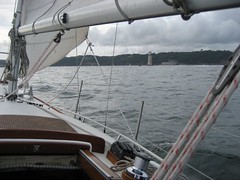
We finally went to sea on Saturday afternoon – Pete and I. A run to stretch the sails and check the rigging.  

I had planned to go on Friday but the weather dictates – and this year it is dictating more than average. It seemed that most of the boats in Plymouth were taking advantage of the sunny day. 


Uncluttered deck
The deck proved good to work on. The Folksong deck is uncluttered anyway, but painting it this colour with an uninterrupted non-slip surface makes it seem large. 


New grab rails
Also, placing the grab-rails around the edge of the coach roof has kept the coachroof free to walk on. They make good toerails when sitting full on the deck, and are not too high to sit inboard with feet on the toerails proper.


No.2 jib
The wind was dropping as the afternoon wore on. It was really a genoa wind but I wanted to try out the No.2 jib. This is a heavier sail and cut differently from the others. It also stretches the full height of the forestay, whereas the luffs of the other sails are shorter and their tacks can be raised with a strop to make visibility easier.


Plymouth Breakwater - high tide
Blue Mistress handled well but it kept her speed down and I felt a hint – (just a hint), of a need to compete when we joined the line of yachts returning in the early evening. We had sailed gently along the outside of the breakwater towards them, gybing round the lighthouse on its western end, just as a Contessa 26, a boat I remember admiring last year, powered by with spinnaker set. 

We have a lot more to do before we can look in that direction.