The same question

 (continued . . .)

The depth reading is less is 2 metres and falling, the gps says I am exactly on track. Despite my resolution a mile back, I am still following the numbers – and for a moment am completely confused.

The gps says there is a straight line and just to the next waypoint and it’s just under one nautical mile away. It’s on the screen. I want to believe it but I can see it’s wrong  Looking closely at the chart it says the channel crossed to the other side of the river about 100 yards back. I make the adjustment and realise the mistake. When I was entering the waypoints I missed one; even though I checked them, I still missed it . . . not good. (You have to do it to know it).

 (Click on image to enlarge)

DSC_4519

Although this is the only yacht I saw on this part of the river, part of the pleasure has been in the other boats. I will add them to the next post.

Continue reading

Drifting on about technology

 (Continued . . .)

The channel narrows and we pass close to ruins of the South Hooe Mine on the outside of the bend.

(Click on image to enlarge)

DSC_4491

All the way along the reaches of the Tamar from here was a busy mining area. In its heyday, more tin, copper, silver and arsenic were mined in this region than anywhere else in Europe.

The mines eventually ran out and the mining came to an end very suddenly in the late nineteenth century, the villages and towns emptied and Cornish miners spread all over the world.  In a small cemetery in Russell, New Zealand, I was very moved to find the grave of a young miner from Cornwall who died in the late eighteen hundreds. He had made the long voyage, found work . . . and died shortly afterwards, far away from home.

Once the mining had finished, the landowners landscaped the land and it was turned over to market gardening, but a number of remnants of the industry can still be seen – like these useful cuts in the bank.

Continue reading

Waypoints

(. . . continued)

Once through the bridge, I enjoy the scene that’s opening up,

Then the depth reading drops from 4 to 3 metres . . . then 2.5 metres.

The channel is wide here but I’m obviously out of it already.

The tide seems to be taking me down towards the entrance to the River Tavy.

The buoy I had failed to see turns out be a lot further towards the other bank than I expect.

I need to zoom in on the gps. At the level I had it – a  wider view, it didn’t show the loss of track in enough detail. It would have been fine out at sea, but not here where the margin for error is a lot less.

That’s one of the reasons I am doing this.

I look at the chart and sigh. I need to pay more attention.

(Click on image to enlarge)

DSC_4447

The buoy at last. The entrance to the Tavy behind.

Because I have neither the boat nor the money to navigate like this . . .

Continue reading

Rite of Passage

(continued from . . .)

I am watching the Udder Rock buoy further up the coast. The tide is taking us inshore and I head further out to sea to stay to the seaward of it.

This is the third day of this trip, finally a day of wind, sea and sail. The cloud cover is still low, clinging to the tops of the cliffs. There are no other boats visible and, despite being close to the shore. I can see no one on the coast path.

The early mist had given the harbour a silent, closed feel.

(Click on image to enlarge)

P1030375


Continue reading

Time to look around

(continued from . . .)

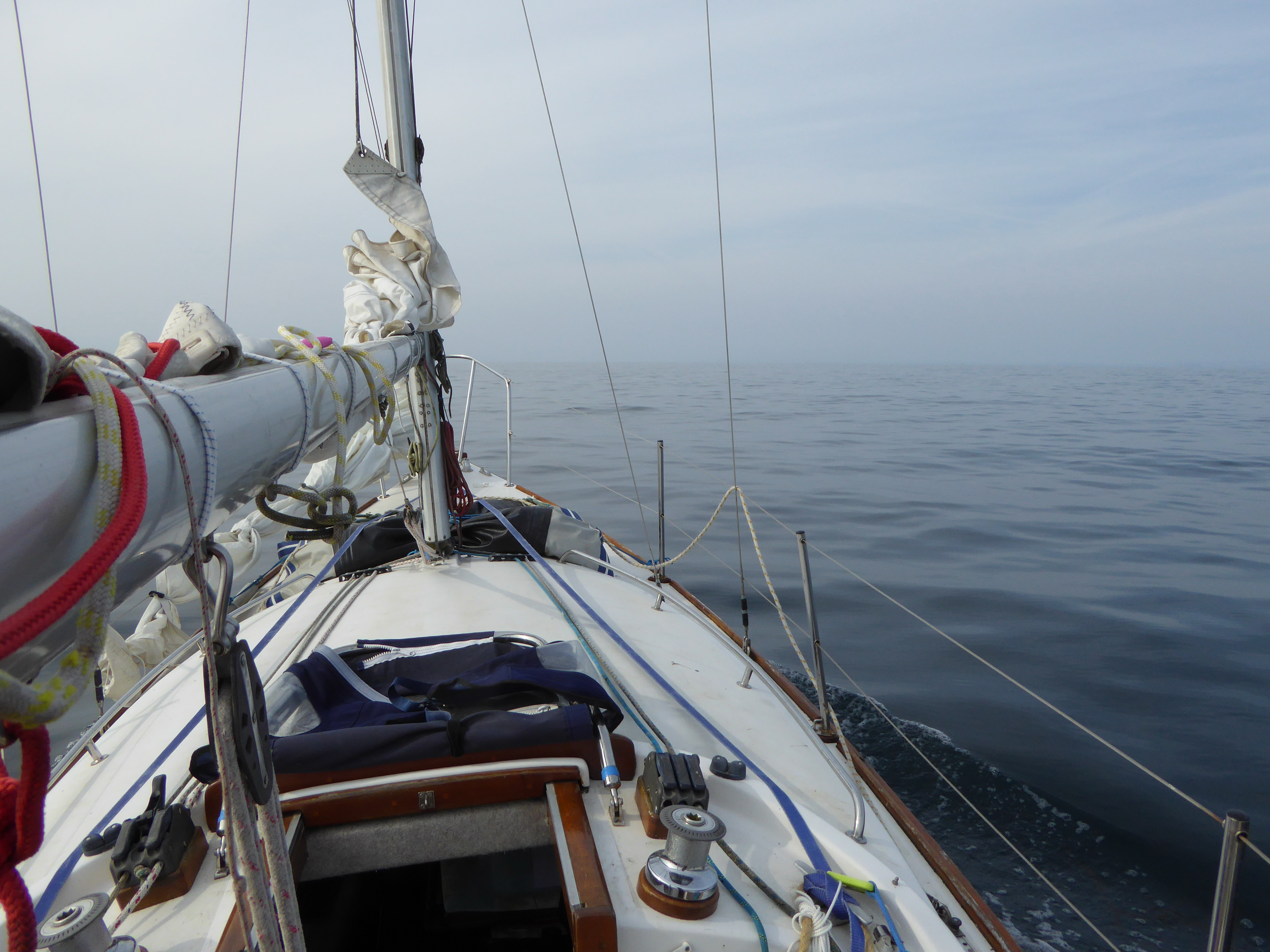
The weather is benign – so benign there is no wind and no sun either. The sea is glassy, the colours bluish grey, the sky and seas almost matching, the horizon sometimes clear, sometimes vague.

The engine gives a comfortable 5 knots, the distance is approximately 40 nm, I have six hours of fair tide. Time to reflect, time to look around.

(Click on image to enlarge)

P1030315

There are gannets, diving, resting, flying.

Continue reading

A voyage of my own

It has taken a while to get used to people saying “What? By yourself?” as in “I took the boat down to Falmouth and returned to Plymouth via Fowey? It was a quick three-day trip.” “What? By yourself?”

How do you explain it? To the uninitiated it invites the disapproval of

  • the safety industry – “the tiny crew”;
  • the health industry – “the older man on his own”;
  • the social industry – “all alone”;
  • the professionals – “a rank amateur”;
  • the bigger boats – “a smaller boat”;

Despite all of them I succeeded – as do many, many others in far more challenging circumstances.

It has taken many years sailing to be able to say with confidence “I do it like this. I know it is possible to do it like that but I have chosen to do it like this. Yes, the most knowledgeable of intellectuals, the most graceful of athletes, the most creative of artists, the grandest of grandees, they all know better than me. But not quite. Individually they know certain areas of my life better than me and combined they know many areas of my life better than me but the whole of my life belongs to me and I choose to live it like this. I will listen to them but I will make up my own mind whether it is useful for me or not. There’s no side to it, no competition, I respect their point of view but I am taking responsibility for me so I can give back what I learn as I go along.”

Time and money – (not enough of either), have meant that it has taken not months but years to bring Blue Mistress to her current standard – a standard that makes me comfortable in taking trips along the South Devon and South Cornwall coastline.

‘Single-handed’ means thinking things through long before they are needed. The layout of the boat, its contents and every maneuver that may or may not be made has been gone through in your head, maybe on paper, certainly on a computer, and books and videos and charts and tables studied, with the intention that all this be absorbed into experience.

Even then mistakes will be made – some of them very memorable with solutions needed in a breath-taking hurry, but mostly things will go right. Very few of the latter are memorable because what is going on outside the boat is as interesting as what is going on inside. Have you ever seen a coastline from the sea? The Devon and Cornish coasts are particularly stunning. (And, yes, there are plenty of other stunning coastlines too).

I like aloneness but enjoy company. A week ago we took my London-based, four-year-old grandson for his first trip. Enthusiasm on all sides. What’s not to like?

And every trip, every voyage is different.

I took few photos on the Falmouth trip but I will make a short storyboard next post. In the meantime, here is Blue Mistress in Fowey on the last day of September 2014 with the morning mist rising. As I say, what’s not to like?

Blue Mistress, Fowey

(Image taken by Bill Whateley)

(to be continued . . .)

A beard on a whim

I awake to an unfamiliar pillow. I touch my face and it isn’t the face I remember. A stranger looks back at me from the mirror. The post-shower drying ceremony has an extra twist.

Yes, I’m growing a beard. Three whole weeks without shaving my chin – hair is now covering the lower part of my face. Well, more of a stubble really – certainly can’t call it a real beard yet, but the end of the prickly stage, it’s beginning to catch the wind and I am constantly reminded that there is something there.

Continue reading

A taste of happiness

Early one summer morning, we went shark-fishing.

That’s not quite right . . . my dad went shark-fishing on a friend’s boat and I was taken along.

The friend’s boat, Sanu, was large, 62 feet large – a very solid wooden boat – a wartime-built tender for the Admiralty.

This was 1960. I was twelve years old. I had no idea what I had let myself in for.

There were several men and women on board. I was being allowed into the world of adults and I felt pretty good. This was a world where to be grown-up was to drink alcohol and to smoke cigarettes and to tell jokes that I didn’t really understand and where people used swear words when they thought I wasn’t listening. I liked my dad’s friends. They dressed casually, laughed a lot, were easy to be with. They were certainly different from my teachers and the other parents from school.

The fishing-ground was out of sight of land and took a while to reach. All was well till we got there. However, there are one or two things to remember about shark-fishing. Firstly, when the engine stops, the boat starts to go up . . and down . and up . . . and down in an unending, uneven rhythm. Somewhat disconcerting. Then there are buckets of rotting fish called rubby-dubby that are poured into the sea to attract the sharks. They have a disconcertingly distinctive smell about them. None of this is conducive with inexperience and a full breakfast.

Very, very quickly I started to feel clammy, my eyes failed to focus, my head spun. It must have shown because the next thing I remember, my head is being directed over the rail and my breakfast has been presented to the sharks. I must have been taken below to a small cabin smelling of paint (yes, really), a bunk with a large bucket on the floor. There were several times during that day when the bucket became a gaping hole that I would willingly have disappeared down. The sweat, the tears, the smell, the motion, the nausea. Death would have been a relief. I had nothing left inside to give the world. It went on and on.

At various times during the day, there was unappreciated sympathy – female only, and the occasional offer of a hot drink – “no thanks”. But for most of the next six hours I suffered alone, incapable and humiliated.

Late in the afternoon, I heard the engines start. The motion changed and we turned for home. The boat throbbed comfortingly. Dad came down to the cabin to see how I was. He got me to come on deck into the fresh air. I put on someone’s woollen sweater, several sizes too large, and a large oil-skin jacket which reached to my knees.

We sat together, him and I, behind the wheel house, out of the wind. We watched the evening sun catch fire to the waves and the seagulls wheeling and crying as they followed the fishing boat hoping for an easy meal. He told me about the fishing and the catch and there was no fuss – not once did he berate me for being ill. I loved him for that. I accepted the offer of hot soup – “It’ll do you good.” We both had a mug – mushroom soup and crusty bread. Looking back now, I don’t know what my dad and the others thought of me during the time I was below. They left me to get on with it and then talked to me as though nothing had happened. In my turn I have got older and passed through the age they were then. I became an adult in a different period of political correctness but an adult nevertheless. I would have treated me the same. I recognise the rite of passage they allowed me and thank them for it.

And the soup? Never, ever has anything tasted so good. It wasn’t the sea sickness I remember, it is the post sea-sickness – the happiness I found in spending that time with my dad.

~~~

As a post script, the last I heard of Sanu was a couple of years ago. She was high and dry on a beach in North Cornwall. The current owner was unlocatable and she was being sold off by the owners of the beach – the National Trust. This was the first time I learnt a little about her history. Now I hear she has been broken up. She was a special boat for a number of reasons, one of which was very personal to me. The story of Sanu’s demise can be read here, here, here and here.


Headland

The grass here is sparse. It is not the lush green grass of a farmer’s field nor the tight tidy grass of a football pitch. No, this grass is short and stiff and twisted by the weather, the ground around it full of stones. Despite the odds against it, it grows on this small headland, facing the Atlantic Ocean and the prevailing south westerly gales – gales full of salt air and storm-tossed water. And when the wind stops blowing and the rain stops raining, the sun shines equally fiercely, parching it dry as a bone. Standing here we stand on an apparently unpromising bare patch of ground, but . . .

I came here first as a child on my father’s shoulders. We would climb the narrow path from the valley where we lived, one step at a time, no room for a stumble. On our left side, the higher we rose the steeper the slope, till it fell away altogether to become a vertical cliff dropping to the rocks below. On our right, rocky outcrops allowed little room to lean inwards.

We would reach the headland, him slightly out of breath, me exhilarated by the ride. The view was what we had come to see. Behind us, we could look down to our home in the valley and follow the lane inland until it was lost in deep woods – woods that led our eyes up to the solid church tower marking a village several miles away.

South to our left, we admired a coastline with row upon row of sea-hewn rocks stretching out into the surf. Depending on the weather and the tide, they could be lines of sharp, bare, reptiles teeth, or, in a storm, ragged fangs beneath a constant whirl of spume, broken water flying in the wind.

Straight ahead to the west beyond the horizon was Newfoundland – or so my Dad said. What I saw was sea and the horizon and the sky and “see the ship, Bill?” – occasionally the whole ship on that distant line, more often the smudge of a funnel. This was not a place where ships came close to the shore. It was a wreckers’ coast, where, in the nineteenth century, many sailing ships came to grief. There is a wreck immediately below this headland. I have never been sure of its name but there is an official record of a wreck that may fit: on 29th March 1878, St George, a schooner out of Looe carrying copper ore to Swansea “was lost in a NE force 9 gale accompanied by heavy snow, the crew saving themselves in their own boat after the vessel drove ashore on the rocks near Morwenstowe at 4 am.” The official record continues sparingly: “This schooner was wrecked during a snow storm at Morwenstowe, happily all on board were saved.” – surely an understatement.

If I seem to be talking about the past, I am also talking about the present. This is as much about now as then. The headland, the valley, the cliffs and the rocks are still there. That horizon also remains but now heralds a wider world beyond. My memories of my father and everyone else I have climbed the path with are still there. And those intense moments shared by the crew on that snow-laden night in 1878 still hang in the air. They survived. But there are many others who didn’t and whose spirits still inhabit this coast. They have never left.

And there’s more – another level to this place, a level not grounded in the past but very much delving into the future. Glancing north, we look down into a grey pebbly bay, the very bay where the St George came ashore. Our headland forms the southern end of this bay, the cliffs that back it rising high over where we are standing. If we lift our eyes, we can just see, peering over the cliff edge to our right, the white lips of two giant dishes, two of the many aerials of a large and reputedly vital communications tracking station. Wide and deep are the search capabilities therein. Its satellites span vast tracks of the planet. We are not allowed to know what goes on there. But whether or not we do ever discover what does go on, the fact of its presence and the products of its endeavours will surely affect us and our children and their children. Technology, including the technology I am using here, inevitably governs our future. It has been a long time since I could tell myself this point of land was unspoiled by man.

This place I am writing about, where past and future meet, is Steeple Point.

This is my source. This is Cornwall. This is where I was born.