This afternoon, at the eastern end of the Breakwater, we met Alert putting to sea.


~~~
For the origins and full set of images in this series, here.
This afternoon, at the eastern end of the Breakwater, we met Alert putting to sea.
~~~
For the origins and full set of images in this series, here.
Seb writes that he has bought Mischief.
Found her in a yard at Calstock on the River Tamar.
There is work to do on her but “her hull, decks and mast are sound; she has new standing rigging; a good set of sails etc.”

“Her interior is completely bare however (pure, as the previous owner put it), with no through hull fittings other than the engine water intake, but she does needs a lot of work done on her interior”

He is doing some immediate work on her “. . . gave her a good scrub; fitted a new fore hatch; refit the genoa tracks; tinkered with the engine . . .”


“I will be taking Mischief to Portsmouth from Plymouth as soon as she is sea worthy.”
Seb has plans for Mischief and originally contacted me about self-steering gear:
I posted on this and two useful links came back – thank you again for those. In the meantime, he (Seb) has noted:
“It seems that few Folksong’s have been fitted with mechanical self-steering gear, so I have been using the Contessa 26 as a source of information regarding the suitability of wind-vanes (given that they are both loosely based on the Folkboat). So far the Windpilot pacific light servo-pendulum gear, or the Hydra Autosteer trim-tab system, seem the most likely candidates, mainly due to their weight and cost.”
My choice would be the Pacific Light but that’s based on study and other people’s preferences – not practical experience.
Here is a clip of one in action following last year’s Jester Challenge.
“Crossing Lyme Bay after returning from 2 months away on Jester Challenge to Azores. Big following sea and wind around F5.”
I’m sorry, I don’t know who made the clip – perhaps somebody could let me know so I can thank them personally.
Any further comments would be welcome.
And Calstock looks the perfect place to find a Folksong!

Talking of tides and waves (here and here):
The ebb tide is running fast leaving wakes trailing from both the buoy and the fixed mark.
The buoy is floating, attached only by its anchor line. The water is passing more or less unimpeded below it, leaving a clean wake; whereas the fixed mark totally disrupts the flow, resulting in very confused water downtide.
Between the two, you can see the wake from another buoy – dying down but still confusing both of the above wakes.

A short while later, the tide has built up enough to submerge the buoy.
In the foreground are eddies from the uneven bottom, causing smooth upwellings of water.

Should we be interested in this?
Aren’t the two images merely pictures of a spring tide ebbing?
Well, it’s a matter of scale. If we want to know more about the sea, this is a good place to be.
Now we move on.
Below is a an image of Ham Stone, between Bolt Head and Bolt Tail on the South Devon Coast.
The effect of the rock on the tide can clearly be seen. Although the tide is not running as fast as in the images above, the water will be confused here especially at the border with the main flow. However, for a small boat, there will be temporary shelter from the main flow of the tide.
In fact, this boat is fishing downtide of a wreck on the sea floor, the disturbing currents attracting food for the fish, the fish attracting the fishermen.

Ham Stone, South Devon
Compare this with another phenomenon – this time rocks interrupting the swell.
These are waves in motion over the surface of the sea rather than the sea itself being in motion.
Instead of causing the waves to spread outwards, the drag effect of the rocks causes them to slow down and swing inwards, so that the sea is confused on what might have been the sheltered side.
Even if the water was deep enough for a small boat, there would be no shelter from the swell here.

Rocks between St Ives and Zennor, Cornwall
In practice, what happens around the coast depends on the swell, the tide and the size of the various obstructions, whether above the surface of the sea or on the seabed – (not to mention the weather).
So, let’s up the scale again.
The fishing boat on the right has chosen to go between the headland and Godrevy Light, avoiding the long haul out round the off-lying reefs.
It’s about one hour after low water and the tide is running against him – the direction of the tidal stream can be seen to the right of the island

Godrevy Light, Cornwall
It’s running faster between the island and the mainland than further out to sea – but nowhere near fast enough to hold him up.
Although, as you can see, he is having to work at it.

At the western end, the swell is swinging round the end of the island against him, just as in the image of the rocks near Zennor.
He is keeping well over to the right to minimise the effects.
And when he leaves the local effect of the island he makes appreciably faster progress towards his home port.

It’s a matter of scale.
The sea is doing its thing on a vast scale – slopping around the planet under the firm but distant control of the moon and the sun and the vagaries of the weather.
For the most part, we see it locally – we watch it, we study it, often we eulogise it (as you will see in the next two posts), but in the end we have no control over it.
The fisherman chose his time according to the tide and the weather.
He could not choose the tide or the weather to suit his time.
There are a few occasions in the year when my journey to work coincides with sunrise.

from Labrador Bay, 1st December 2009
These are the ships I mentioned in a post from Southwold last September – still there, still waiting for trade.
I have learnt more about them since, in particular the concern they have created in some quarters – here.
~~~
Fifteen minutes later, five miles further on, the sun higher, the perspective lower, the same ships . . .

from Meadfoot Beach, 1st December 2009

The row out to the boat was shrouded in the morning mist – the top of the tide increasing the deep silence over still water.

Others were busy too. It was the annual mooring shift to allow the Cattewater Harbour Commission to lift and reset the moorings – a valuable service that gives peace of mind but requires some swift work to oblige.

The buoys are stripped of their usual tangle of lines and shackles, most of which have been there all year. As a result the pins are usually well and truly fast.

In Blue Mistress’ case this is not altogether true. We lost a pin due to a poorly moused shackle earlier last autumn, so there is one new, easily removed shackle. In fact all three of the shackles on our stern buoy (above) were relatively easy to remove but the two on the bow buoy were jammed. It required a very large spanner, another one jammed in the shackle to hold it still and two of us to lean on it. Thanks to Freya’s skipper for his foresight and help – I promise to buy a bigger spanner next time!
~~~
When I looked up the fog had lifted and the rowers were out.

It seemed to good an opportunity to miss, so I motored down to the end of Mountbatten Pier in the sunshine, catching “Sweet As” returning from an early morning fishing trip.

The emphasis then came on lorries parked for the weekend – here below the mark (DirFRWG),

and here in gentle salute on the Cattewater Wharf.

I was expected in Exeter this afternoon but checking the boat after the snow, the frosts and the rain of the past two weeks was a priority, so I seized the moment this morning.
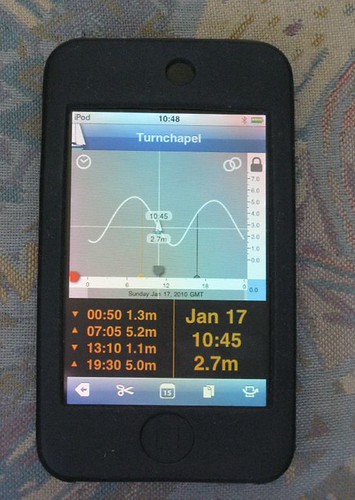
The drive to Plymouth is about an hour and I got there about 10:15. By the time I had pumped up the dinghy, talked to the man who was going fishing in his ocean kayak and taken some photos, it was about 10:45 when I finally arrived aboard.

There is debris in the river from the heavy weather. In general, it floats past, but occasionally snags boats that are moored on the trots.

The mooring lines were as I had left them two weeks ago. There were no loose halyards. The sail cover was still firmly in place – it is too short and I have promised myself I will get one the right length one day. In the meantime, the boom end is covered by a square of canvas.

She looked neat in the morning sun.

The ten minute row demanded a small celebration.
Then start the engine (it fired first time!) and a look around before getting on with the several jobs I had planned:

The seagulls were enjoying the sunshine;

the fine house on the Cattewater shore was still overwhelmed by her industrial neighbours;

the boatyard on the opposite shore was the usual marvellous jumble of work-in-progress;

and the rowers were taking advantage of the weather.
A good day for a sail. Pity I had to return so soon.

1030, Sunday 13th December
My first sail since the end of October.
Blue Mistress has ridden the storms reasonably well.
The forehatch has sprung a small leak. The sail bags are wet.
We have lost not one but two shackle pins on the stern lines.
Poor mousing on my part – (yes, I did use wire), and not helped by the vastly increased run-off of water from Dartmoor into the Plym.
~~~
The wind was easterly this morning and gusting. I left the Sound through the eastern entrance and sailed happily south – course 180 degrees (M), until Dodman Point opened up in the west.
I turned for home about 1330.
There were one or two boats sailing and a number of small fishing boats. Mostly I had the sea to myself.

Looking towards Devon in the east to Great Mew Stone and the entrance to the Yealm

and towards Cornwall in the west – Rame Head with Kingsand and Cawsand on the right of the picture.
~~~
The wind decided to back towards north which was exactly wrong for re-entering the Sound.
I was concentrating on clearing the eastern end of the Breakwater, when four dolphins appeared from nowhere . . .

They were intent on play, appearing randomly around the boat, racing passed or lazily rolling under the keel.

As they levelled with the cockpit, I could have touched them.
Delighted, excited and entranced, the tiller in one hand, the camera in the other, I took lots of images – mostly of freshly disturbed water.

They lead me on – (note the rapidly approaching conical mark on the end of the Breakwater), and, when I looked up, I had missed the entrance and had to tack very quickly.
My new friends immediately disappeared, and I was reminded of the Sirens of Greek Mythology.
“OK, guys, joke over.”
250 yards on, I tacked back and there they were again.
They escorted me to the entrance to the Sound, before swimming off – no doubt chuckling all the way back to sea!
~~~
I was asked last week why I hadn’t taken my boat out of the water for the winter.
There’s your answer.

A perfect sail yesterday – sunshine and steadyish wind (maybe needed a little more for absolute perfection).
Starboard tack out through the eastern entrance to Shag Stone, then a close reach to Cawsand.

Plenty of other boats out.


We anchored for an hour or so’s picnic close inshore, a short distance from Cawsand and Kingsand

And enjoyed the run home to Cattewater wharves. picking up the mooring around 1700.
Good sail, good company. Thanks, guys.
We sailed round to The Yealm thinking, if we got it right, we could have lunch in Newton Ferrers. I wasn’t familiar with the river and certainly not sure about the tide – a high spring tide which would still be ebbing when we got there. The wind was from the west.
Leaving Oreston just after the top of the tide, we made fast progress even though the wind was light.
There is a wind level – low Force 2-3, when Blue Mistress‘ weight and shape tell against her when compared with less heavily keeled boats. A couple of yachts passed us in style.
We enjoyed the sail, boiling the kettle and making tea, talking of this and that.
However, rounding Great Mew Stone with plenty to spare, we had to concentrate as we headed into Wembury Bay on a dead run, the genoa goose-winged to port.
There seemed to be more wind here and we occasionally surfed as the sea and wind piled up against the tide pouring out of the Yealm. The sun reflected off the tops of the waves and boats not too far away disappeared hull down, to rise immediately on the next wave. Several boats were motoring out from the river, lifting their bows and showing their keels, as they worked into wind and sea.
We followed a boat ahead who seemed to know where she was going and watched as the foresail came down and she disappeared into the narrow entrance.
Our turn next. Not wanting to risk any sail inside, we lowered the genoa first, Charles negotiating the tricky task of keeping it inboard. Then into the wind, momentary chaos and the main came down. Then, boom secured with mainsheet, a few minutes of grabbing, rolling, hurriedly tying flogging canvas – a less than neat job (below) but good enough on a moving deck.
We motored past the bar, watching the tide flow round the two port hand buoys before following the leading marks across the river, then through the many moorings to the first pontoon.
Choosing the outside of the pontoon to avoid the possibility of rafting, we accepted the weight of the tide would hold us against it. I hadn’t bargained for just how strongly it would hold us. The direction and force of the outgoing tide can be seen in the image below. Mooring lines were almost superfluous. Getting off would obviously be interesting – but first thing first – lunch.

It was good too -:)
It was about 1400 when we got back. Low tide at The Yealm entrance was 1500, giving 0.8 m clearance above LAT, enough for us if we kept to the narrow channel.
As expected. the weight of the tide was still holding the boat against the pontoon, but it had slackened enough for the two of us to push the boat off and move our large round fender to the starboard quarter. Removing the mooring lines had no effect. A combination of heavy push with boat hook at the bow and gentle astern on the engine with the tiller to port, brought her quarter onto the fender and her bow away. Briskly forward on the throttle and we left the pontoon headed upstream looking for space to turn – briskly because there is a certain point when the tide will catch her and she turns downstream whatever I do – in this case it would have been into the cruiser moored astern of us.
The ferryman had mentioned that they would be playing cricket on the sand bar today to celebrate the particularly low spring tide. The short entrance to the river is very narrow, a few yards wide, rocks on one side, sand bar on the other. The light surf was clearly visible on the exposed sand bar as we crossed the river towards it.

Yealm sand bar – Great Mew Stone behind
There were yachts moored in Cellar Bay as well as many dinghies on the beach. People were on the sand bar – the whole area a hive of activity.

Yealm sand bar – exposed at low spring tide
A few minutes later we were through the entrance into an altogether different sea to the one we had met in the morning.

Yealm entrance – the extreme right hand yacht is in the channel.
Sailing close-hauled across the Bay towards Great Mew Stone, we noted the exposed Inner and Outer Slimers, tacked across to clear the Western Ebb Rocks, tacked again before we reached them, cleared Mewstone Ledge and eased away onto a close reach across to Cawsand. Then home on the incoming tide.
It was one of those days. No broken records, no prizes, just a great day sailing.
I went down to the boat on Friday evening to spend a few days on board.
The following morning, having worked out the early routine, I made a cup of tea and sat with my head out of the hatch to enjoy the peace in the morning sunshine and watch the tide as it slackened towards high water. Today was the top of the spring tides – (0903, 5.4m; the still higher 5.7m due just after 2200). I cannot remember seeing the level so close to the top of the Cattedown Wharves (below).
A blast on a ship’s horn and the bow of Bro Deliverer, registered in Goteborg, appeared from behind the sheds – adding a different shade of blue to the scene and totally changing the perspective. A tug and the pilot boat tripped alongside her.

0756
She nosed into the turning area and came around stern first. The tug scurrying around while the pilot boat stood off with an air of dignified watchfulness.
A yacht motored briskly out of the Yacht Haven, promptly eased off and drifted gently, waiting for the ship to slip up river stern first.
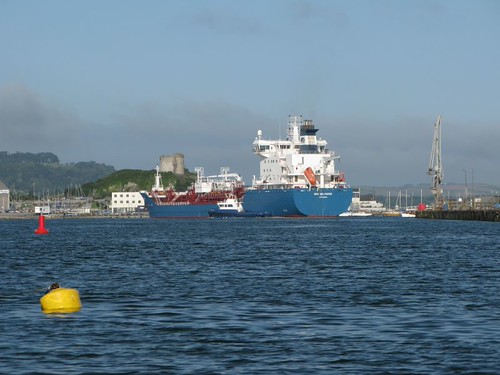
0800
A few minutes later, a pleasure boat left its berth on the outside of the Yacht Haven pontoons and hurried around her bow to pick up its first passengers of the day.
Meanwhile, Bro Deliverer came level with the wharves and, with a little help from the tug, eased sideways into her berth. Lines were thrown and she came to a stop, dwarfing the cranes and sheds.

0815
All was over in 20 minutes or so – a well rehearsed routine, neatly accomplished by the ships crew, the crews of the tug and pilot boat as well as the shore crew.
My brother rang at this point to say he was five minutes away. Time to row ashore.
 Beyond Steeple Point