9a/14 True art or painting-by-numbers

Water's edge - Teignmouth 2006

Having completed the fourteen posts I had set out to write and not yet being satisfied, I am going to insert this as an extra post to see if it helps.

I awoke in the middle of the night not thinking about the practice. So there has been progress of sorts.

What I was thinking about was how to describe in non-digital terms the face-to-face relationship I have been highlighting when I am actually using a digital medium. If I fail to do that then my argument fails and, in my small world, digital technology will have taken over at the expense of a core relationship.

~~~

In the previous two posts I have produced two linear images to demonstrate the continuum of a relationship where ‘Trust’ is at the top and ‘Vindictiveness’ at the bottom. The images consist of straight lines with the various stages marked at more or less equal intervals along the line. In computer-speak, this is a simple algorithm. Algorithms are extremely useful tools from which we can derive policies, protocols and procedures. They have become an essential part of almost every language I have previously mentioned.

However, this way of looking at life has no place in the human relationship I am talking about. There is are complex patterns and rhythms in human relationships. It could be likened to the difference between painting-by-numbers and true art.

In painting-by-numbers an outline drawing is created for the “artist” and a number is assigned to each separate area of the drawing. Each number represents a particular colour and the “artist” is invited to fill the areas in the drawing with that colour. He/she can follow the rules exactly or, if they are feeling a little freer, he/she can change the colours and even meld different areas if they so wish but nevertheless the work is confined to the prescribed drawing. This is how basic software works. However sophisticated software has become (and it has become very sophisticated), the actions of the “artist” are defined by the software. In producing this series, I have used Scrivener, WordPress, Freemind and ACDSee imaging software. I like them all because I can use the framework they provide to put on screen what I am trying to say. The problem is that the very thing I am talking about is even more sophisticated than the software I am using. Hence the painting-by-numbers/true art analogy.

A true artist is faced with a blank canvas. Which colours and where, when and how he/she applies them is entirely a matter between brain and brush. The result is instantly available only to the artist and those immediately present. The purpose of the exercise is to produce a work of art. The quality of that work is confined to the artist and a few others. Dissemination has to wait and in most cases may never happen. So with face-to-face relationships. The quality of the relationship is between the participants and it is for them to value it or not.

To take this further, I have likened a relationship to a painting. However a painting has borders. If we think of it in terms of music then the borders fade away. There is an infinite variety of choices from single notes to complex chords, from quiet to loud, from short notes to long notes and every combination between. The potential is more or less infinite. The extent of the composition is confined by the composer/s.

Mendelssohn wrote that ‘music cannot be expressed in words, not because it is vague but because it is too precise for words’. Man has spent eons trying to put words to relationships – defining and redefining them. The problem is the human condition. When one physical, emotional, intellectual and spiritual being with all their physical, emotional, intellectual and spiritual strengths and weaknesses meets another physical, emotional, intellectual and spiritual being with all their physical, emotional, intellectual and spiritual strengths and weaknesses, a work of art ensues – it’s value is between the participants. Do you always need to break the resultant interaction into some defined chemical reaction or do you let it germinate and grow? There is a reason for both.

The problem is that the scientific intervention to break it down in the form of digital technology has the means to take the art out of the relationship and my comment is (and please feel free to prove me wrong) that digital technology has so impinged on the language of all sections of society as to be a detriment to the face-to-face relationship that is the core relationship of humanity.

~~~

Although it can be read as a single post, the above is part of a series that illustrates one of the author’s current interests, taken from a locker full of interests, at a major waypoint in his life. The series sets out as a comment on retirement before focusing around language. He wonders whether he himself has the language to cope as he steps out into the wider world popularly known as ‘retirement’ – an irreversible step into a world that he has previously only glimpsed out of the corner of his eye, a world in which he thinks the word ‘retirement’ to be a misnomer. He has used the medium of the blog to paint the picture. The irony is that, whereas writing about it does allow him to reflect, sitting alone at a computer actually distances him from the face-to-face interaction he is describing.
Wave - Bude

9/14 A negative language by default?

Rough - Teignmouth 2014b

So far, so easy. Now it gets more difficult.

In my previous posts, I have been talking about language – the way we string words together. Now I want to point out that I am also talking about attitudes – patterns of behaviour shaped by the language we use towards each other. I am using the concept of a continuum as the outline for a particular language (and hence the pattern) that I want to highlight.

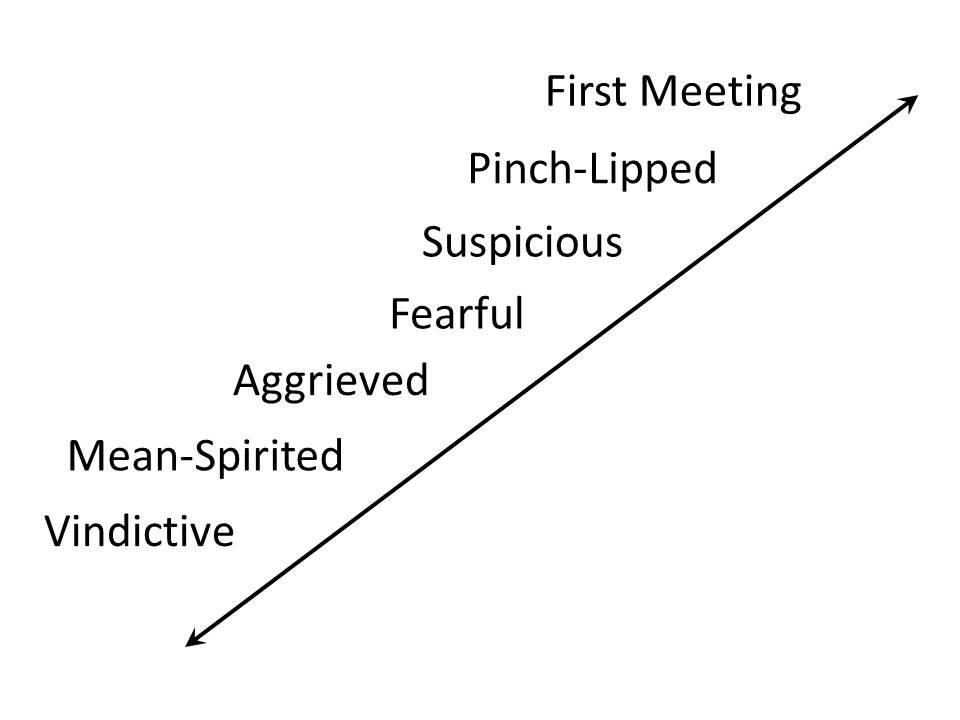
So . . . if the positive end of the continuum runs upwards from a central point of the neutral meeting, leading to rapport, then understanding, then respect, then trust, (see the previous post), then the negative end of the continuum could be said to descend from that same neutral meeting to being pinch-lipped, suspicious, fearful, aggrieved, mean-spirited and ultimately vindictive.

It is extremely simplistic (not to say arrogant) to try and sum up human behaviour in a straight line. I apologise. I am trying to paint a picture and I have to use words to do it. If the individual words resonate with you then mark them but try and keep the whole picture in mind.

Thus the negative side of the continuum looks like this:

Losing Trust

I suggest that it is very easy to slide from being suspicious to being fearful and aggrieved and, if there is no resolution, then to becoming mean-spirited and ultimately vindictive. Look around you, read the newspapers, watch the news on TV. It is the vindictive end of the continuum that causes the headlines.

However, I wonder if this is so because we expect the other end, the respectful end, to be the norm and the vindictive end to be an unfortunate but rather exciting aberration – containing attitudes that we can explore and exploit because we are assured that all is well really.

The attitudes in the continuum are natural human ones but some are more productive than others in building the civilised, trustworthy, caring society I mentioned in an earlier post. My concern, and the only reason I am pursuing this, is that our breaking down of society into sections, each with its own language, each promoted with increasing success, has resulted in our beginning to neglect to maintain “understanding, respect and trust” across society as a whole and we are in danger of becoming a pinch-lipped, mean-spirited, vindictive society by default.

In the next post, I will put this into context and give a specific example of why I think this is happening.

~~~

Although it can be read as a single post, the above is part of a series that illustrates one of the author’s current interests, taken from a locker full of interests, at a major waypoint in his life. The series sets out as a comment on retirement before focusing around language. He wonders whether he himself has the language to cope as he steps out into the wider world popularly known as ‘retirement’ – an irreversible step into a world that he has previously only glimpsed out of the corner of his eye, a world in which he thinks the word ‘retirement’ to be a misnomer. He has used the medium of the blog to paint the picture. The irony is that, whereas writing about it does allow him to reflect, sitting alone at a computer actually distances him from the face-to-face interaction he is describing.
Gale - Millook 2007

8/14 A language that heals

Smooth - Torpoint 2006

This series has developed into a comment on language. I have made some general statements; now I want to be more specific.

I have recently retired after forty plus years as a dentist. One of the privileges of being a dentist – (or doctor or any other health-related professional), is that you spend your days meeting a succession of individuals. Each one is a solid, whole, complete human being – a physical, emotional, intellectual and spiritual being with all his/her physical, emotional, intellectual and spiritual strengths and all his/her physical, emotional, intellectual and spiritual weaknesses.

We face this person with all the knowledge, skills and attitudes of our profession that we can muster, knowing that science does not yet have answers to every aspect of their being nor technology the solutions. And, however experienced, I too am a human being with strengths and weaknesses of my own and, as such, not totally master of the art of caring for this person. (This might appear negative but bear with me).

So there we are, together in a room, trying to sort out problems and find solutions. In the dental surgery, these problems, whether current or potential, are predominantly physical. However, all the rest – the intellectual, emotional and spiritual aspects of the person, come attached.

Not only that but there is a third person in the room – a nurse, with strengths and weaknesses all of his/her own. The three of us could be described as imperfect people living imperfect lives in an imperfect world. And yet, in order to make the interaction worthwhile, we have to find a way of building a productive professional relationship.

Where on earth do you begin?

In the last post, I talked about language, the way people address each other, how languages have become digitalised and how, as a result, the language used by certain groups of people can grow to dominate the language of other groups. There is a constant evolutionary competition where at any one time the language of, say, economics, overwhelms the language of, say, politics, or vice versa.

However, there is a universal language, a particularly important one for the healing professions because it works towards the aim of their particular relationships – to leave the person in better health than when they first met. It is a non-digital language well-known to the physician.

Relationships ebb and flow. However well you get on with someone, you are closer at certain times than at others. Thus there is a sliding scale – a continuum, in a relationship. We tend to be more aware of this in negative situations but it is a common characteristic whether the relationship is positive or negative.

Starting with the time when we did not know this person at all, our first meeting is hopefully a neutral one with no prejudgment. (This is not necessarily so. For reasons stated in the last post, we are already prejudging to a certain extent).

In a positive relationship, the process runs from that first neutral meeting to an initial rapport between the parties, from which emerges a mutual understanding, blossoming into mutual respect and finally a degree of trust – but not necessarily total trust in every aspect of the relationship. (I love you dearly but I probably would not trust you to sail me round Cape Horn!)

Building Trust

Nowadays trust is treated as a right – a label acquired automatically. In reality it is a value that is earned, hence the word ‘trustworthy’. We must go through those stages of rapport, understanding and respect to get there. It is an ‘uphill’ task. Going downhill is much easier. We can lose trust but still retain mutual respect, or lose respect and still retain an understanding of the other person. The relationship is less close but still positive because trust is a result, understanding is the key. And we get to understanding by actively looking for some initial aspect of mutual sympathy or empathy – (that initial rapport) with the other person. This may emerge naturally but more often comes from an opening, an expression of a mutually recognisable idea or feeling provided by one party or the other.

Of course there are specific languages in medicine and dentistry – full of specialist jargon. These should be reserved for doctors, dentists, nurses and everyone else in the health professions. However, the language above is the language of the true physician. It is a relationship-based language, reaching out to individuals, actively working to build relationships that heal.

~~~

In the next post, I will show that the continuum has a negative side to it, one that is much easier to attain. And I will ask the question, “Which end of the continuum is better?”

~~~

Although it can be read as a single post, the above is part of a series that illustrates one of the author’s current interests, taken from a locker full of interests, at a major waypoint in his life. The series sets out as a comment on retirement before focusing around language. He wonders whether he himself has the language to cope as he steps out into the wider world popularly known as ‘retirement’ – an irreversible step into a world that he has previously only glimpsed out of the corner of his eye, a world in which he thinks the word ‘retirement’ to be a misnomer. He has used the medium of the blog to paint the picture. The irony is that, whereas writing about it does allow him to reflect, sitting alone at a computer actually distances him from the face-to-face interaction he is describing.
Sun on water - Fowey 2008

7/14 A mix of languages

Tide - Teignmouth 2009

When I talk about language, I do not mean the culture behind a language. Nor do I mean individual jargon words. I mean the way words are strung together – the string of words people speak and the string of words they hear.

What people say and what they hear have always been slightly different but now the gap between what is spoken and what is heard has, in many cases, become a yawning gulf. We consistently talk at cross-purposes. Understanding each other is becoming a major complication in a time when the complexity of modern life demands that we do understand each other and are able to work together.

The days when language was predominantly concerned with national identity or religious identity are gone. Now there is a polyglot of tongues all competing for a place in society, ebbing and flowing between themselves.

As I was growing up, language was pretty well defined – not just the over-riding languages of national identity (English, French, German and so on) but the more subtle range of languages within those national languages – the languages of organised religion, politics, law and order with its legislation and formal legal system, the languages of economics – business, commerce and finance, the languages of science and art, academia and health, not forgetting the language of conflict and war. This was the post Second World War period when we needed to respect languages and work together as the country got back on its feet.

In the sixties, this began to change and other more social languages were added to the mix.

So now we have the languages of equality and human rights, ethnicity, gender, sexuality, generations, aging and retirement, health and well-being and, with the growth of the corporation, corporate language and the language of regulation and dispute – and so on.

And we have increasingly adopted the languages of digital technology, the social media and gaming – languages that are changing and developing at a far, far greater rate than any of the other languages. Moreover, we express ourselves more and more through this digital technology.

Digitalising means converting communication into numbers and code. Putting numbers to ideas and objects implies a precision that may or may not be there in reality. We can now ‘speak’ the above languages in digital form. The power of digital technology gives each language a life and power of its own. The danger is that the increasing specialisation that results divides us rather than unites us.

We need  technology but we need it to feed humanity not humanity to feed technology. The problem is how do we maintain stable human relationships in a society which has put its trust almost totally into digital technology. a medium in which the speed of change makes it inherently unstable?

This is the crux of my argument: all the ‘languages’ mentioned above will continue to evolve in the developing face of technology. However, at the same time, we need to continue to develop and respect the non-digital language of face-to-face relationships. Because this is the core language of humanity – the basic unit of human interaction. 

~~~

Although it can be read as a single post, the above is part of a series that illustrates one of the author’s current interests, taken from a locker full of interests, at a major waypoint in his life. The series sets out as a comment on retirement before focusing around language. He wonders whether he himself has the language to cope as he steps out into the wider world popularly known as ‘retirement’ – an irreversible step into a world that he has previously only glimpsed out of the corner of his eye, a world in which he thinks the word ‘retirement’ to be a misnomer. He has used the medium of the blog to paint the picture. The irony is that, whereas writing about it does allow him to reflect, sitting alone at a computer actually distances him from the face-to-face interaction he is describing.
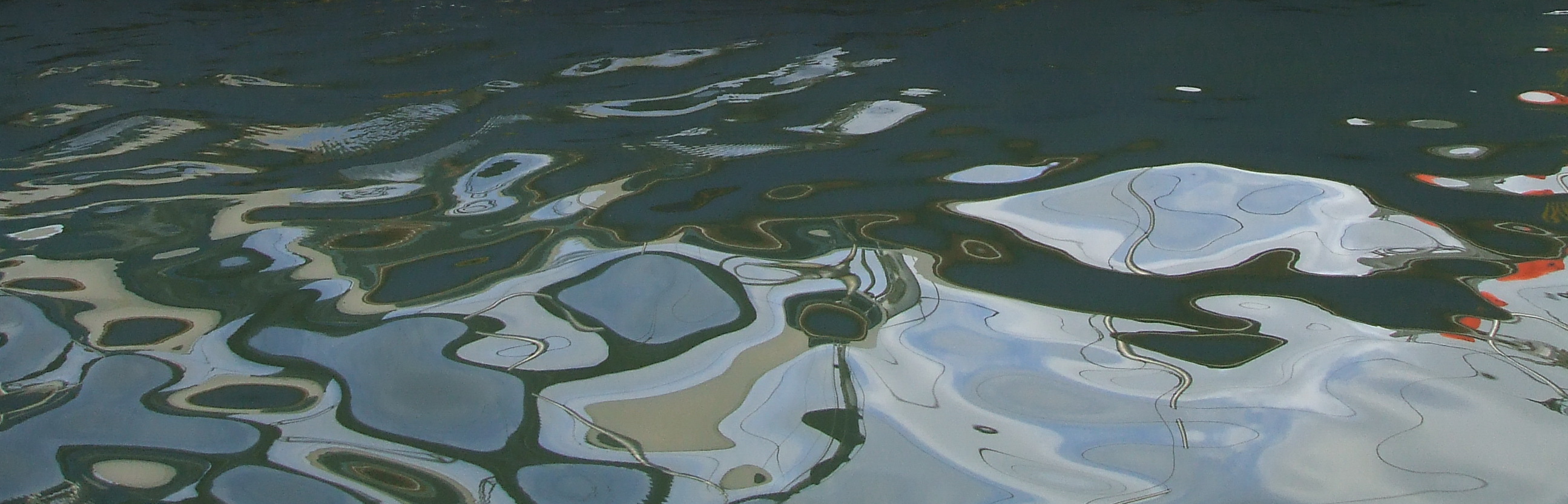
Turbulence - Torquay 2007

6/14 A Matter of Language

Ripples - Rethymnon 2009

I’m in a similar position as everyone else who finishes their day-job. I worked in the same disciplined fashion for over forty years and now I’ve stopped. I want to move on to other activities with a different way of working but my mind and body are still geared to my previous life. I am still thinking in “dentist language”.

The job was intense. My days were spent developing close professional relationships – closer than in many other occupations; not just intellectual relationships but relationships with strong physical and emotional elements too. You’ve been to the dentist, you know what I mean.

You might also recognise that the relationship your dentist has with you is different from that with the patient before you and different again from the patient after you. Indeed, it may be different with you from the last time you were there. A dentist spends the day riding a constantly shifting pattern of relationships. It is a deeply rewarding but intensely demanding career. After forty years, enough is enough.

As I keep mentioning, shaking it off is taking a little time. It is easy to slip back into ‘professional’ mode. Dentistry is about health, comfort, function and appearance. It covers a wide range of knowledge, skills and attitudes that spread well beyond the surgery. I won’t lose those interests, but I haven’t been away from them long enough to get used to this new way of using them.

And, as I begin to stand away, keeping a sharp look-out for rocks and shoals, I once again notice the language I am using – (the insistently nautical one!), and the way I am using it to describe my current situation.

The use of language has been a constant interest and increasing concern in the last few years because I – and I am sure many others in the health professions, have become increasingly aware that the language that we use in everyday practice has evolved away from the language we originally learnt to use to build trustworthy, one-to-one relationships – those relationships which we, as patients, reach out for when we seek professional help – (yes, I am a potential patient as well as a professional)

What I am describing is a natural evolution driven by the effects of modern life:

  • The complexity and expense of new technology;
  • New developments occurring at shorter and shorter intervals;
  • Each new development uncovering yet more challenges requiring still more solutions;
  • Each solution having little time to bed in before the next new solution takes over;
  • With the result that we are being pushed and pulled in different directions without fully understanding the issues;
  • Understanding comes from being fully informed. Unfortunately, the sheer volume of information we are presented with under the guise of transparency and clarity has created a situation in which transparency and clarity are beginning to lose meaning as they bemuse, confuse and ultimately inhibit the interest of those they are designed to inform;
  • And, crucially, the language and culture this invites directly affects the building of those above-mentioned one-to-one relationships between professionals and patients.

In the newspapers, on television and online the cry for solutions is increasingly driven by extreme language – language that excites the excitable and upsets the vulnerable, with the result that society appears to be increasingly moulded by seemingly random regulation monitored by self-propelled regulatory bodies who have developed a language entirely of their own.

And yet there is a navy of practitioners, consultants, nurses and managers out there with the knowledge, skills and attitudes to overcome this – to deal with the complexity of modern life while maintaining effective professional relationships with individual patients.

If we want to be treated as a civilised, trustworthy, caring society, then the right questions need to be put in a common language that we can all understand and join in resolving. The right questions come from the people on the ground. It is rediscovering a common language that is the problem.

In fact, the term ‘common language’ is misleading as it implies one language – I really mean a subtle mix of languages. I do not have a problem with different languages per se, but I do query the increasing dominance of languages that ignore the core language – the language of face-to-face human relationships.

In the next post, we will explore this in more detail.

~~~

Although it can be read as a single post, the above is part of a series that illustrates one of the author’s current interests, taken from a locker full of interests, at a major waypoint in his life. The series sets out as a comment on retirement before focusing around language. He wonders whether he himself has the language to cope as he steps out into the wider world popularly known as ‘retirement’ – an irreversible step into a world that he has previously only glimpsed out of the corner of his eye, a world in which he thinks the word ‘retirement’ to be a misnomer. He has used the medium of the blog to paint the picture. The irony is that, whereas writing about it does allow him to reflect, sitting alone at a computer actually distances him from the face-to-face interaction he is describing.

Tide - Torpoint 2006

5/14 Talking at cross-purposes

Slight swell - Eddystone 2006

This is the fifth in a series of reflective posts. They started with some uncertainty about how to deal with a common situation – a major life-change. As I have persevered, the posts are beginning to take a definite shape.

~~~

There’s been no shortage of advice on finishing the day-job.

The most popular one is “You’ll be so busy, you won’t know where you found the time before.”

That maybe so but the time between finishing the day-job and “being so busy” is an important one – not to be wasted as you ride the wave between one life and the next.

The process is running something like this:

  • Last month you were in a career, this month you’re not;
  • Last month you had spent over 45 years working within a special discipline, this month you are starting afresh;
  • Last month you were a member of a particular profession, this month you are an amateur in a wider world;
  • From being an older practitioner, you are now the new boy with a locker full of knowledge, skills and attitudes, wondering which ones which will be useful in the future, which ones you will leave behind.
  • People appear to be seeing a different person; you are certainly seeing people differently.

None of this is unexpected, and all of it is current.

What I particularly notice is that there is a change in the language that is being used. People are talking to me in “retirement language” while I am wanting to talk in “fresh-start language”. The difference may be subtle but the result is that we are talking at cross-purposes. This is not an uncommon occurrence. However, in times of change, we become very aware of it which is why it is worth pursuing.

~~~

Although it can be read as a single post, the above is part of a series that illustrates one of the author’s current interests, taken from a locker full of interests, at a major waypoint in his life. The series sets out as a comment on retirement before focusing around language. He wonders whether he himself has the language to cope as he steps out into the wider world popularly known as ‘retirement’ – an irreversible step into a world that he has previously only glimpsed out of the corner of his eye, a world in which he thinks the word ‘retirement’ to be a misnomer. He has used the medium of the blog to paint the picture. The irony is that, whereas writing about it does allow him to reflect, sitting alone at a computer actually distances him from the face-to-face interaction he is describing.
Gentle swell - Off Plymouth 2008

4/14 Rite of Passage

Wave 5

I was a dentist for over forty years. I entered dental school as a naive fresher in 1966. Now, 47 years later, the time has come to let go of dentistry and make a fresh start. In many ways, I am still naive and because of this the lead up to the fresh start has been a real challenge.

You may not be interested in dentistry but you may be interested in what it is taking to bring a long career to a halt and to start afresh. If you sail, you may appreciate this way of looking at it. The analogy is an easy one – the language straightforward.

Most sailors will tell you that being at sea is the simplest, safest and best part of sailing, just as the daily running of a dental practice was the best part of it for me. At sea there are problems to face and solutions to be found – sometimes the weather is stormy, sometimes there is a problem with gear, sometimes the crew demands extra attention, but it’s all part of what you are good at – keeping the boat sailing and improving as you do so. This was what running my practice was like – over the years I grew more competent, the team became more skilled and worked more successfully together, we got to know our patients better. Working together, we developed a common language and we enjoyed it more and more.

And then came the time when it was sensible to stop and start afresh.

Continuing the nautical analogy: Starting afresh is similar to making a foreign landfall. You read the pilot books, look at the charts, listen to those who have been before you. You think you know what to expect but getting there suddenly becomes complicated – the language is different. This is your first time. You haven’t spoken this language in earnest before. In some ways, you are reduced to being a child again – able to communicate simple desires in simple phrases but unable to manage the more sophisticated interaction your position as skipper demands. It will take time to learn.

To overcome this lack of skill, you take on board a pilot to guide you through – someone who knows about the place you are headed and the languages they speak there but can only know your boat as one of many. In effect, you take the boat you built with your own hands and which carried you through calms and storms, the boat you know inside and out, and put it into someone else’s hands. In terms of a business or an organisation or, in my case, a dental practice, however careful you are in organising it, however aware you are of the processes involved, however skilled the ‘pilot/s’, this inevitably disrupts the routines and alters the relationships you have developed over the years.

Was it worth it. Not yet but it will be. At the moment it is so-so. I don’t have any further responsibility for the practice, but I still care very much what is happening there.

Yes of course I can let go, I am letting go as I write, “taking command of the boat again ready to sail in a new direction” – but there is still a part of me . . .

What I am describing is a rite of passage not a tale of woe. Many people have an easier transition, still others have a more difficult one and many more are not in a position to experience it at all. I am not describing a generic event just sharing in my naive way a major waypoint in my life and a change which resulted in my ceasing to write over the past year and, more importantly, kept me away from the boat.

~~~

Naive: Lacking worldly experience and understanding, simple and guileless; unsuspecting or credulous.

Paradoxically, in being simple and guileless, unsuspecting and credulous and in making mistakes, worldly experience and understanding develop. It comes with a warning: be(a)ware, this process can hurt.

~~~

Although it can be read as a single post, the above is part of a series that illustrates one of the author’s current interests, taken from a locker full of interests, at a major waypoint in his life. The series sets out as a comment on retirement before focusing around language. He wonders whether he himself has the language to cope as he steps out into the wider world popularly known as ‘retirement’ – an irreversible step into a world that he has previously only glimpsed out of the corner of his eye, a world in which he thinks the word ‘retirement’ to be a misnomer. He has used the medium of the blog to paint the picture. The irony is that, whereas writing about it does allow him to reflect, sitting alone at a computer actually distances him from the face-to-face interaction he is describing.

Wave 7

3/14 Turning into the wind

Wind eddy - Teignmouth 2008

This is essentially a boat-based blog and therefore I will continue to use nautical terms. Work with me on this.

As I mentioned in my last post, I am in mid-tack – head to the wind. I have just finished the day-job. Several weeks ago I was a dentist, now I am not.

I am in a situation that must be common to everyone who has just completed a career of forty plus years plus – a feeling of facing two ways at once.

The first direction – a wistful glance over the shoulder to the life I am used to. Less so now but I still wake in the middle of the night mulling over what may be happening in the practice. “How are the team getting on? How can we improve our service? How can we make life easier for those patients who are currently experiencing problems?” I have always done this. Some might call this a source of stress but it is natural for anyone in any responsible job.

BUT this is no longer my concern! A younger, skilled, capable professional has taken it out of my hands. In a nautical sense, for me the weather has changed, the tide has turned and new tactics are required. I guess it will be a while before I get used to it. Perhaps I never will entirely. I have had the privilege of working close to people all my life. I have watched previous generations go through the same process. Some never lost the effects their working life had on them, others never looked back from day one.

The other direction poses the more challenging problem, of course – how to deal with the next stage in a long life.

In theory, it would have been easy to bear away and run before the wind now. The wind would feel less strong as I sailed with it, the boat’s motion less marked. Maybe even the sun would shine!

But what about all the sea I have worked so hard to gain over so many years? What about all that knowledge, all those skills, all that experience – and all the attitudes that go with them? Should I let myself lose that sea-room just because it’s easier? Or should I tack, face the tide and work further to windward?

As I hinted in the last post, the whole retirement process has taken a lot longer than expected – the shore is a little close for comfort. To avoid the rocks and reach the open ocean, I need to change direction – to tack away from the shore. As I turn to gain the sea-room, I am very aware of what is going on about me and there is an opportunity to reflect on this critical waypoint in my life.

~~~

Although it can be read as a single post, the above is part of a series that illustrates one of the author’s current interests, taken from a locker full of interests, at a major waypoint in his life. The series sets out as a comment on retirement before focusing around language. He wonders whether he himself has the language to cope as he steps out into the wider world popularly known as ‘retirement’ – an irreversible step into a world that he has previously only glimpsed out of the corner of his eye, a world in which he thinks the word ‘retirement’ to be a misnomer. He has used the medium of the blog to paint the picture. The irony is that, whereas writing about it does allow him to reflect, sitting alone at a computer actually distances him from the face-to-face interaction he is describing.

Wind eddy 2 - Teignmouth 2008

2/14 A new tack

DSC05597

Let me ask you a question:

Let us say you have spent most of your life sailing down the same long estuary. Where you started, the head of the estuary was narrow, the product of a meandering stream which had grown into a river. This river joined other rivers, all flowing into the very same estuary. The further you sailed, the wider the estuary became. And as it widened, so you grew. The shoreline contained you but you always had enough sea-room. There were a few navigation problems but no more than on any voyage. Now finally you have reached the open ocean and the opportunity to steer a completely different course. You have a good feeling about this.

But at the last moment the weather turned. Instead of being free to ease the sheets and sail gently away as originally planned, you found yourself sailing into the wind – tacking back and forth across the estuary entrance, hanging on to each tack till the very last moment in the hope of making headway in one direction or another. This was immensely frustrating, each tack seeming longer than the previous one, pushing you ever closer to the shore. There was the  temptation to give up and head for the nearest port. However, as the man said, “ships are safe in port, but that’s not what ships are built for,” (Grace Hopper). There is more you want to do, so you kept going – one last tack should do it!

Finally, with one eye on the closing shore, you push the tiller away from you and bring your boat into wind for the last time – the sails flap and the boat slows as it plunges into the waves. You watch the bow, mind the sheets and feel the wind on your cheeks. In a short while you will come round and set off in a new direction – your other hand on the tiller, the wind on the other cheek. In slowing into the tack, there is a very brief pause, a watchful moment to reflect, to look around and see what you see.

Here is my question:

Do you keep what you see to yourself and merely enjoy the moment? Or do you record a note or two? This is a unique moment for you, Should you say something? But this is 2014. Even if you do speak out, you know that last year there were over thirteen and a half million new WordPress blogs on top of the ten million the year before. Isn’t your note going to be lost in the ocean of words you are sailing into? Your few square yards of sea are unique but the wind and the waves will sweep the ripples away the moment you sail on.

IMG_5552

Perhaps you should make a record. Others may judge of they want to.

Surely the significant point is that you still have the freedom to say anything at all.

~~~

Although it can be read as a single post, the above is part of a series that illustrates one of the author’s current interests, taken from a locker full of interests, at a major waypoint in his life. The series sets out as a comment on retirement before focusing around language. He wonders whether he himself has the language to cope as he steps out into the wider world popularly known as ‘retirement’ – an irreversible step into a world that he has previously only glimpsed out of the corner of his eye, a world in which he thinks the word ‘retirement’ to be a misnomer. He has used the medium of the blog to paint the picture. The irony is that, whereas writing about it does allow him to reflect, sitting alone at a computer actually distances him from the face-to-face interaction he is describing.
1/14 Writing again

Image

A little perspective. There were 13,704,819 new WordPress blogs in 2013, 10 million the year before. That’s a lot of people writing a lot of words. But we still do it – writing them and hopefully reading them too.

We can’t read them all, so we follow particular blogs. We like the writer’s style or we like the subject and hope to learn more. Over time, we get to know the writer pretty well – or we think we do. And we notice the changes. Maybe the original topic has run its course, (perhaps the particular voyage has come to an end), or maybe the writer has reached a life-changing junction, (a different sort of voyage coming to an end). Few subjects are consistently interesting over a long period and even fewer writers are able to make them so. The blogs that stand the test of time ebb and flow – the writer revealing a pulse that keeps his/her blog alive.

Sometimes there is a longer pause. The writing stops. The writer needs to back away and think for a while. So with this one.

Well over a year ago I decided to finish the day-job. The process of finding a successor and finishing work took over. As life became less certain, I found writing more difficult. And as with the blog, so with the boat, I lost sea-time – something I thought would never happen. The whole process took a lot longer and was a lot more traumatic than I imagined. For a long while it felt like walking a very narrow gangplank with a long drop to the sea and every possibility of falling into it. It’s over now – the stormy period is easing. Maybe I will talk about it when the time is right. I want to start writing consistently again.

~~~

Although it can be read as a single post, the above is part of a series that illustrates one of the author’s current interests, taken from a locker full of interests, at a major waypoint in his life. The series sets out as a comment on retirement before focusing around language. He wonders whether he himself has the language to cope as he steps out into the wider world popularly known as ‘retirement’ – an irreversible step into a world that he has previously only glimpsed out of the corner of his eye, a world in which he thinks the word ‘retirement’ to be a misnomer. He has used the medium of the blog to paint the picture. The irony is that, whereas writing about it does allow him to reflect, sitting alone at a computer actually distances him from the face-to-face interaction he is describing.