On sailing a Folksong – The timing could have been better

The day job is demanding at the moment – and the holiday was abroad, therefore I have not spent enough time on the boat.

So, I thought, why not lift her now that most boats are back in the water and get a couple of jobs done.

This includes removing layers of anti-fouling that weren’t removed properly in her early years. There are patches where it flakes off easily under a hose.

And there are a couple of innovations on Blue Mistress (more on these later) that have been in the pipeline for some time.

She was last lifted was eighteen months ago. There was limited but great sailing during the winter, but it has taken its toll on her hull.

So we lifted her . . .

– and guess what. We have now had a prolonged stretch of beautiful weather – the best for a long while.

My hands are itching to feel the tiller, the pull on a sheet, the rise of the bow on a swell.

I stood in the cockpit yesterday, my feet seeking the vitality of a boat on the water and, you know what?, she felt solid and lifeless.

However elegant, a boat out of water is little better than a glorified shed.

On sailing a Folksong – Mischief

Seb writes that he has bought Mischief.

Found her in a yard at Calstock on the River Tamar.

There is work to do on her but “her hull, decks and mast are sound; she has new standing rigging; a good set of sails etc.”

“Her interior is completely bare however (pure, as the previous owner put it), with no through hull fittings other than the engine water intake, but she does needs a lot of work done on her interior”

He is doing some immediate work on her “. . . gave her a good scrub; fitted a new fore hatch; refit the genoa tracks; tinkered with the engine . . .”

“I will be taking Mischief to Portsmouth from Plymouth as soon as she is sea worthy.”

Seb has plans for Mischief and originally contacted me about self-steering gear:

I posted on this and two useful links came back – thank you again for those. In the meantime, he (Seb) has noted:

“It seems that few Folksong’s have been fitted with mechanical self-steering gear, so I have been using the Contessa 26 as a source of information regarding the suitability of wind-vanes (given that they are both loosely based on the Folkboat). So far the Windpilot pacific light servo-pendulum gear, or the Hydra Autosteer trim-tab system, seem the most likely candidates, mainly due to their weight and cost.”

My choice would be the Pacific Light but that’s based on study and other people’s preferences – not practical experience.

Here is a clip of one in action following last year’s Jester Challenge.

“Crossing Lyme Bay after returning from 2 months away on Jester Challenge to Azores. Big following sea and wind around F5.”

I’m sorry, I don’t know who made the clip – perhaps somebody could let me know so I can thank them personally.

Any further comments would be welcome.

And Calstock looks the perfect place to find a Folksong!


From Steeple Point – the music of a gale

Following my last post,  let’s up the tempo and orchestrate a gale:

First, change the season to winter;

Then darken the light with heavy cloud;

Now add two, perhaps three major storms over the Atlantic, each in a different area, each several days previously;

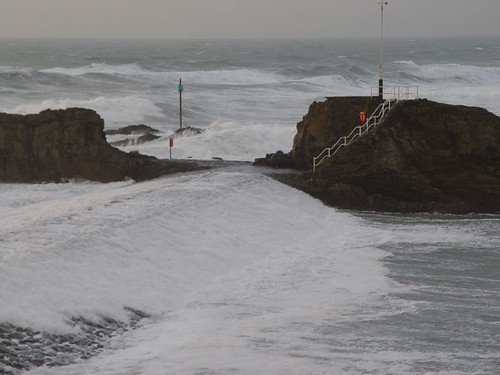
Let’s have an onshore gale blowing – (the cameraman can barely stand upright);

And the first ebb of a high spring tide, the full flood just beginning to flow out of the river;

Add backwash to develop an undertow – the water has to go somewhere once it reaches the beach;

With cross-currents from a tide now heading down the coast;

And sound – the wind hammering in ears, the sea thundering and crashing, the snatched cry of seagulls.

Now we have music – a climactic moment in a symphony without a beginning or an end, composed by Nature and performed by The Elements.

.

But how to describe it for those who sail in small boats.

There is probably a scientific explanation, with each molecule of water predicted to a particular position with regard to every other molecule and the surrounding conditions.

Perhaps there is, but it is far too confusing, too complex for we mere mortals, so we rely on words.

And finding words is an art.

These days, we might try “Awesome“, but it is short-hand and doesn’t really express a storm  properly.

Some have described storms with first-hand reportage . . .

“The Spray neared Cap Pillar rapidly and, nothing loath, plunged into the Pacific Ocean at once, taking her first bath of it in the gathering storm. There was no turning back even had I wished to do so. for the land was now shut out by the darkness of light. The wind freshened and I took in a third reef. The sea was confused and treacherous. In such a time as this the old fisherman prayed, “Remember, Lord, my ship is small and thy sea is so wide.”  Joshua Slocum

Some with extreme drama . . .

“Poor naked wretches, where so’er are you / That hide the pelting of this pitiless storm.” William Shakespeare (King Lear).

Some with more rhythm . . .

“And large blue seas each other chased, / Cascading over down the waist.  / At every pitch he held his breath; / As if he saw the face of death. / “She’s pitched away a topmast, smash!” / All hands to clear away the wreck, / Were in an instant turned on deck; / From hammock starting out alert, / Up flew each seaman in his shirt! / And up the straining shrouds they swarm, / Growling and swearing at the storm.  / The wreck secured or cut away, / She snug beneath a trysail lay.” Capt J. Mitford RN, from Adventures of Johnny Newsome.

Of course, there are always those who see it in an entirely different way . . .

“At night came on a hurricane, the sea was mountains rolling / As Barney Buntline chewed his quid and spake to Billy Bowline: / “A strong nor’wester’s blowing, Bill, can’t ye hear it roar now? / Lor’ love me how I pities them unhappy folks ashore now. / As comfortably you and I upon the deck are lying, / Lord knows what tiles and chimney pots about their ears are flying.” Dibdin

~~~

And if poetry doesn’t work for you, then Adlard Coles’  “Heavy Weather Sailing” , now in its 30th edition, is the definitive work.

With acknowledgement to John Irving for the poetry, quoted by him in a Yachtsman’s Week-end Book, 1938.

From Steeple Point – a hatful of wind

The wind increases, the foam begins to streak, the Atlantic swell presses home.

Force 7: “In which a well-conditioned man-o’-war could just carry topsails, jib, etc in chase. And smacks remain in harbour, or, if at sea, lie to. And ashore, whole trees are in motion.” (Beaufort)

The North Cornwall coast, from Millook Haven

The images were taken in March and it’s not the “snowing gale” mentioned below but a fresh south easterly, blowing off this west-facing shore, the southern edge of a high pressure area, a low somewhere to the south, the wind funnelling between the two.

~~~

But how to describe weather?

Beaufort’s original description of Force 7 is one way – (and the accepted one when first introduced – and now modified), but the poets can be  more vivid.

For example, Stevenson’s few words on a gale bring life to the scene. I particularly like the “flash of sun” and “the passion of the gale”.

It blows a snowing gale in the winter of the year;

The boats are on the sea and the crews are on the pier.

The needle of the vane, it is veering to and fro,

A flash of sun is on the veering of the vane.

Autumn leaves and rain,

The passion of the gale.”

It Blows A Snowing Gale, by Robert Louis Stevenson

~~~

Previous posts on this – waves, waves (cont), a question of scale.

From Steeple Point – a question of scale

Talking of tides and waves (here and here):

The ebb tide is running fast leaving wakes trailing from both the buoy and the fixed mark.

The buoy is floating, attached only by its anchor line. The water is passing more or less unimpeded below it, leaving a clean wake; whereas the fixed mark totally disrupts the flow, resulting in very confused water downtide.

Between the two, you can see the wake from another buoy – dying down but still confusing both of the above wakes.

A short while later, the tide has built up enough to submerge the buoy.

In the foreground are eddies from the uneven bottom, causing smooth upwellings of water.

Should we be interested in this?

Aren’t the two images merely pictures of a spring tide ebbing?

Well, it’s a matter of scale. If we want to know more about the sea, this is a good place to be.

Now we move on.

Below is a an image of Ham Stone, between Bolt Head and Bolt Tail on the South Devon Coast.

The effect of the rock on the tide can clearly be seen. Although the tide is not running as fast as in the images above, the water will be confused here especially at the border with the main flow. However, for a small boat, there will be temporary shelter from the main flow of the tide.

In fact, this boat is fishing downtide of a wreck on the sea floor, the disturbing currents attracting food for the fish, the fish attracting the fishermen.

Ham Stone, South Devon

Compare this with another phenomenon – this time rocks interrupting the swell.

These are waves in motion over the surface of the sea rather than the sea itself being in motion.

Instead of causing the waves to spread outwards, the drag effect of the rocks causes them to slow down and swing inwards, so that the sea is confused on what might have been the sheltered side.

Even if the water was deep enough for a small boat, there would be no shelter from the swell here.

Rocks between St Ives and Zennor, Cornwall

In practice, what happens around the coast depends on the swell, the tide and the size of the various obstructions, whether above the surface of the sea or on the seabed – (not to mention the weather).

So, let’s up the scale again.

The fishing boat on the right has chosen to go between the headland and Godrevy Light, avoiding the long haul out round the off-lying reefs.

It’s about one hour after low water and the tide is running against him – the direction of the tidal stream can be seen to the right of the island

Godrevy Light, Cornwall

It’s running faster between the island and the mainland than further out to sea – but nowhere near fast enough to hold him up.

Although, as you can see, he is having to work at it.

At the western end, the swell is swinging round the end of the island against him, just as in the image of the rocks near Zennor.

He is keeping well over to the right to minimise the effects.

And when he leaves the local effect of the island he makes appreciably faster progress towards his home port.

It’s a matter of scale.

The sea is doing its thing on a vast scale – slopping around the planet under the firm but distant control of the moon and the sun and the vagaries of the weather.

For the most part, we see it locally – we watch it, we study it, often we eulogise it (as you will see in the next two posts), but in the end we have no control over it.

The fisherman chose his time according to the tide and the weather.

He could not choose the tide or the weather to suit his time.

From Steeple Point – waves (cont.)

The previous afternoon the weather was similar. . .

a light swell is coming off the Atlantic.

Waves are in motion, just visible, moving towards us across the surface of the water – at speed.

The actual water they pass through is barely changing position, describing small, slow, circular, vertical orbits.

Finally, almost at the last moment, a small section of a wave is cut off  by the rocks-  guided into a gully.

Forced into the tight space, it loses speed as it drags against the sides. But it retains its energy.

Thus gaining height, it trips over itself, breaking on some underwater obstruction.

And now it is the water itself  – (at a ton per cubic metre), that is surfing down the face of the wave, accelerating towards us.

In speeding up, it quickly reaches its end, dashing itself with abandon on the Breakwater – while, a few seconds later, the rest of the wave, still in the freedom of comparatively open water only a few feet away, rolls sedately up the stones.

And here, it is lifted by the swell above the surrounding sea, only to sluice downhill across the rocks, seeking balance with the main body of water.

From Steeple Point – waves

Last Saturday, browsing through my favourite second-hand bookshop – Books by the Sea in Bude, I found a book on seamanship by John Russell – The Shell Book of Seamanship, published in 1974.

I already have another book of his – Yachtmaster Offshore, published in 1977 for the RYA  Seamanship Foundation and bought around that time.

Note the publishing dates – before a lot of things that have happened since.

I like his attitude.

From the blurb inside the dust cover: ” . . . ‘safety equipment’ is a misnomer. It is emergency or survival equipment. True safety comes from good seamanship which minimises the incidence of accidents and that is what this book is all about. Examples of true safety equipment . . . are the humble electric fuse, the lifeline and the harness . . . and the pound or two of slush that every one of us carries around for life in his skull.”

It is the slush, of course, that is the problem.

~~~

Chapter 3 is entitled ‘The Sea’ and deals with waves.

Coincidentally, my photos of the weekend included waves and I have put some together with John Russell’s text to see how they fit.

The weather was governed by high pressure.

The sky was blue, with occasional light cloud.

Such wind that there was was north westerly as the Cornish flag on Chapel Rock shows.

The sea was flat – you would not expect any waves other than the residual swell from weather far out in the Atlantic.

And this is what we had – the chance to look at individual waves washing ashore.

~~~

“When the wind stops blowing or changes direction, the sea it caused continues to travel on as a swell . . . Without the energy of the wind to sustain them the waves of a swell gradually decrease in height, but their period and length continue to increase, although at a diminishing rate: thus they become less obvious but move faster as they travel away from the original area.”

“. . . When the wave enters water less deep than half the wave length it begins to feel the interference of the sea bed. Its length decreases without alteration in its period, so it goes more slowly, while its height, after an initial slight decrease, begins to increase rapidly with decreasing depth. This causes the swell to become shorter and steeper . . .”

“When the depth of water falls to one-tenth of the deep-water wave length the increase in height becomes very marked, the progressive deceleration causes crowding with steepening and narrowing of the crests, retardation of the troughs steepens the wave fronts more than their backs and the wave is ready to break at the least provocation. At a depth equal to one-twenty-fifth of the deep-water wave length the relationship between length and period disappears, the wave speed becomes dependent on depth alone and it breaks.”

“For a given speed the energy of a breaking wave depends on how much solid water, as opposed to air and water, it contains, but with sea water at a ton a cubic metre even a modest, well-aerated crest produces  a clout equivalent to collision with a small car.”

“It seldom happens that the fronts of advancing waves are parallel to the bottom contours, so one side reaches the critical depth and begins to slow down before the rest with a result similar to optical refraction. Refraction causes the swells to swing round and align themselves with the bottom contours.”

“Waves frequently cross and even when they travel in the same direction their different characteristics blend to give results that do not appear in either system alone. When the difference in length is pronounced, as commonly occurs when  a sea is meeting or being overtaken by an old swell, the two component waves retain their identities. But when waves of only slightly different period and length combine they produce groups of noticeably higher waves interspersed at intervals with groups of remarkably lower ones as the component waves move in and out of phase,”

~~~

It is worth concentrating on the extracts above. Even if not written in customary blog language, they are a very good description of an often ill-described phenomenon.

You might ask why a book on seamanship should include a section on waves. Well . . . that’s where the ‘slush’ comes in.

For love of a boat – reflection

Following on from yesterday’s post . . .

. . . . . . . . . . .  For the origins and full set of images in this series, here

“There’s not much sail in that collection” – Ed.

No, there’s not. There’s something else I’m  . . .

“A revival of working boats, locally-built, local materials, ‘close-to-the-sea’, preferably under sail? – Sounds pretty specialist, limitist, elitist to me.” – Ed.

No, listen, I’ve been trying to . . .

“And some of those boats look pretty badly kept. If their owners don’t look after them, why should we care?” – Ed

Listen, will you? Just listen!

I have been recording the boats for lots of reasons – (not the least being that I enjoy doing it).

For me, they reflect two things – the people who built them and the places where they were built.

When I was young, there was a song we used to sing along to. It had a verse:

“And they were all built out of ticky-tacky and they were all built just the same.”

Well, there’s plenty of ticky-tacky still around, and not only are things being built the same we are now being ‘encouraged’ to think the same.

It’s not so much about tradition, or being tied to certain materials, or blessed with certain skills (although that all comes into it).

It’s about people who set out to build boats that achieve beauty through a combination of their function, their structure and the knowledge, attitudes and skills that went into their construction.

No, they are not necessarily classical, nor tidy, nor showy, they merely reflect the lives of those immediately around them – about as far from ticky-tackiness and sameness as you can get.

That’s my take on it, anyway.

“Oh, really. What’s for tea?” – Ed.