The wider world is never far away

(continued from . . .)

P1030349

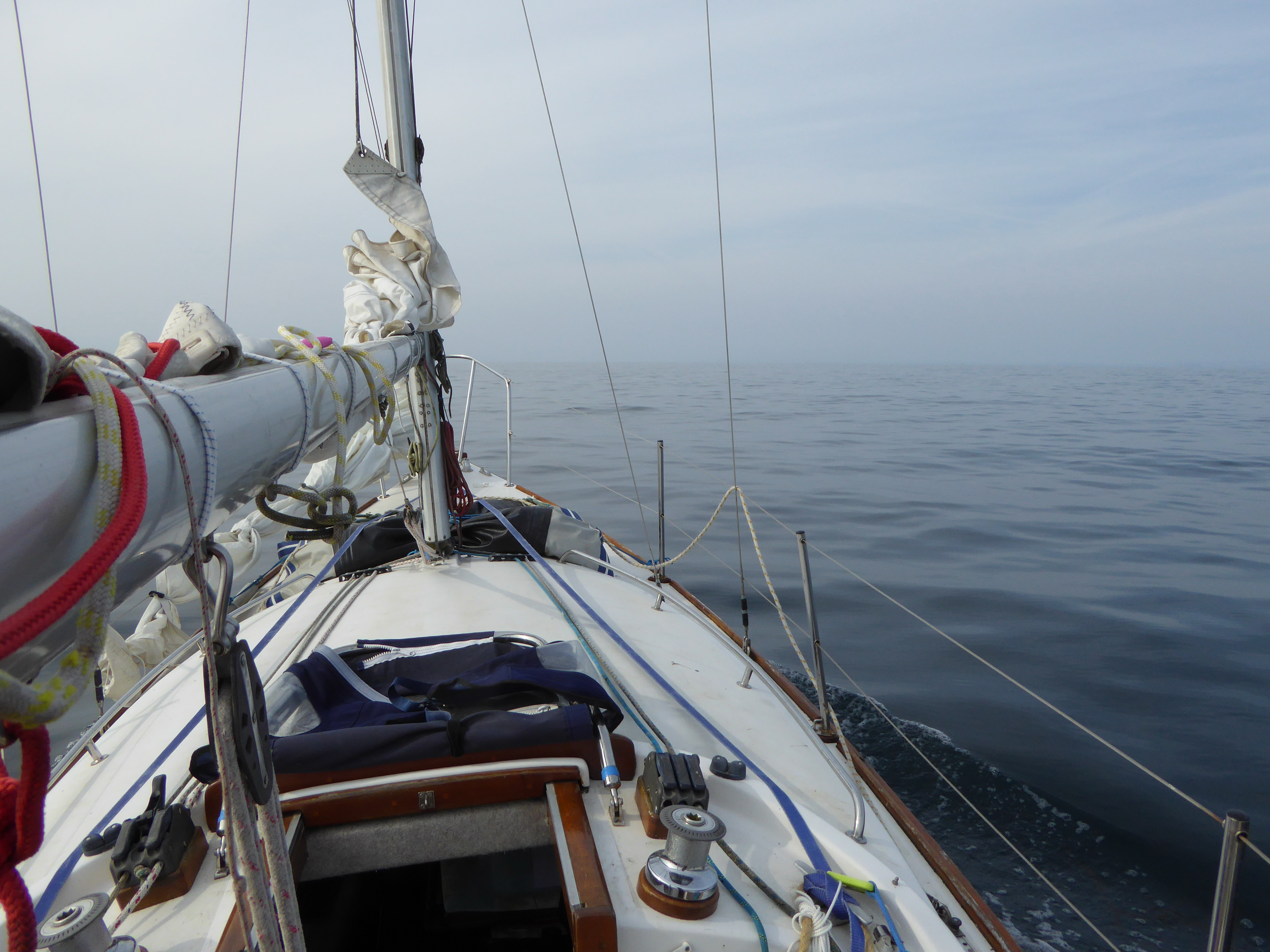
The early morning sunshine doesn’t last and we are soon back to a windless, blue-grey, engine-powered day.

(Click on image to enlarge)

P1030355

Wherever you are, the wider world is never far away. I spy Grace with her magnificent Cornish flag leaving the Maritime Museum pontoons. I admire her lines and recognise a smaller version of Ceres, my grandfather’s Westcountry trading  ketch mentioned extensively in earlier posts in this blog.

Continue reading

Time to look around

(continued from . . .)

The weather is benign – so benign there is no wind and no sun either. The sea is glassy, the colours bluish grey, the sky and seas almost matching, the horizon sometimes clear, sometimes vague.

The engine gives a comfortable 5 knots, the distance is approximately 40 nm, I have six hours of fair tide. Time to reflect, time to look around.

(Click on image to enlarge)

P1030315

There are gannets, diving, resting, flying.

Continue reading

A voyage of my own

It has taken a while to get used to people saying “What? By yourself?” as in “I took the boat down to Falmouth and returned to Plymouth via Fowey? It was a quick three-day trip.” “What? By yourself?”

How do you explain it? To the uninitiated it invites the disapproval of

  • the safety industry – “the tiny crew”;
  • the health industry – “the older man on his own”;
  • the social industry – “all alone”;
  • the professionals – “a rank amateur”;
  • the bigger boats – “a smaller boat”;

Despite all of them I succeeded – as do many, many others in far more challenging circumstances.

It has taken many years sailing to be able to say with confidence “I do it like this. I know it is possible to do it like that but I have chosen to do it like this. Yes, the most knowledgeable of intellectuals, the most graceful of athletes, the most creative of artists, the grandest of grandees, they all know better than me. But not quite. Individually they know certain areas of my life better than me and combined they know many areas of my life better than me but the whole of my life belongs to me and I choose to live it like this. I will listen to them but I will make up my own mind whether it is useful for me or not. There’s no side to it, no competition, I respect their point of view but I am taking responsibility for me so I can give back what I learn as I go along.”

Time and money – (not enough of either), have meant that it has taken not months but years to bring Blue Mistress to her current standard – a standard that makes me comfortable in taking trips along the South Devon and South Cornwall coastline.

‘Single-handed’ means thinking things through long before they are needed. The layout of the boat, its contents and every maneuver that may or may not be made has been gone through in your head, maybe on paper, certainly on a computer, and books and videos and charts and tables studied, with the intention that all this be absorbed into experience.

Even then mistakes will be made – some of them very memorable with solutions needed in a breath-taking hurry, but mostly things will go right. Very few of the latter are memorable because what is going on outside the boat is as interesting as what is going on inside. Have you ever seen a coastline from the sea? The Devon and Cornish coasts are particularly stunning. (And, yes, there are plenty of other stunning coastlines too).

I like aloneness but enjoy company. A week ago we took my London-based, four-year-old grandson for his first trip. Enthusiasm on all sides. What’s not to like?

And every trip, every voyage is different.

I took few photos on the Falmouth trip but I will make a short storyboard next post. In the meantime, here is Blue Mistress in Fowey on the last day of September 2014 with the morning mist rising. As I say, what’s not to like?

Blue Mistress, Fowey

(Image taken by Bill Whateley)

(to be continued . . .)

A beard on a whim

I awake to an unfamiliar pillow. I touch my face and it isn’t the face I remember. A stranger looks back at me from the mirror. The post-shower drying ceremony has an extra twist.

Yes, I’m growing a beard. Three whole weeks without shaving my chin – hair is now covering the lower part of my face. Well, more of a stubble really – certainly can’t call it a real beard yet, but the end of the prickly stage, it’s beginning to catch the wind and I am constantly reminded that there is something there.

Continue reading

Time – in 400 words

Unnerving – to write 400 words straight off. I was taught to think before you speak – think before you write.

Finishing the day-job has altered my concept of time. I spent my working life working in blocks of minutes – 20, 30, 45, 60, always working with the knowledge that this task would be coming to an end in so many minutes and the next task would start.

I am finding that there are people who have never worked that way. Their days are one long continuation – days meld into days until the job is done. This is a novel experience for me.

Last Wednesday I sailed to a river a few miles east of where I keep my boat. By early evening, I had moored, cleaned up, cooked a meal and am sitting reading. The companionway is open and I can see the trees on the steeply sloping banks and a line of converted fishermen’s cottages.

It is quiet, peaceful. The water is glassy smooth. The tide has been coming in, occasional pieces of weed floating upstream, a gentle ripple on the bows of the neighboring yachts.

Even though the boat is absolutely still and there is no noise, I notice a change. There must have been a tension because I feel it ease, the boat seems to slacken. It’s not the boat that’s slackening, it’s the effect of the tide on it. The view through the companionway alters very slightly. A few more trees come into a view, I lose sight of others. Gradually, my view alters, from trees to cottages, another boat in the foreground, to different cottages, more trees, boats. A long pause later we are realigned, facing upstream against the outgoing tide.

This is time – real time. Not one expressed in numbers. The Earth has turned, it’s relationship with the moon and the sun altered in space. The billions of tons of water that has flowed in one direction, now turns and flows away again. This is the real rhythm of life, the music that unites us and all species, this surpasses all the endless explanations we use to justify our presence in this world. This happens despite us. In the past, I would not have had time for it – my own preoccupations would have masked it, but this evening, just for a few moments, I had the privilege of feeling that rhythm, of hearing that music. I was glad.

7�6 �


“Back in a minute, mum”

“Come indoors, Claire!”

“Just a minute . . . “

No I won’t go indoors, not while Betty is being bothered. That greasy fat man has come in his shiny black car and he’s brought two police cars with him. She said this would happen and I was not to worry and she wasn’t going to let them in.  She said her boys would come to rescue her.  She said Josh has a Harley and lots of friends on bikes and the others would come in their cars and they would all come and rescue her. Where are they? There’s no sign of them.

I don’t think she’s thinking straight, not since her George died. She changed a bit then.

I do love Betty and her ways. I remember when I first went across the road and down the side alley and looked through the fence. There was this woman crying out back. I was five and I had never seen a grown up cry  . . . I have now though . . . lots of times. The gate was unlocked and I went in. She didn’t see me until I stood next to her. “Don’t cry.” I said. And she looked at me so sad. I didn’t know what to say, so I picked a flower and gave it to her. She took it and tried to smile a bit. Her hands were wet with the tears. One day last year, when I was having tea with her and Mr Pauley, she showed me that flower. She had pressed it in a book all that time ago. I was so surprised.

That first day I had gone home and told Mum about it – this was before all the trouble started, and she said that the lady was Mrs Pauley and her youngest son had just left home and now she only had Mr Pauley left and that was what made her sad. Mum made a funny movement with her eyes when she said Mr Pauley’s name. I didn’t know what that meant, but I decided that I would try and make Mrs Pauley happy and I would go there again. And I did. One day she said, “Don’t keep calling me Mrs Pauley, dear, you can call me Betty.” I had never called a grown up by their first name. It felt strange at first, then I got to like it. She always called Mr Pauley “George” but I could never do that. He was nice but a bit fierce. And now he’s dead and Betty is on her own and I don’t care if they are policemen, those men are bothering her

The year before last, when my mother and father started fighting, I went over there more often. Betty seemed to know why I was there but she never spoke of it. She could see I was upset. She would sit me down and make me a cup of her fresh orange juice and a piece of cake and we would look at old photographs of her “boys” as she called them. And she would tell me stories of when she and Mr Pauley were first married and didn’t have any money and the places they lived and how they kept moving on. But the stories I liked most were the ones when she was girl the same age as me and lived in the country and had adventures. She told me about the farm and about the horse her dad got for her, and how she rode all by herself for miles and miles. And she told me about the animals and how she looked after them and what happened when they were ill. When she told me these stories she looked so young and happy, and I forgot just a little about what was happening back home across the road.

At some point, we would hear a door slam and my dad would come out of the house looking horrid and get in our rusty old car and drive off very fast. And Betty would say “You’d better go back now, dear” and she would give me a long hug and I would go back across the road and mum would be crying and I would give her a hug too and say “It’s ok mum. I’m here.” And she would say “I’m so so sorry, Claire.” And cry even more.

And now dad’s been gone for a year. It’s more peaceful but we don’t know where he is. Mum is working in the shop down the road “to pay for food and find the rent,” she said, but I think she likes to be out doing and meeting other people.

And now Betty’s being bothered by those men and her boys haven’t come to rescue her so I must go and help her because no one else will.

“Back in a minute, mum.”


The Fall

As I climb the path, the ground falls away on my left. The path narrows, the ground falls away more. It steepens to my right. Soon there is nothing but fresh air on my left and a rock wall on my right. A knot has started in my belly – just a small knot, a tightening somewhere inside. Then my knees – a wobble. Clamminess next; then dizziness; then, “Sit down. Now!” Sitting on a narrow path with back pressed against rock and legs dangling down a vertical drop. Nightmare.

“Trace it back to the first time. When did it start?” I want it to be logical. But logic is too slow for emotion in the race for fear. Logic can pull fear back, can try not to let it get away, while emotion bubbles and troubles and blasts its way forward.

It only happens on the way up, never on the way down. Up is a problem, down is a doddle.

I dealt with it years ago. I don’t sit down now. Sometimes you’ve just got to climb. Wider paths. Avoid narrow ones if you can. Walk close to the wall. Hand holds. Stick on the outside pushing inwards.

But I often feel it start – recently on a mountain in New Zealand – small mountain, big feeling.

High buildings – stand back from the window. High bridges – that feeling of falling with nothing beneath, over and over and over. As for the London Eye – I sat on the bench in the middle of the pod – fantastic views through shaded eyes.

Might there be a cause – a reason – an explanation? Aged three, I watched a man climb a cliff. Towards the top, he stopped. He fell backwards. I see him now, sailing through the air, bouncing against the rock face. I don’t remember the end.


Lost and Found?

Imagine . . .

Our mother died a year after our father. They had lived separate lives in the same house, she doing good works, he hunting and fishing. I was generally too tied up with my own life to think there might be a flaw in the relationship. I had been very close to my mother but regularly fell out with him. My sister, Jill, had acted as the go-between in the frequent father-son disputes. We both left home early and built lives of our own. When the time came, we knew instinctively that neither of us wanted the house.

However, we could not bear the thought of getting someone to strip our possessions away in one anonymous sweep. We would go through everything first. And we did. Little by little, room by room, we sorted through the physical remnants of our family lives .

One evening, in the attic, a fertile source of wartime memorabilia, Jill finally opened the locked wardrobe. We had never seen inside it. Mother had always dismissed it, “Oh, it’s full of old clothes. You don’t want to go there,” which of course made us want to go into it all the more. But we never found the key. It was a very large wardrobe and very heavy. We had had to move it to get a large chair out of the way to get to the other side of the room. It was a struggle but we did it. And there, on a brass hook, high on the back of it, was the missing key. To Jill’s delight, it really was full of mother’s old clothes, clothes from the thirties and forties – her party clothes, her wartime clothes, her uniform, formal wear, casual clothes, shoes – all with the faint smell of old moth balls.

A happy hour was spent going through them. The curious thing was they had a fresh look, they looked as though they had been cleaned occasionally – the wardrobe had more the appearance of a modern charity shop than an untidy junk shop. Mother had been very fashionable and loved to dress well. The difference in the material of the prewar dresses and the wartime dresses was marked but she was a talented seamstress and the designs stood out. Jill swept the dresses away to try them on.

I was less interested in the clothes than the wardrobe. It was magnificent. Oak, I thought. Room to stand in. I looked idly around it wondering if there was a clue as to why it had been kept locked and why the clothes looked so tended. Inside, above the door, was a small envelope – and a fading black-and-white photograph.

My mother is sitting on a rock by a beach with a good-looking, vaguely familiar young man. She is stunning in one of her summer dresses – a dress I had just seen Jill take out of the wardrobe. He is casually smart, too. He has lost the universal tie and wears his shirt open-necked, the trousers fashionably baggy. They are lovers. Their eyes are bright, their smiles radiant, happiness flows round them. The photographer was very, very good. They are more than posing for him, the electricity between them is real for all to see. I was immediately pleased for her.

On the back is written “To Margaret, with all my love. Thank you for a wonderful weekend. John.” There is a date in the corner in my mother’s hand – Thursday, 23rd July 1942. I looked at the picture again and smiled at my mother’s happiness, realising, as I did so, that I was slightly shocked – I had never imagined her, let alone seen her like this.

Then it occurred to me, “Mum and Dad had married in 1941. 23rd July 1942? Surely that was nine months before I was born. No . . . I was a fortnight premature. They told me that. Dad came on leave at the beginning of August 1942. But I see why the man is familiar. I saw similar eyes in the shaving mirror this morning . . . And I never looked like my father . . . And my name is John . . . ” From being excited by what I saw, I grew puzzled, then troubled.

It seemed I had found a photograph and might have lost an identity.


Random questions kept coming:

Was this possible or was I way out of line?

Had she kept her secret all this time?

Did my father know? It seems unlikely if she kept this wardrobe to herself.

Did anyone else know? Her sister for instance? Had my favourite aunt been pretending to me all my life?

Should I tell Jill? Did she know? What would this do to our relationship – half brother-half sister?

What about this John person? Should I look for him? He may well be dead too.

And who am I now anyway? And am I right to feel so troubled or does it free me from the habitual irritation I felt towards my ‘father’?

And what about that irritation? Has it changed now? Is the cause obvious?

Had my mother been disappointed all her life because she had known happiness once?

Or had she been content because she had found happiness and knew its zenith to be far too singular to last a lifetime?

Had she found solace in coming to this wardrobe and re-experiencing her love through her clothes and this photograph? I imagined her reaching round the back of the wardrobe for the key and opening the door, her feelings for her lover flooding over her once again.

Was this why I always felt her close to me?

Why couldn’t she tell me – even at the end?

Would it have been better if I had never found the photograph?


Do I know that life will go on whether I find the answers or not?

Will the answers colour my life and add to it, or is it enough to know that the questions exist and leave it at that, the search for answers acting as a distraction to whatever the future holds?

I didn’t know then and, if I am honest, I don’t know now.


But I did know more about my mother and I understood.


Real disappointment . . .


You ask how I would feel to lose an event that I hold dear, how I would feel to be told that it would never happen again. To say I would be upset would understate it. To say that I would be desperately disappointed would be getting closer.

When I was 17, I went on an Outward Bound course in Wales. It was March in the mountains, it was cold, my hands were freezing and I was climbing a rock face. I slipped. The grey rock flew upwards and I hurtled downwards. I fell about fifteen feet before the rope held, a split second between the relative security above and the grazes and bruises below. Too quick for fear, too swift for anger, the world had shifted before my eyes. Shaken, I needed time to recover and regroup . . . Now we are even closer to what I would really feel losing that event, but we’re not there yet.

The event I am thinking of is a yacht race – the Jester Challenge. It is not a competition in the way we accept competition nowadays – strict rules binding the competitors, encouraging increased financial input, possible corporate sponsorship and insistent media attention. The race I am following is from Plymouth, Devon to Newport, Rhode Island. The organisers describe it as “run on a ‘gentlemanly basis’ within the following guidelines:

  • for sailing vessels between 20 and 30 feet
  • human power is the only acceptable alternative propulsion to that of the wind
  • single-handed to Newport
  • one way
  • stops allowed
  • no time limit . . .
  • no fees
  • no inspection
  • no regulation: skippers will be entirely responsible for the equipment they take, based on their own experience

These are the guidelines, not rules; the rest is up to those who wish to enter. As one of this year’s entries said on his blog “Big ocean, little boat, low budget and more about cooperation and camaraderie than competition.” The mightiness of the task means that more people sign up for the voyage than arrive at the start. They are not diminished by dropping out. It takes courage to opt in . . . and courage to opt out when preparations fall short. The decision is yours and yours alone. (Yes, of course it upsets those who would like us all to lead a strictly regulated life).

With or without a race, the solitude of single-handed sailing draws me – not loneliness but aloneness and the sense of freedom that comes with it. A state of awareness, of continuous problem-solving, of feeling the changing wind and sea – the keenness of the boat. There is a continual desire to be good enough in my own eyes, then a wish to be better still. ‘Practice’ wins over ‘perfection’. And if I remove the words ‘sailing’, ‘wind’, ‘sea’ and ‘boat’, this becomes a description of writing – for surely this is a single-handed occupation too, and a clue to why I am here.

So what are my deeper feelings if the race were lost?

You are a writer. Imagine that someone takes your keyboard and your mouse, then your monitor and the computer with all your stuff on it. Imagine that they then remove your pens and pencils and your notebooks and paper. Imagine . . .  Now we’re getting very close.

It’s not the race itself that concerns me – (although I confess I would like to do it), it is the thinking behind it that encourages me. The instigators saw their chosen preoccupation – sailing, taken over by big business, by technology, by fashion, by people’s need for immediate excitement. They also noticed that one of the potential benefits of sailing, the development of the truly self-sufficient individual – (small boat, low budget, big ocean!), was being stifled by these changes. Here was a way to give those with the will an opportunity to grow their skills and widen their experience.

Whether these sailors like it or not, (and I suspect they don’t), the leadership built into their activity is becoming increasingly important in a world overtaken by universal communication. We need individuals who stand out. Where will they come from? Already it is virtually impossible to disappear into the wild without some form of tracking device. You can find Webb Chiles, who has sailed alone around the world at least five times without such a device, here, or Jeremy and Phillip who are sailing round Britain in a Wayfarer dinghy, here. These are people undertaking amazing adventures. We, who sit in front of our computers, can find them instantly.

What will we do when the Google satellites make everyone and everywhere visible in real time? We’ll work it out no doubt. But, in the mix of a humanity shaped by technology, we will still need leadership from individuals shaped by hands-on experience. I am not suggesting this race produces world leaders – although some amazing individuals have taken part. I am suggesting that the attitudes behind it are important in the search for those leaders.

So, if the race were abandoned, I,for one, would be desperately disappointed. Good leaders create spaces for their followers to move into. The space created by the Jester Challenge and those who participate in it has significantly enhanced my life. I would have lost that source of leadership. I would definitely miss it.


Resolved

Continued from Day 4 . . .

It is 1966, I am 18 years old. Yesterday I crossed the Atlantic and landed in New York. Today I lost my address book . . .

Bit of a problem, I know no one in New York and I’m struggling to think whether I know anyone anywhere near here. It’s a difficult moment.

Then, after an agonising age, I do remember the name of someone – in Point Pleasant, New Jersey. I look at my map. This doesn’t seem too far away. So I ask my way to the bus station and, after a long anxious walk with the humidity rising and the suitcase getting heavier, eventually find a telephone kiosk, determined to tackle the stack of giant telephone books. I search the New Jersey book, looking for an entry in Point Pleasant. There are several entries under the same name – of course, there are, I should have guessed. Should I ring each one now or go to Point Pleasant and try my luck there? Either way, I need to get out of New York, because I’ve nowhere to go here and I don’t want to spend money on another hotel when I am unfamiliar with . . . well, everything here really. But I do still have my Greyhound bus ticket, valid for 99 days. There will be no problem getting on the bus. So let’s go now.

The address book had been my safety net. I have spent six months putting names and places together, each address another waypoint in the ninety nine day journey. One or two were family ones I had to visit but most were added because either I might be in the vicinity, or I might decide go in that direction rather than another, or, let’s face it, I might be in trouble and need someone.

I laugh about it now. Now I would have all those addresses on my mobile phone and on my iPad, and, in the unlikely event I lost them both, the back-up would be on the Cloud and I could access them in an internet cafe. Besides that, I would probably have a printout tucked in my socks; and failing all that my mum would be on Skype to list them out again. Before I arrived, I would have looked up each address on Google Earth and Google Maps – oh, and emailed profusely. But, do you know what, I had none of these, just a small book which I lost immediately. How lucky was that?

I am sitting in a window seat on a Greyhound bus. The seat is a blue, synthetic material, quite comfortable, moulded by backs mostly bigger than mine. There’s a cloth head rest. The seat next to me is empty and there is a piece of gum stuck on the back of the seat in front. The driver climbs on board, looks back at his dozen or so passengers, takes his cap off and swings the door shut. It closes with a satisfying hiss. The corner of the window is greasy but the view is leaving-a-bus-station fascinating. I don’t care about the vehicle, I’m travelling at last.

I still plan to see North America. Now that I have got over the shock, I realise that, without the address book, I am free to navigate wherever and whenever I want in the next three months. I don’t have a lot of money but I can sleep on the buses or in cheap hotels or with people I meet. In the next weeks, I will narrowly escape arrest in a Las Vegas casino, get asked to leave a bus in New Orleans because I am white, and find myself uncomfortable with the party scene on a beach near Vancouver. I will visit parts of the continent that the tourist boards won’t want me to see and I will be elevated by places, people and events in ways that I can’t yet imagine.

In 1966, three years after John Kennedy was shot, two years before Martin Luther King will suffer the same fate, four years before Woodstock, this is a remarkable continent. For the rest of my life, my view of the US, Canada and their relationship with the rest of the world, all their ups and downs, will be coloured by this trip. For now, all that is ahead of me. I sit back, relax and enjoy the journey.

And one part of the emergency plan has already been tested: if caught out, move on.

To be continued . . .