For love of a boat – Trechandiri

Paleochora, Crete 2009

I have started reading Mike Smylie’s ‘Fishing the European Coast’.

In 153 pages, he has written a comprehensive series of notes and reminiscences on the very wide range of boats found around the European coast.

It is the perfect overview for someone who enjoys differences in boat design  from port to port, from local conditions to local conditions, from culture to culture . . . as well as for someone interested in the evolution of craft.

For example, over the past year, I have posted many images of Greek trechandiri. Smylie writes:

“The trechandiri is the workhorse of Greek coastal fishers . . . . . The advent of motors in the 1920s simply produced a fatter, fuller body section, while in profile they were unchanged. Once the rig was removed, superstructures were added! They are ubiquitous throughout the Aegean – that sea of thousands of islands, and have one thing in common, a length/beam/depth ratio of round about 9:3:1. There are two schools of thought on their origins. Some say they developed from a particular type of caique, first built in Hydra in 1658, while others suggest they evolved from the trabaccolo, a type of sailing vessel used for trading in the Adriatic.”

Agios Nikolaos, The Mani, Greece 2007

Length/beam/depth ratios have taken on a new meaning :-).

Mr Smylie adds to what I learnt from the National Maritime Museum in Falmouth earlier in the year and from Denham’s book on ‘The Aegean’.

And the images have taken on a new meaning too.

For the origins of this image series, here


For love of a boat – 40+ Fishing Boat Association

Last Thursday’s (6th August) edition of the Western Morning News had a centre spread entitled “One man’s love affair with old wooden boats.’

It featured historian Mike Smylie, whose book “Fishing Boats of Cornwall” has just been published by The History Press.

In the article he is quoted:

‘”For this book on Cornish fishing, I spent a lot of time in Newlyn talking to local fishermen and the people involved with the local fishing industry . . .

“Something which particularly saddens me is seeing boats being chopped up – there’s a photograph in the book of a perfectly good wooden fishing boat being demolished in Newlyn in 1998 with a JCB. This happened because of the European Union fishing policy which encouraged fisherman to take boats out of fishing and scrap them.”

In 1995, Mike co-founded the 40+ Fishing Boat Association to fight that policy and help preserve old, decommissioned fishing boats.’

I am ashamed to say I have not heard of this association up to now. However, those of you who have been following the For Love of a Boat series will know this is precisely my own view on what has happened as a result of the European policy. Captain George’s video shows a Greek fishing boat demolished in just the way mentioned above for exactly the same reason.

Looking at the 40+ website I have not discovered how to join the Association yet, but will pursue it and let you know how I get on. The link to the equivalent Greek website is here. (To translate into your own language, I find Babel Fish works reasonably well).

I have ordered Mr Smylie’s “Fishing the European Coast” and look forward to reading it. The Cornish book will come later.

In the meantime, I wish Mike Smylie well – and encourage him to keep up his good work.

On sailing a Folksong – Saturday morning

I went down to the boat on Friday evening to spend a few days on board.

The following morning, having worked out the early routine, I made a cup of tea and sat with my head out of the hatch to enjoy the peace in the morning sunshine and watch the tide as it slackened towards high water. Today was the top of the spring tides – (0903, 5.4m; the still higher 5.7m due just after 2200). I cannot remember seeing the level so close to the top of the Cattedown Wharves (below).

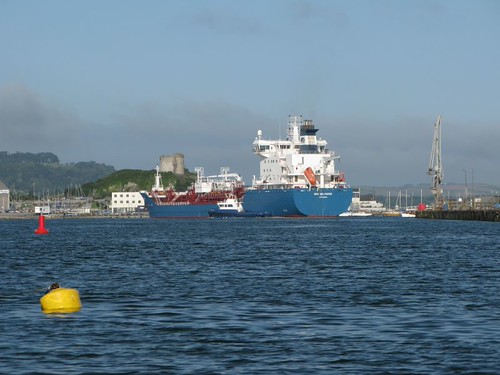
A blast on a ship’s horn and the bow of Bro Deliverer, registered in Goteborg, appeared from behind the sheds – adding a different shade of blue to the scene and totally changing the perspective. A tug and the pilot boat tripped alongside her.

0756

She nosed into the turning area and came around stern first. The tug scurrying around while the pilot boat stood off with an air of dignified watchfulness.

A yacht motored briskly out of the Yacht Haven, promptly eased off and drifted gently, waiting for the ship to slip up river stern first.

0800

A few minutes later, a pleasure boat left its berth on the outside of the Yacht Haven pontoons and hurried around her bow to pick up its first passengers of the day.

Meanwhile, Bro Deliverer came level with the wharves and, with a little help from the tug, eased sideways into her berth. Lines were thrown and she came to a stop, dwarfing the cranes and sheds.

0815

All was over in 20 minutes or so – a well rehearsed routine, neatly accomplished by the ships crew, the crews of the tug and pilot boat as well as the shore crew.

My brother rang at this point to say he was five minutes away. Time to row ashore.

For love of a boat – keep them alive

Last week, I admired this boat in Padstow, Cornwall

and early last month, this one in Finikas, Crete

They are about the same size, both registered fishing boats.

One is built for fishing inshore in the Atlantic Ocean off Cornwall. the other in the Lybian Sea off Southwestern Crete.

To look at, these are totally different boats – but there are many similarities – similarities that come from their function and the work that is put into building, maintaining and running them.

Without a specific function and the people who use them, working boats become mere objects to look at (albeit very fine objects). Add in the people who built them and run them and they take on a life.

Someone decided to build them, lay the keel, add molds, timbers, planking, decking, an engine. Someone finished them. Perhaps the same people, perhaps someone else now takes them to sea, fishes from them, maintains them. These people have families, friends, fellow fisherman, customers – a community of people who know the boats.

Well, they have one other thing in common, they won’t last for ever. As time goes on, and fishing becomes more regulated, and plastic and metal construction finally takes over from wood, and universal design takes over from local design, and costs become more and more prohibitive, so these boats and those like them will disappear into history. Maybe this generation. And the skills that come with them will likely dissolve or resolve into some other field.

Celebrate them now, while you see them working.

Record them and share them

. . . and admire those who are working to keep those skills alive.

Try the boatbuildingacademy site – here, or Charlie Hussey’s marinecarpentry site – here.

Enjoy Mark Harris’ video on building the Isolde, then go to his woodenboatbuilding site – here.

On sailing a Folksong – one nautical mile

I woke on the boat on Saturday morning to a slowly clearing sky and little wind. By the time I had prepared for a morning’s solo sail, the sun was emerging.

The spring tide had been flooding fast when I had my first cup of tea but was now less fierce.

Leaving a fore and aft trot mooring single-handed can be tricky. The tide makes all the difference.

Blue mistress, like all the others on the trot, is moored looking downstream. She has two stern lines – one to each quarter and  two bow lines over the bow roller.

This morning, the incoming tide allowed me loosen the port quarter line and drop the starboard one. This let the stern drift to starboard away from the trot line but still stay attached to the buoy. Lightly lashing the tiller to port caused the bow to want to turn to starboard, away from the forward buoy. Engaging the throttle very lightly to hold her against the tide, I went forward, dropped the bow line to port, releasing the bow to swing slowly (the long keel helps here) out to starboard. I returned aft, dropped the stern line and pushed the throttle gently forward.

~~~

Now that Blue Mistress is more or less as planned (always more to do, of course), I have time to look around and enjoy the surroundings as well as the boat. The early morning was crisp and clear, so, camera in one hand, tiller in the other, I motored down to the Sound enjoying the ride. There was nobody around. I had the water more or less to myself.

What follows is that early morning trip down the Plym – from the mooring to Plymouth Sound, a little over one nautical mile, highlighting some of what I saw:

The entrance to Hooe Lake

Astern, the sky was still heavy with cloud over Oreston and Plymstock.

Cattedown Wharves. The previous evening, I had watched a ship enter Plymouth Sound via the western entrance. She was busy unloading when I returned to the mooring later. She left silently in the night.

The entrance to Plymouth Yacht Haven. Little movement there.

Further downstream, through the moorings, the buildings on Plymouth Hoe were catching the sun.

The Hangars that were a part of RAF Mount Batten and are now boatyards. The Mount Batten Centre is this side of them.

Victoria Wharves.

Queen Anne’s Battery with the Royal Western Yacht Club, the home of OSTAR, on the far right. The National Marine Aquarium is in the centre.

The austere ramparts of the Royal Citadel

The entrance to Sutton Harbour and the Barbican.

Smeaton’s Tower and the Hoe with Tinside Pool beneath and the Royal Plymouth Corinthian Yacht Club on the right

And, round the end of Mount Batten Pier, the Sound itself, with the Royal Navy much in evidence.

A lone fishing boat scuttled past, in a hurry to get to sea, her wake underlining Drake’s Island with the Mount Edgcumbe Estate in the background.

~~~

The mainsail set without the battens snagging the lazy jacks. I’d had a hard time of it the previous afternoon, but there was less wind today. Then the genoa – and we made a starboard tack in under Jennycliff where the wind was stronger as it hugged the short Fort Bovisand to Ramscliff Point stretch of coast

Tacking onto a close reach, it took an hour and a half  to cross the 3 nm of the Sound from Jennycliff to Cawsand –  a patient and gentle 2 knots.

Close to the top of the tide, the Breakwater was washed by the slight swell, the western end bathed in the morning light.

There was even less swell in the Sound and Blue Mistress sailed upright and silent.

In towards Cawsand, the wind increased from around Penlee Point, and we made 4 knots right up to the trees that come down to the water here.

A nod and a wave to a man on his boat anchored close in, and then the second tack of the day to look along the outside of the Breakwater.

But by then the wind was dropping away further and my 1.5 knots (and falling) would not get me back to the mooring in time.

Stowing the genoa, I motored back across the Sound and up the Plym again.

This was not sailing as sport – but sailing as therapy, the cares of the week blown away.

~~~

An hour later and barely three miles away, I was stationary in the car, caught in two impatient lanes of holiday traffic waiting for an accident to be cleared. Hey, ho . . .

For love of a boat – one year on.

A year ago, I started the Love of a Boat series following a holiday in Croatia.

I had seen an old boat arranged ‘tastefully’ on the sand as a piece of beach furniture for tourists. I was saddened that something as complex and special as a wooden boat should be left as a casual prop for those who probably wouldn’t care whether it was there or not.

This was slightly naive of me but, as it turns out, a good basis for learning.

Since then I have shared some of my collection of boat images on a weekly basis. These are images that I take, firstly, for the pleasure of looking at boats and, secondly, because I have always been interested in how the design of working boats varies according to their location – (form following function).

In sharing them, I have found that:

  • There are many people all over the world who share my enthusiasm and care very deeply about wooden boats – (and not just wooden boats).
  • Some confine their interests to particular types of craft, interests which they pursue intensely and exclusively.
  • Thanks to blogging, it is possible to follow what they are doing and thinking, and watch new ideas emerging

Above all, I note in this group a genuine desire to learn from the past and to build the best of the past into new projects.

This may sound self-evident to you – of course we learn from the past, don’t we?  The older I get, the less sure I am.

I have banged on about this before. The way modern technology advances in leaps and bounds seems to have created a rather blinkered environment, one in which we look intently forward hoping for solutions to our problems, often ignoring the fact that man has been facing many of the same problems for generations and the core solutions are already there. Yes, technology gives us new ways to deal with them, and, yes, technology is a source of new creativity – (excitingly so!), allowing us to enter areas we have never entered before.

But for some solutions we don’t need technology . . .  just a way of dealing with them at a more human level.

to be continued . . .