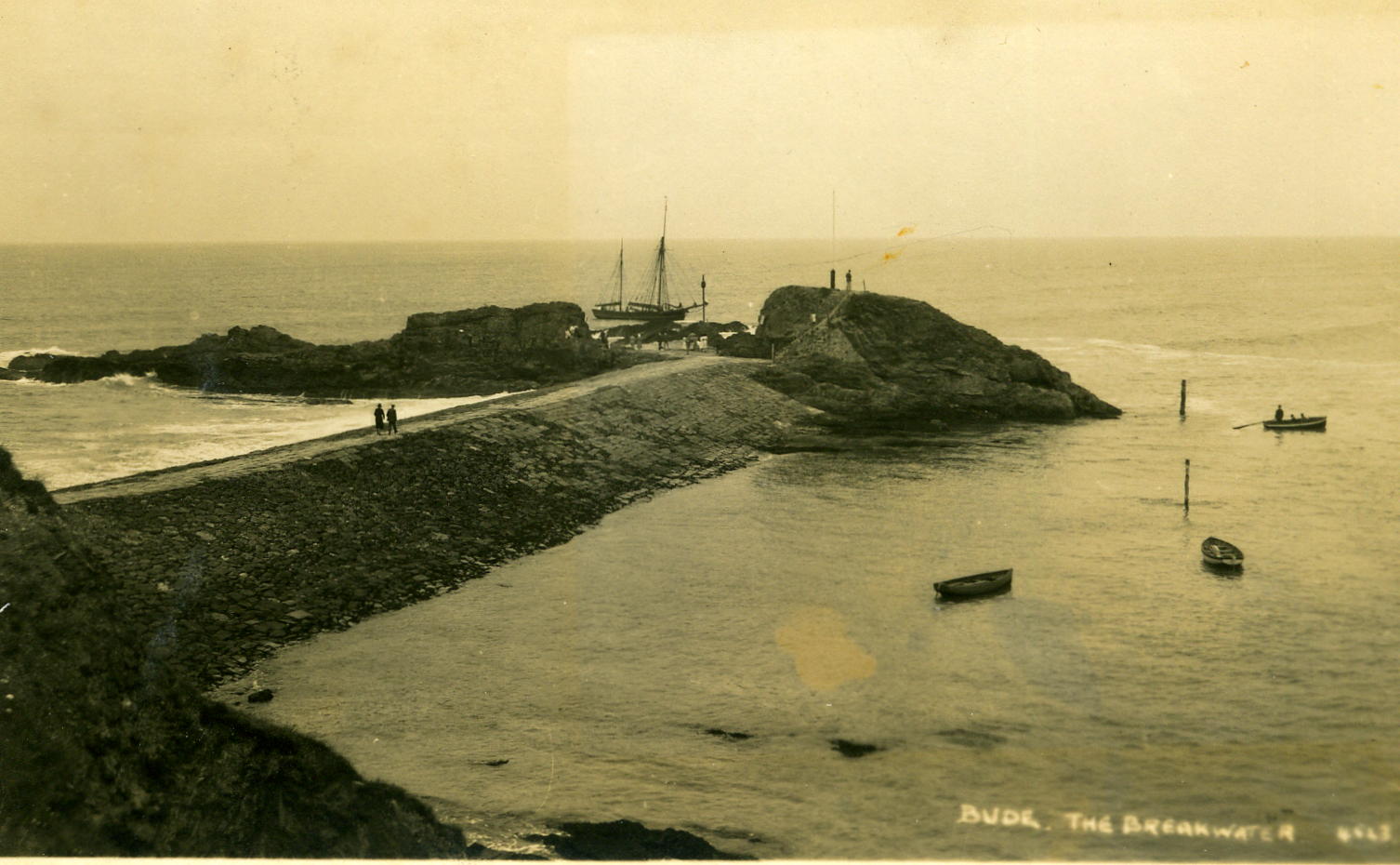
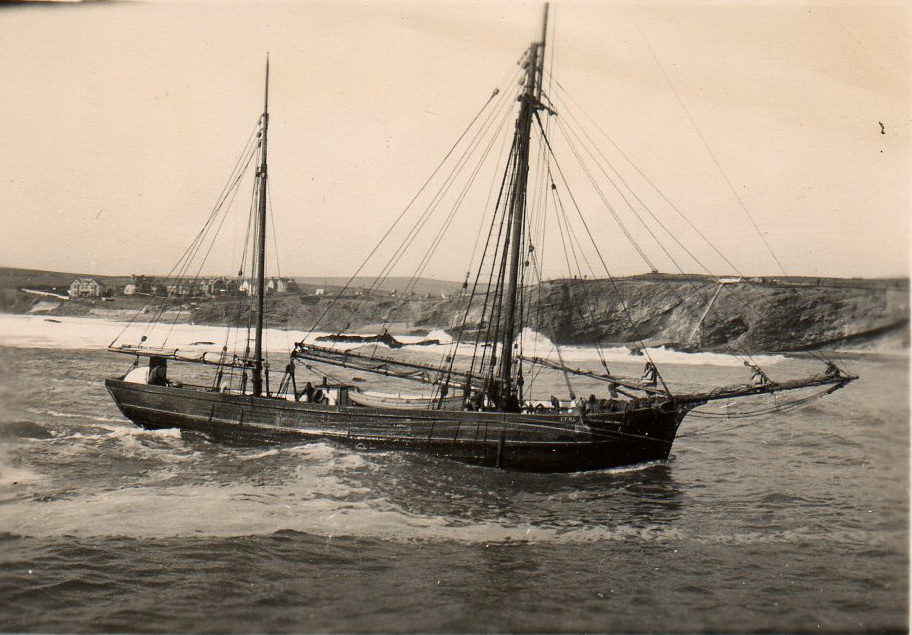
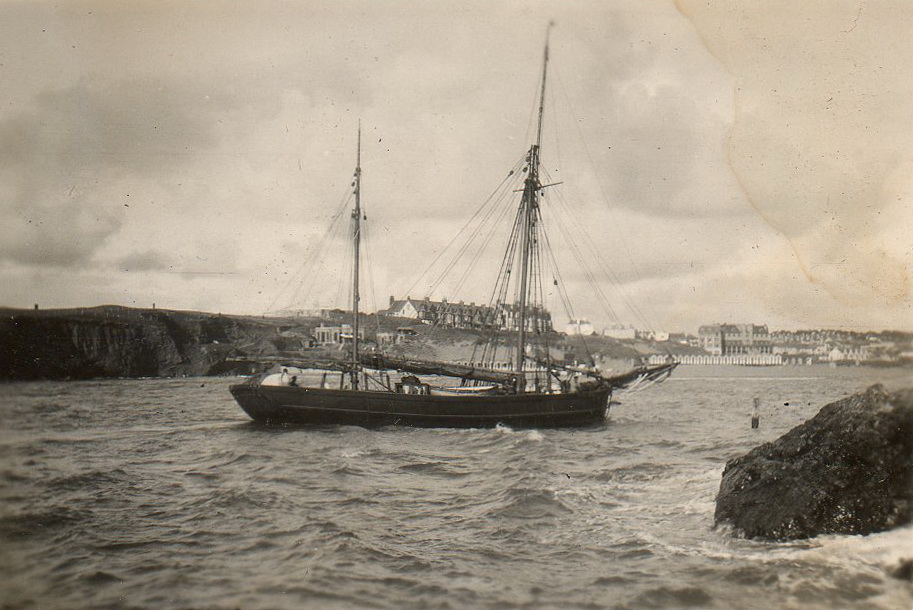
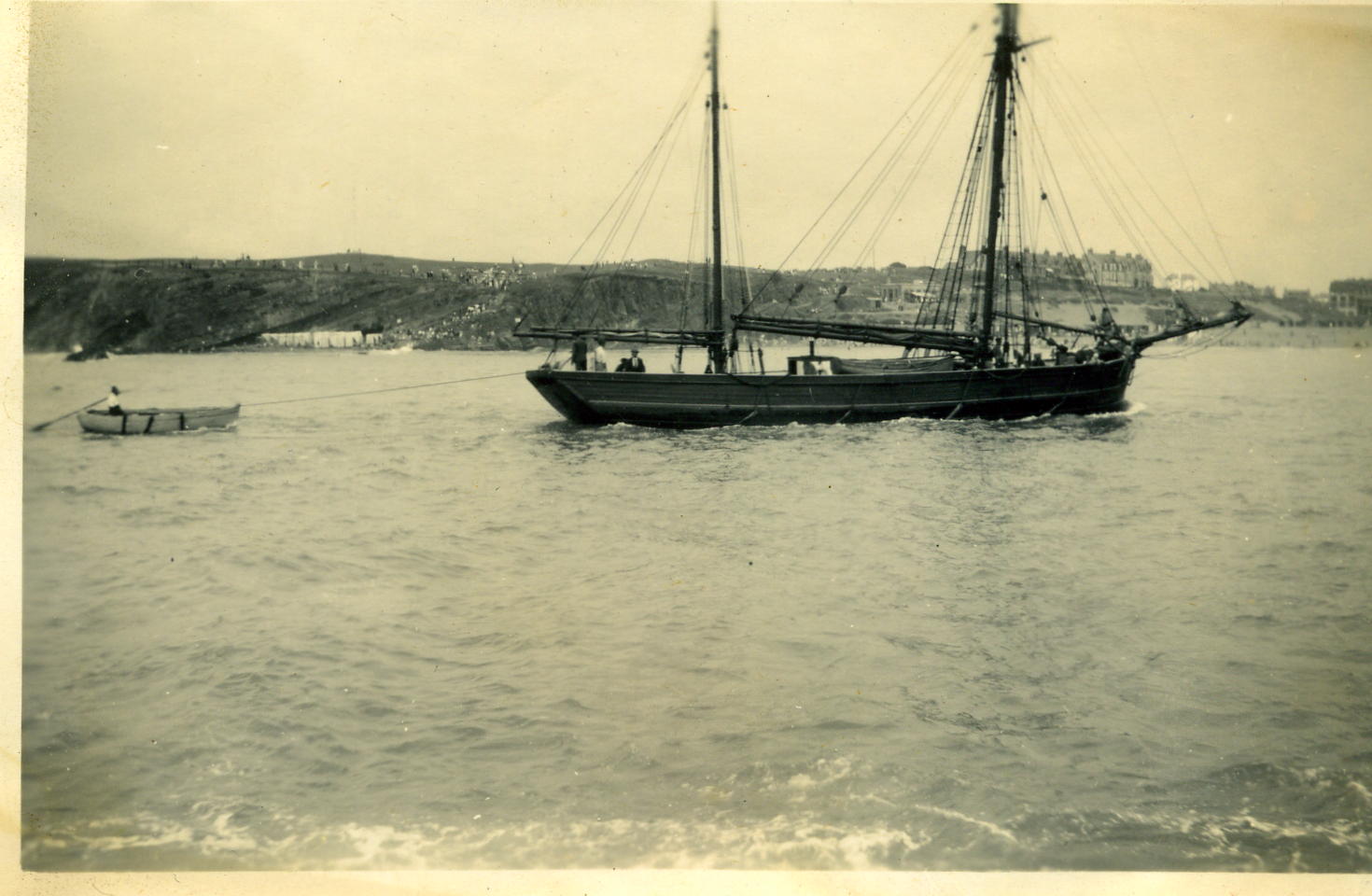
The ketch ‘Ceres’ entering Bude


Six pictures of Ceres found recently – pressed between the pages of an old volume.

Several years ago years, a sudden flood swamped the old leather suitcase they’d been lying in. They were all damaged – water-marked and curled. The flattening-them-out-in-an-old-book trick seems to have worked.

~~~

Here she is rounding Barrel Rock. A hobble boat is waiting just inside Chapel Rock

The crew are working hard, preparing mooring lines; the helmsman barely visible in the stern.

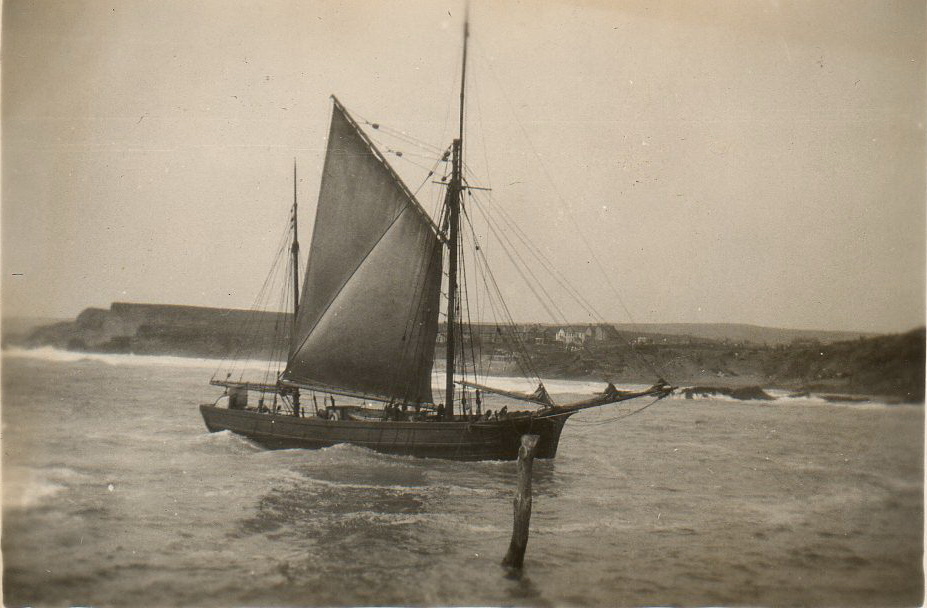
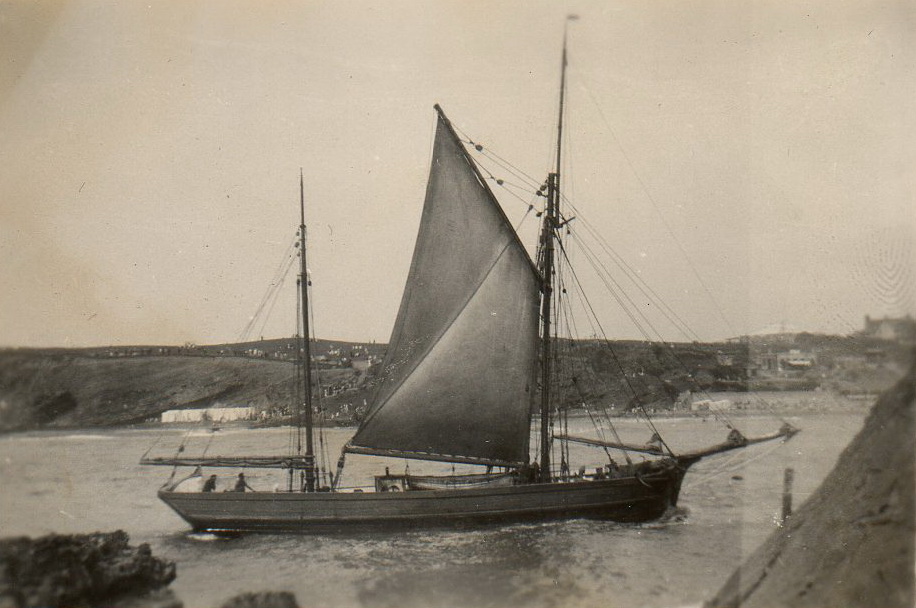
On another occasion, she enters Bude with her mainsail set.

Bude seawater swimming pool is to the right of the picture

By the size of the bow wave, the main seems to be helping the engine, perhaps on a falling tide.

With hobble boat in tow

~~~

There were several more old photos of Ceres in those pages.

I will group together and post them as a series.

From Steeple Point – coincidence

This afternoon I finished reading John Howlett’s book – ‘ Mostly About Boats’.

In the last chapter, acknowledging the experience at his disposal – (a lifetime sailing and having designed a number of his own boats), he describes the boat that he would now build for himself. One that he could sail single-handed if need be.

Remember, he was writing in 1956, when he was in his sixties.

He gives a sail plan:

I looked at the plan and thought, *Surely, I’ve seen a boat with a sail plan like that recently. . .”

From Steeple Point – character and individuality

I found John Howlett’s book in my favourite second-hand bookshop – Books by the Sea in Bude.

‘Mostly About Boats’ could have been the title of this blog.

Three pages in: “We are so controlled and directed and generally bedevilled from the cradle to the grave, that any activity engendering personal initiative and self-reliance – qualities in serious danger of extinction, is surely laudable in itself . . .”

I’m beginning to like this man.

Talking of a trip to Flushing and the Scheldt, “. . . we were so fortunate as to see a Schevingen Bom. Nearly as broad as she was long and completely rectangular, save that the angles were rounded off, she was immensely strong, and was built to run in anywhere on the sands, where she was loaded or unloaded from carts at low water. Like so many things of character and individuality, they are now extinct.

. . . and about cruising: “Escapism? Well, that is an easy taunt to throw at those who ignore the values of the herd; but if we seek contentment and, perhaps, some enlightenment on those same values, here is a road for those who will take it.”

. . . and then a sentence that resonates: “The flood of man’s ingenuity has overwhelmed his power to create beauty.”

I looked at the short biography of the author on the cover – Mr Howlett, the Editor of the Cruising Association Bulletin, who calls his book a “hydrobiograpy” . . .

The date of publication? – 1956.

He must have been more or less the same age as I am now.

What would he think of 2010?

For love of a boat – Kalkan 2010

The purpose of this series is to observe the small, traditional working boats that are still out there.

And to do so without being too sentimental – times change – the world moves on.  Most of the boats I am looking at will have disappeared within a generation.

However,  it’s not just the boats that are disappearing.  There is a human element to this.

Local skills that have evolved over many lifetimes are being lost in favour of shorter-term technical skills designed to serve a blander, more uniform world – one that demands quicker and quicker solutions. I am not knocking  technical skills – I am using their product as a write.  However, the fact is that within a remarkably short time (years? no . . . months) this laptop will have been superceded by a more technically advanced unit. I will never really get to grips with this one because it will not last long enough for me to master it. It’s the speed (and, often, shallowness) of this continuous innovation and change that is the problem.

For each one of us, trying to keep up with change puts a permanent pressure on the deeper human values that bind individuals, families and communities. We have to continually adjust. The pressure will always be there. It’s the failure to acknowledge it that’s the mistake.

~~~

For example, this boat moored in the harbour of Kalkan.

How many men did it take to build it – one, two? How many men fish from it – three? How many people will it feed? Not many.

It has a small engine, but the thole pin positions would indicate a time before the engine . . .

Four nets are ready to set . . .

In the early evening, two men come out to lay the nets – one to work it, one to man the oars . . .

Early the following morning, they come back to bring raise them again, bringing an extra crew member . . .

Now there is now one man to raise the net, one to clear and stow it, one to steady the boat with the oars . . .

~~~

I hope these men will forgive my intrusion on their work, but their’s is part of a story that runs deeper than my images show. Like many people, they live in an area where the local skills to build a boat, to work with it and to make a living for their family is becoming less viable.

Tourism is now sweeping along this coast, and with it an infrastructure of villas, apartments and restaurants plus the inevitable increase in living costs. Local craft is caught up in the need to satisfy a universal demand.

I appreciate the economic benefits of tourism. For many, it is a good thing. A lifestyle becomes affordable that was never there before. But deeper down there is surely a change of identity as local attitudes are reshaped to cope with the new commercial reality.

As far as fishing is concerned,  the tourist industry needs all the fish it can get to cater for the fickle tastes of  the visitors – but on such a scale that the viability of the smaller boat is compromised.

Now bigger boats with their enormous nets moor snugly in the same harbour – travelling further, catching more fish, more often.

This is a worldwide phenomenon – the number of places where small scale fishing is still viable is decreasing, and with it the boats and the skills of the boat-builders. It is not necessarily that people find it a dissatisfying occupation, it is because it is more and more difficult to make a living from it.

I wonder if the young man on the tiller will be available next year to help the gentleman (his grandfather?) . . . or will he like so many others be swallowed into the tourist industry?

If I’m sentimental, it’s because the character of those that built and worked them are reflected in their boats – together with the coast they serve. I remember admiring such men when I was a child. Perhaps they still exist here. They are certainly less in evidence. As I say, priorities have changed now and with them a whole set of attitudes.

The friendliness, hospitality and sheer goodwill of those we met in the Kalkan were outstanding. We really enjoyed our time there as we have in so many parts of the Mediterranean and Aegean.

I wish these men in their fine boat good fishing.

~~~

For the origins and full set of images in this series, here.

On sailing a Folksong – Betsy

The last I heard of Betsy, she was fitting out for a trip from the Algarve to Lisbon.

I look forward to hearing how they got on.

~~~

In terms of maritime history, this is a coast of great importance, the early Portugese navigators leaving a legacy that is still relevant to us today.

Looking through the links, I came across this report – The Wreck Report for ‘Hantoon’ and ‘Rothesay’ 1882, which occurred some 50 miles north of Cape St Vincent. Although it doesn’t compete with the early use of astronomical tables for navigation (or even events like the Battle of Cape St Vincent), for those  interested in seamanship, particularly where the Collision Regulations are concerned, it’s worth reading – and remembering even though it happened over a century ago, it could have been yesterday.

From Steeple Point – the music of a gale

Following my last post,  let’s up the tempo and orchestrate a gale:

First, change the season to winter;

Then darken the light with heavy cloud;

Now add two, perhaps three major storms over the Atlantic, each in a different area, each several days previously;

Let’s have an onshore gale blowing – (the cameraman can barely stand upright);

And the first ebb of a high spring tide, the full flood just beginning to flow out of the river;

Add backwash to develop an undertow – the water has to go somewhere once it reaches the beach;

With cross-currents from a tide now heading down the coast;

And sound – the wind hammering in ears, the sea thundering and crashing, the snatched cry of seagulls.

Now we have music – a climactic moment in a symphony without a beginning or an end, composed by Nature and performed by The Elements.

.

But how to describe it for those who sail in small boats.

There is probably a scientific explanation, with each molecule of water predicted to a particular position with regard to every other molecule and the surrounding conditions.

Perhaps there is, but it is far too confusing, too complex for we mere mortals, so we rely on words.

And finding words is an art.

These days, we might try “Awesome“, but it is short-hand and doesn’t really express a storm  properly.

Some have described storms with first-hand reportage . . .

“The Spray neared Cap Pillar rapidly and, nothing loath, plunged into the Pacific Ocean at once, taking her first bath of it in the gathering storm. There was no turning back even had I wished to do so. for the land was now shut out by the darkness of light. The wind freshened and I took in a third reef. The sea was confused and treacherous. In such a time as this the old fisherman prayed, “Remember, Lord, my ship is small and thy sea is so wide.”  Joshua Slocum

Some with extreme drama . . .

“Poor naked wretches, where so’er are you / That hide the pelting of this pitiless storm.” William Shakespeare (King Lear).

Some with more rhythm . . .

“And large blue seas each other chased, / Cascading over down the waist.  / At every pitch he held his breath; / As if he saw the face of death. / “She’s pitched away a topmast, smash!” / All hands to clear away the wreck, / Were in an instant turned on deck; / From hammock starting out alert, / Up flew each seaman in his shirt! / And up the straining shrouds they swarm, / Growling and swearing at the storm.  / The wreck secured or cut away, / She snug beneath a trysail lay.” Capt J. Mitford RN, from Adventures of Johnny Newsome.

Of course, there are always those who see it in an entirely different way . . .

“At night came on a hurricane, the sea was mountains rolling / As Barney Buntline chewed his quid and spake to Billy Bowline: / “A strong nor’wester’s blowing, Bill, can’t ye hear it roar now? / Lor’ love me how I pities them unhappy folks ashore now. / As comfortably you and I upon the deck are lying, / Lord knows what tiles and chimney pots about their ears are flying.” Dibdin

~~~

And if poetry doesn’t work for you, then Adlard Coles’  “Heavy Weather Sailing” , now in its 30th edition, is the definitive work.

With acknowledgement to John Irving for the poetry, quoted by him in a Yachtsman’s Week-end Book, 1938.

From Steeple Point – a question of scale

Talking of tides and waves (here and here):

The ebb tide is running fast leaving wakes trailing from both the buoy and the fixed mark.

The buoy is floating, attached only by its anchor line. The water is passing more or less unimpeded below it, leaving a clean wake; whereas the fixed mark totally disrupts the flow, resulting in very confused water downtide.

Between the two, you can see the wake from another buoy – dying down but still confusing both of the above wakes.

A short while later, the tide has built up enough to submerge the buoy.

In the foreground are eddies from the uneven bottom, causing smooth upwellings of water.

Should we be interested in this?

Aren’t the two images merely pictures of a spring tide ebbing?

Well, it’s a matter of scale. If we want to know more about the sea, this is a good place to be.

Now we move on.

Below is a an image of Ham Stone, between Bolt Head and Bolt Tail on the South Devon Coast.

The effect of the rock on the tide can clearly be seen. Although the tide is not running as fast as in the images above, the water will be confused here especially at the border with the main flow. However, for a small boat, there will be temporary shelter from the main flow of the tide.

In fact, this boat is fishing downtide of a wreck on the sea floor, the disturbing currents attracting food for the fish, the fish attracting the fishermen.

Ham Stone, South Devon

Compare this with another phenomenon – this time rocks interrupting the swell.

These are waves in motion over the surface of the sea rather than the sea itself being in motion.

Instead of causing the waves to spread outwards, the drag effect of the rocks causes them to slow down and swing inwards, so that the sea is confused on what might have been the sheltered side.

Even if the water was deep enough for a small boat, there would be no shelter from the swell here.

Rocks between St Ives and Zennor, Cornwall

In practice, what happens around the coast depends on the swell, the tide and the size of the various obstructions, whether above the surface of the sea or on the seabed – (not to mention the weather).

So, let’s up the scale again.

The fishing boat on the right has chosen to go between the headland and Godrevy Light, avoiding the long haul out round the off-lying reefs.

It’s about one hour after low water and the tide is running against him – the direction of the tidal stream can be seen to the right of the island

Godrevy Light, Cornwall

It’s running faster between the island and the mainland than further out to sea – but nowhere near fast enough to hold him up.

Although, as you can see, he is having to work at it.

At the western end, the swell is swinging round the end of the island against him, just as in the image of the rocks near Zennor.

He is keeping well over to the right to minimise the effects.

And when he leaves the local effect of the island he makes appreciably faster progress towards his home port.

It’s a matter of scale.

The sea is doing its thing on a vast scale – slopping around the planet under the firm but distant control of the moon and the sun and the vagaries of the weather.

For the most part, we see it locally – we watch it, we study it, often we eulogise it (as you will see in the next two posts), but in the end we have no control over it.

The fisherman chose his time according to the tide and the weather.

He could not choose the tide or the weather to suit his time.