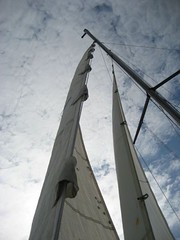
On sailing a Folksong

At the top of this blog is a subtitle which says ‘”Blue Mistress” our Folksong 26’. The blog was started with the intention of seeking out other Folksongs and learning more about the boat.

However, in the past year, I have only occasionally written about Blue Mistress and I think it is time to get a series together for other Folksong owners and anyone else who is interested.

Blue Mistress – January 2008

Firstly, the honeymoon was over for me in the spring. Blue Mistress was no longer ‘new’ to me. A couple of major refits had been completed and I had become familiar with the boat. I could go aboard and know that she would be dry below despite the heavy rains we were having. In a sea, I could trust the engine box not to come apart. I have solved some basic stowage problems, and so on.

People are very complimentary about her appearance. Being complimentary about a boat will always flatter the owner and I’m no exception. I would like to say that I carried out all the work, but it’s not true. I’d like to say I spend more time sailing than I do, but I don’t spend enough time, I have to earn a living.

However, from being a very naive owner of a boat, I am now slightly less so and ready to talk seriously about the ups and downs of sailing this boat. When they are ready, I hope other owners will join in. I am not a committee person or a ‘lets all do this together’ person. I value my independence. But neither am I so dumb that I can’t see that two, three or more brains bent to a problems can be very useful.

Plymouth – early Friday evening

In my teens, I dreamed of sailing all day and arriving in the early evening in some isolated cove, with a sandy beach, palm trees, a freshwater spring – and all the other things teenage boys dream of.

Well, these days, reality is slightly different but no less interesting.

On Friday, I sailed out of and arrived back in Plymouth – the sun shone, the wind blew hard enough, there were few boats around, Blue Mistress flew along – a fantastic sail. I didn’t arrive back to palm trees waving in the breeze but to a view that countless seamen have had reason to appreciate.

I took these in quick succession.

Before me was the Royal Citadel, with the Royal Plymouth Corinthian Yacht Club in the foreground.

Over there was Plymouth Hoe, where Sir Francis Drake was given news of the Spanish Armada – the lighthouse is Smeatons Tower brought ashore and rebuilt when it was replaced with the new Eddystone Lighthouse, ten miles offshore.

And, to starboard, was Mount Batten. My course lay in this direction.

The aim of this post is not to act as a tourist guide to Plymouth (although I’m happy to do so), but to note the excitement of coming to a mooring in the evening through waters that generation upon generation have used before – and generations will continue to use.

We must keep it right for them.

A salutary lesson in getting back on board

I went for a swim on Saturday.

Peggy and I chose what felt like the one sunny day this August, with a perfect wind for sailing, not to sail but to take a couple of hours out and motor out into the Sound for a picnic.

We anchored under Jennycliff, where the bushes and shrubs come almost down to the water, and a narrow waterfall splashes onto the rocks. We were out of the wind, on a perfect holding ground, with the sea sparkling, enjoying the warmth of the sun – yes, this is Devon.

Ever since I bought Blue Mistress, I have been wondering how to get back aboard should I ever go over the side. In a high-sided boat with a near vertical transom, I would have a metal boarding ladder which folded down. In an open-sterned vessel, I might have a built-in step. But Blue Mistress is neither of these – sloping transom, elegant sheer. A ladder attached to the stern seemed far too cumbersome for such a boat.

So, last spring, I invested in a simple ladder I could stow away a neat, collapsible boarding ladder, which can be stowed away with ease. 112 cm long with 6 rungs and spacers to hold the ladder away from vertical surfaces •Very stable and safe • Weighs only 1.3kg • folds down to just 255x255x125mm • Safe Working Load: 226kg.

The lesson is there in the detail, of course, and you can see what’s coming – but to date I have been very pleased with it – neatly stowed away in a stern locker, waiting to be tested.

So yesterday, I said, “We’ll try the ladder out today. Better I go first in case there’s a problem.”

With my smart, white ladder hooked over the shallow toe rail, and the top rung made fast to a winch base on the cockpit coaming, I stepped over the lifeline and descended – rather more swiftly than I intended, but with what grace I could muster, into the water. The temperature was ok so I spent time swimming around the boat, cleaning the algae off the waterline. It took about fifteen minutes to go round. The sides are low enough for me to hang onto the toe rail with one hand and clean the sides with a rag using the other hand.

The one area that was difficult to clean was the starboard quarter, which, as she is moored head to stern, is the one area of the hull the sun (when it does come out) doesn’t reach.

Now comes the time to get back on board. I had already realised that the sides of the boat aren’t high enough to support the bottom of the ladder – it slides away from me. My first attempt leaves me taking a wild clutch at the lifeline and falling back into the water – strike one.

Peggy moves the ladder towards the stern. I think it will be ok this time because I can grasp the stern rail. But the sheer is greater here and my legs go from under me. Not only that, the ladder slides off to one side. This time I am higher out of the water – (and I am not strong enough to hold on). The subsequent descent gave me a fine view of the bottom of the rudder – strike two.

The splash was also very effective and we have attracted the attention of several boats anchored nearby. Drinks are put down and binoculars come out (at least, that was the feeling I had in the back of my head). Better get it right this time.

We decide that we will try further forward as a last try. (Plan B is to swim to the next boat which does have a fold-down ladder). I notice that I broke the ladder when I pushed it sideways and it won’t hang straight.

However, it doesn’t fold under the hull so much, so up I go, clutching a stanchion, not a little tired, but desperate to make it out of the water. There is a critical moment when my arms are being wrenched out of their sockets and I feel myself going backwards, but I make one last heave (it’s amazing what you can do when you have to), put one foot quickly on deck then the other and then over the lifeline – trying to look nonchalant, but, in reality, rather discomfited – (more hurt pride, and realising my age).

The ladder no longer folds neatly, (although it is repairable), and is no longer on the boat.

Ever since, Peggy has been unable to stop laughing when telling the story and I do feel a tad foolish – but I’ve been there, done it, learnt from it, and now have a design for a proper ladder.

Lessons learnt?

  • Think through what you need before you buy. There was nothing inherently wrong with the ladder, except it was on the wrong boat.
  • Read the specifications first.
  • Respect the fact that getting back aboard is more difficult than you think – even for a relatively fit person.
  • A firm, fixed ladder is better than a flexible one – I wonder about the safety rope ladders that hang on the stern rail. I know about climbing rope ladders placing your feet on alternating sides, but this is difficult against the sides of a rolling boat.
  • Lifelines and stanchions are not designed for this purpose. Although, I have to say, my starboard lifelines have now been thoroughly tested. 🙂
  • If I have had trouble getting back into a low-sided boat, how much more difficult is it to get on board the higher-sided ones?
  • Practice. I am responsible for my own actions. Therefore I have a responsibility to myself, and those who are affected by my actions, to try things out first. In theory, the ladder should have worked – I was very pleased with the idea, (in fact, I was convinced it would work). In practice, it barely made it. In this case, I was wrong to rely on my intuition.
  • So, a reminder: “theory” is good but “practice” is better. You do need both and, at sea, you have to marry them together, (sometimes very, very quickly).

An extra headsail

There was no wind yesterday morning when we left the mooring, and we motored across the Sound and out through the Western Channel on a glassy sea. One hour, two mackerel and a pollock later, a light wind ruffled the surface. Just enough wind to try different sail arrangements.

Blue Mistress shows a slight but noticeable wetherhelm in certain wind conditions and I have been wondering what difference an extra headsail might make. If I used the spinnaker halyard – (we have a spinnaker which I haven’t got round to repairing yet), and the deck fitting I normally attach my jack lines to, this was a chance to try it out.

From the depth of sail bag, I dug out our smaller jib and set it flying. It set very well and we made a gentle knot under this sail alone. Then I added the no. 2 jib which is the relatively heavier sail I set when single-handed in stronger winds.

I was trying to match sail shapes. The smaller sail has a longer foot than the no.2 jib but otherwise the match wasn’t too bad. After lots of adjustments, we found a balance and, still without the mainsail, we were making an extra knot or two. I took these images when we were reaching and you can see how the light wind affects each sail.

I need to think this through some more and would be interested to hear other people’s experiences/thoughts on headsails and weatherhelm.

During all this, we looked up to see three short but steeply breaking waves coming towards us out of nowhere. The sea was flat, there were no vessels creating wash anywhere near us, and yet suddenly we found ourselves beam on to a breaking sea. There was just time to disengage the autohelm and turn stern to. The second wave just lapped over the stern and then they were gone – the sea flat again. I guess some disturbance hundreds of miles away . . . but a reminder not to be fooled by the conditions and to keep a good watch . . .

Why I like sailing

I realise I haven’t written about Blue Mistress for a while now – but I have been sailing as often as the weather allows.

For those who like clips, this is another one in the Why I like sailing series – here

I have been told by someone who doesn’t sail that nothing appears to be happening in the clip. My reply is that everything is happening . . . beautifully.

Enjoy.

Enjoying the wait

The trapeze artist said: “Living is walking the wire. Everything else is waiting.”

The finest Sunday of the summer. The sun shone, the wind blew. A brilliant day for a sail.

But there was something wrong with the car. . . and, as I have damaged my thumb, sailing was out.

So we took the train to Exeter . . .

Teignmouth – Dawlish – Dawlish Warren – Starcross – Exeter St Thomas.

This is the coast-line – to be more exact, Isambard Kingdom Brunel‘s line, the line of his Atmospheric Railway.

The sea sparkled the way it does here when the wind blows from the west and stirs the calm surface to catch the morning sun.

A mile or so off the beach, a ketch, in full sail, was reaching across the bay. Each time we emerged from one of short tunnels through the cliffs, she had stretched away further south towards Hope’s Nose and Berry Head.

We stopped in Dawlish, then Dawlish Warren, (disembarking families carrying beach clothes and picnics), before we turned inland along the Exe estuary.

The tide was high and the Folkboat (I always notice her) was on her mooring. I had thought of keeping Blue Mistress here before settling on Plymouth.

It seemed that people were taking to the water wherever we looked.

In Exeter, they were enjoying the river, including the short crossing on Butts Ferry.

The ferry is left over from the wonderful and much lamented Exeter Maritime Museum.

The warehouse that housed the museum is still there. I have always thought, whimsically perhaps, of the boats moored along the canal as ganging up in sympathy for the small gem of a museum that has been lost forever.

We had come to Exeter to visit our son and spent the day doing ordinary things – walking and talking, greeting and eating, before returning to the train.

Along the Exe, the tide was now very low and the Folkboat closer to the shore – well, close to the bird flocked mud flats.

And in Teignmouth, in the late afternoon, there was gig racing. On shore, rowers were hurrying to their boats, busying themselves before the start of their race.

Offshore they were heaving on their oars, some boats flying, some labouring, all working to a common cause.

Today the rowers had been out ‘walking the wire’, while we were ashore ‘waiting’ and doing ordinary things – walking and talking, greeting and eating  . . .

and we were all having a thoroughly enjoyable time.

Helpful clips

I posted a short clip of Blue Mistress some months ago (the same clip I keep on my desktop at work!), but hadn’t thought much more about the medium – I have always preferred still images.

I went for a solo sail out of Plymouth one cloudy and suspiciously dark afternoon – (it blew up and rained after I came ashore).

There was a light breeze while I was out and the idea was to work with the autohelm, trying various sail trims, wind directions and so on. It was fun and I got several simple jobs done at the same time.

I though I’d try out the movie mode on the camera again.  And became irritated by the set of the foresail with its flapping foot – we sometimed accept things for ourselves that we wouldn’t accept if we thought other people were going to see them. Sad but true.

The view forward

It’s the sheet position of course, but getting the balance on an older sail is difficult when there has been some stretching. This is the foresail I would normally use in a much stronger wind. The genoa would have come into its own for the wind strength that afternoon, but we were in trials – not trying to break records.

So, a different tack, shifting the sheet one notch, sailing slightly further off the wind and it looks better. But I would like to sail closer to the wind with this sail, so I will need to think it through further.

Heading towards Plymouth

In the meantime, I have these reminders.

For love of a boat – in Crete

Aghia Galini, Crete 2005

I had intended posting a single image each week with no text. However, there was a comment to my initial post that took me by surprise and has made me reconsider.

Usually when I wander round a harbour looking at boats, especially in the Mediterranean, I am far too late to see the boats going fishing – they would all have been out earlier in the morning.

Therefore, of the many images I have collected over the years, only a few show boats as they should be seen – with crew – working. This image of a gentleman from Aghia Galini, rolling his sleeves up as he sets off, has long been a favourite. There is a promise of more to come – and a fine boat to accomplish it. Look at the wake.

So much for the romance. It was AA’s comment that concentrated my mind. He has kindly given me permission to quote the following:

“The preservation of some of these boats is an issue that is not met positively in Greece as well (which is where i am coming from originally)

Only for the last year or so there has been a society formed for the preservation of these boats but things are moving very slowly.

The boat you are showing is “lucky”. It has not been swept away because of a political decision to scrap it, like this one:

http://www.greektube.org/content/view/21126/2/

The government (prompted by some EU financial analysis) is trying to decrease “Professional Fishing” by giving money to fishermen to give away their older wooden boats. So, what do you do with a wooden boat once you have “bought” it in this way? Well, you scrap it in the most hideous way.

Some people have found ways to convert the bigger old fishing boats to recreation vessels for small tours and things like these but the majority of these boats end up chip wood.

The way i see it, these boats are products of a tradition that goes way back. Looking at them is like looking at a compact form of knowledge and experience…The boat is like a library but it has the fate of the Library of Alexandria.”

The last paragraph says it all. Watch the video carefully.

Now my simple pleasure has gained an extra dimension – and I add ‘Maritime History’ to the category list for this series of posts. There’s more to come.

The Cloud Appreciation Society

We were charmed to look up at the mountains across the water from Korcula to see this cloud formation.


I had never seen a cloud like this and wondered if it was a local phenomenon or whether we were just unobservant.

It remained over the peak for a long while and slowly developed.


I don’t think it is related, but that night we had a thunderstorm and a half. The lightning was right overhead and the thunder claps deeply thunderous. At one point, our window blew open.

Anyway, I have looked up the type of cloud (Google) and find it is a Wave cloud. This particular form is called Lenticular:

“Another way that wave clouds can form is where air flows over a mountain or hill. If a cloud forms on this wave, it is called “lenticular” (which means “lens-shaped”) cloud, which has a very smooth, symmetric appearance”

In my search, I came across The Cloud Appreciation Society. Now, I’m ashamed to say I laughed. What! There are people who watch out for clouds and take pictures of them!!

And then I paused – Oh . . . . . . .

Well, here are two more untouched images – (taken two days later on the ferry from Korcula to the mainland) 


– and long live The Cloud Appreciation Society.