
Paleochora, Crete 2009
I have started reading Mike Smylie’s ‘Fishing the European Coast’.
In 153 pages, he has written a comprehensive series of notes and reminiscences on the very wide range of boats found around the European coast.
It is the perfect overview for someone who enjoys differences in boat design from port to port, from local conditions to local conditions, from culture to culture . . . as well as for someone interested in the evolution of craft.
For example, over the past year, I have posted many images of Greek trechandiri. Smylie writes:
“The trechandiri is the workhorse of Greek coastal fishers . . . . . The advent of motors in the 1920s simply produced a fatter, fuller body section, while in profile they were unchanged. Once the rig was removed, superstructures were added! They are ubiquitous throughout the Aegean – that sea of thousands of islands, and have one thing in common, a length/beam/depth ratio of round about 9:3:1. There are two schools of thought on their origins. Some say they developed from a particular type of caique, first built in Hydra in 1658, while others suggest they evolved from the trabaccolo, a type of sailing vessel used for trading in the Adriatic.”

Agios Nikolaos, The Mani, Greece 2007
Length/beam/depth ratios have taken on a new meaning :-).
Mr Smylie adds to what I learnt from the National Maritime Museum in Falmouth earlier in the year and from Denham’s book on ‘The Aegean’.
And the images have taken on a new meaning too.
For the origins of this image series, here


 Or that the loo facilities have been thought through properly and, suitably primed, are now satisfactory.
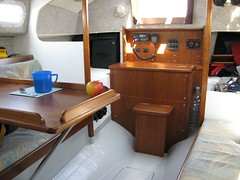 Perhaps it’s because I have rethought the locker stowage so that more gear is to hand – gear that, in the past, had been ‘put away’ to be sorted out later.
 Beyond Steeple Point