For love of a boat – Birling Gap

Birling Gap 2009

Here is a problem most fisherman don’t have to face. Note the tideline.

Not only has the boat to be dragged up the shallow beach out of the tide’s reach, but, having hauled it up the scaffold, there is the further irritation of the gear falling out.

The Birling Gap section of this very beautiful coast is eroding faster than the rest, the buildings at the top of the cliff heading for the sea.

Seven Sisters, East Sussex 2009

For the origins and full set of images in this series, here

For love of a boat – Keep turning left

I’ve been watching and thoroughly enjoying Dylan Winter‘s short videos of his trip round the UK.

The series is called ‘Keep Turning Left – around Britain in a small boat’.

The boat is 19 foot. He starts in Bembridge on the Isle of Wight. I have just watched No 16 – we are in the Medway!

I am not convinced by every one of his opinions, but his description is excellent and the camera work great – particularly of the working boats and especially the Thames barges.

Gentle stuff to idle away an evening – passed parts of the country I have visited recently.

For love of a boat – Dungeness 2009

We walked along the shingle at Dungeness from the Britannia Inn to the Pilot Inn keeping close to the surf.

The sun shone and a heavy north easterly breeze made for a bracing walk.

~~~

RX  is the code for Rye and Hastings on this south coast.

At Hastings and here at Dungeness the boats are not moored in port, but hauled up the shingle beaches – either by heavy winches or by caterpillar tractors.

The distinctive sterns are designed to take the surf at launch and haul-up.

What surprised me – (perhaps it shouldn’t have), was the identical fishing boat fifty yards along the beach.

The design is timeless – only the materials have changed.

For the origins and full set of images in this series, here

On sailing a Folksong – wind over tide

“My second priority was performance – speed on all points of sail and the ability to keep going in a short steep sea where you’ve the combination of wind over tide in shallow water.” – Eric Bergqvist

“When waves run from an area of relatively slack water into an opposing stream they will bunch up in a way similar to when they run into shallow water. Likewise, if waves run into a stream flowing in the same direction, they will spread out.” from Weather to Sail, by Mike Brettle and Bridget Smith

~~~

After the Yealm trip, the crew went home and I spent the night on the boat – bacon, two eggs, beans followed by half a tin of pineapple chunks, then tea and chocolate, a Raymond Carver collection of short stories and the weather forecast – bliss.

Except the weather forecast was bleak – southerly winds, (force 7 was mentioned), rain, poor visibility.

The rain arrived in the middle of the night, beating an uneven tattoo on the deck, while the wind flogged a loose halyard against the mast of an unidentified boat nearby.

And in the morning? Well, what do you do? Stay in your bunk bemoaning the bad luck that brought inclement weather on the one weekend you had to spare for the boat – or do you do something?

OK. Going to sea in a 25 foot boat in poor visibility with the possibility of force 7 onshore winds is not sensible. How about gaining some experience with a motor/sail inside the Sound and up the Tamar to the Lynher River and back?

Not particularly sensible either. The challenge here would be heavy, possibly gusting winds opposing an ebbing spring tide – one of the highest of the year, meaning strong currents, broken water and short steep waves. In our first year with Blue Mistress, we had a swing mooring on the Tamar – on the Cornwall side of the river at Torpoint. I am more than aware of the effect of wind over tide here, and the way the wind can funnel up the river.

Blue Mistress at Torpoint 2006

On the other hand, this a boat designed with such conditions in mind.

And, if nothing else, it would be a chance to see whether my new flotation suit is waterproof!

~~~

The sail from the Plym to the Tamar is brisk – foresail only. The Sound is lumpy, the outgoing tide from two rivers meeting somewhere along the way and the wind blowing hard from the south. Dinghies are flying to and fro to the east of Drake’s Island preparing to race. RIBS full of stewards flitter everywhere.

The current flowing through the Narrows slow us to 1 knot – engine and sail. Sheltered from the full effect of the wind, the water is smooth here, but as we turn north into the wider expanse of the Tamar, the waves become more urgent. By now, there are three of us yachts running with the wind, occasionally surfing, but comfortably settled to the task, helmsmen concentrating.

The car ferries are still running. I commit to going astern of one ferry just leaving the Torpoint shore and have to alter course more than expected passing in close to the fixed moorings – carefully avoiding the ferry’s chain.

We meet one of two fishing boats, powering into the waves, throwing water aside. Towards the entrance to the Lynher, my companions keep straight on towards Saltash while I veer slightly to port looking for the red canister buoy that marks the entrance to the channel. Here there are Royal Naval moorings, with various barges attached.

At his point I am passed in very quick succession by four large RIBs each carrying perhaps a dozen or so helmeted young sailors making for HMS Raleigh. I get a few side-lnog glances but in the main each man clutches firmly the back of the seat in front, looking determinedly forward in the, by now, heavy rain. They must be looking forward to hot drinks and dry clothes a few minutes ahead. As they disappea down the line of bargees a naval launch scuttled past, an officer leaning nonchalantly against the cabin top. They show the way to the buoy and disappeared up river.

~~~

So, rounding the buoy into the Lynher, we (boat and I) are faced with a strong head wind, a strong out-flowing tide and smoother water.

Although we can manage the stretch to the next buoy close-hauled, the sail will have to come down. There follows a few minutes scramble as I point the boat into the wind, slight throttle on the engine to give some direction – (but wind and current too strong to keep that direction for long), let go the jib halyard, rush forward to catch the sail before it drops in the water, hurriedly make it fast to the lifelines, back to the tiller to bring her back into the wind – which requires more throttle than expected, forward again to tidy loose ends, and back to regain control. Thank goodness for the low cabin top and free movement forward on the Folksong.

I motor slowly past HMS Raleigh and turn across the wind towards Antony Passage, making the red canister buoy. At this stage, the prospect of an even slower plod straight into the full force of wind and current loses its thrill and I decided to turn for home.

A large (40 foot?) yacht is running downwind and passes me at speed, three older gentlemen on board, blue ensign flying. I follow her, travelling fast now with wind and tide. under engine only, knowing that all would change when we reach the Tamar again.

An even larger ketch motors across in front of us, seemingly heading for a quieter mooring in the lee on the North Wilcove side.

A white, wooden Folkboat motors upriver towards Saltash, towing a small pram dinghy.

The yacht ahead, heeled abruptly taking the full force of the wind and headed close-hauled to the Devon side on the river. I keep close in the slight lee on the Cornish side until there is no choice but to face the wind.

~~~

It would be possible to write an exciting adventure story around this – how we overcome wind, waves and repeated danger to triumph in the end. But the point is that the boat is up to the trip. All that is required of me is to make directional decisions – keep to a sensible course and speed and avoid taking a wave over the side.

We enter the main part of the river through two standing waves. They are quite steep and close together – or seemed to be as there isn’t time to think about them. Blue Mistress lifts to the first one and comes down onto the second one, slicing into it, throwing water aside – the long keel keeping a firm grip. Very little comes on deck, despite the low freeboard. This seems to be the pattern – spray will blow aboard, but green water very rarely. (As EB says, she was designed to take this).

The wind is strong and steady, throwing up plenty of wind-blown spray. This is the first time I have ever had to abandon my glasses – too salty of see through, too much rain and too much concentration on steering to clean them.

This length of the river is a little over two nautical miles long with a width varying between a quarter and a third nautical mile. Apart from the car ferries and the police patrol launches, there is no one ahead of me. The yacht that has been ahead is now behind and a little later she disappears into the Torpoint shore. The prospect is bleak – empty wharves, dockside buildings, moored yachts appearing and disappearing in the incessant rain.

As we progress, wet sails ready to set if the engine failed, it looks as though the water is slightly less rough over on the Devon side and I angle across. Looking back, I doubt if it was – it certainly didn’t feel it at the time. The waves are short, steep and some of them are breaking – not dangerously, but enough to want to avoid them. At no point am I concerned, but once or twice I remember something my grandfather used to say – “. . . no more – – – – – – sense than he was born with.”

At the end of the straight a much larger boat suddenly appears round the corner heading upriver and we get a friendly wave – then I saw him look upstream and then back across at Blue Mistress and give a thumbs-up. Actually, that’s what I thought, too.

The rest is straightforward. The current down to the entrance to the Narrows is still strong, but the water smooth. I cut the engine, set the foresail and we shoot back to the Plym, passing the Brittany Ferries’ ‘Pont Aven’ manoeuvring stern first into her berth. At the entrance to Sutton Harbour, a large white yacht appears, pauses while a conversation is held in the cockpit, turns and disappears back into the marina.

I lower the foresail off the Cattewater wharves and motor back to the mooring, picking up the trot rope easily in the now slackening tide.  The time is 1430.

Leaving the soaking sails on deck, the rest of the day is spent with Raymond Carver below – and the rain keeps falling!

From the east coast

Back online again.

14th September

There is no internet connection here. I have a chance to finish a couple of long posts that I started a while back and will feed them through as and when.

~~~

We are on the east coast – in a cottage looking down onto Southwold beach. We fall sleep to the sound of waves breaking on sand and wake to the sun rising out of the sea – well, we would do if the cloud hadn’t followed us from the Wescountry.

The lows that have affected the west all summer have given way to high pressure, causing a layer of cloud over this part of the coast and a very bracing north easterly. It does look better this morning, patches of blue sky, the sun spilling intermittently on the water and the wind lighter.

Yesterday, a blue yacht about the same size as Blue Mistress motored up the coast, pitching into the seas, a lone figure at the helm, mainsail ready. I guess he had the tide but it looked a long hard slog into the wind.

~~~

Ships off Southwold 2009

The horizon here is full of ships. At night their lights spread into the distance – twenty four vessels at the last count.

This is a sure sign of the recession.

We have come all this way to see exactly what we see each night off Teignmouth. There are twelve vessels there, moored closer inshore.

The last time this happened was in the early nineties.

When the ships disappear, then we will know the recession is almost over – but not until.

On sailing a Folksong – Fram and Eric Bergqvist

I am not the only one owning a Folksong. In fact, compared to some, I am very much the novice – (as anyone who has read this blog for a while can testify). However, I have learnt a thing or two and I know a gem when I see it.

Kite gybe

This is Fram. The picture speaks for itself.

Mike Burns wrote at the end of last month:

“I home completed a Folksong in 1984 . . . and still have her . . .

“Maiden voyage in 1985 was circumnavigation of the north of Scotland, ie. clockwise Fortrose to Fortrose via the Caledonian Canal.

“Raced her last weekend single handed, flew spinnaker & also had to anchor up when wind dropped & strong tide, only came third out of 8 mixed handicap boats. Had to winch up the anchor with the genoa winch!!”

He has kindly sent images of Fram and copies of his original documents, and has given me permission to publish them here which I am delighted to do. Thank you, Mike. I hope we will exchange more details as time goes on.

~ ~ ~

Among the documents is an interview with the Folksong designer – Eric Bergqvist.

In it, he says: “I wanted a yacht fit for sailing single-handed in the Irish Sea.

“The first of my three requirements was that she had to be attractive. Pride of ownership is always a top priority and a gentle evening’s sail followed by a few pints and a chat at the club can be just as rewarding as a landfall after a long passage.

Fortrose Harbour

“My second priority was performance – speed on all points of sail and the ability to keep going in a short steep sea where you’ve the combination of wind over tide in shallow water. Self-steering is, in my opinion, the best aid to navigation, enabling the skipper to keep dry, warm and alert. The Folksong’s long keel gives good directional stability and suits the construction of a very simple self-steering device.

“My third requirement was ease of construction. Simplicity is the essence of both good design and economy, and I’m not in the position of having a lot of money tied up in a yacht.

These three requirements: looks, performance and economy all add up to a fibreglass Folkboat.”

With dolphins

That sums it up for me. Even though I have spent more money than planned on Blue Mistress – (yeah, well . . .), she is still more economical than many similar boats from the more well-known classes. She performs well and looks good.

~~~

Now, some detail. In the extract above, he talks of “the construction of a very simple self-steering device.” Do any Folksong (or Folkboat, Folkdancer or similar long-keeled boat) owners know which one from the early eighties he may have been referring to?

On sailing a Folksong – a spring tide sail

We sailed round to The Yealm thinking, if we got it right, we could have lunch in Newton Ferrers. I wasn’t familiar with the river and certainly not sure about the tide – a high spring tide which would still be ebbing when we got there. The wind was from the west.

Leaving Oreston just after the top of the tide, we made fast progress even though the wind was light.

There is a wind level – low Force 2-3, when Blue Mistress‘ weight and shape tell against her when compared with less heavily keeled boats. A couple of yachts passed us in style.

We enjoyed the sail, boiling the kettle and making tea, talking of this and that.

However, rounding Great Mew Stone with plenty to spare, we had to concentrate as we  headed into Wembury Bay on a dead run, the genoa goose-winged to port.

There seemed to be more wind here and we occasionally surfed as the sea and wind piled up against the tide pouring out of the Yealm.  The sun reflected off the tops of the waves and boats not too far away disappeared hull down, to rise immediately on the next wave. Several boats were motoring out from the river, lifting their bows and showing their keels, as they worked into wind and sea.

We followed a boat ahead who seemed to know where she was going and watched as the foresail came down and she disappeared into the narrow entrance.

Our turn next. Not wanting to risk any sail inside, we lowered the genoa first, Charles negotiating the tricky task of keeping it inboard. Then into the wind, momentary chaos and the main came down. Then, boom secured with mainsheet, a few minutes of  grabbing, rolling, hurriedly tying flogging canvas – a less than neat job (below) but good enough on a moving deck.

We motored past the bar, watching the tide flow round the two port hand buoys before following the leading marks across the river, then through the many moorings to the first pontoon.

Choosing the outside of the pontoon to avoid the possibility of rafting, we accepted the weight of the tide would hold us against it. I hadn’t bargained for just how strongly it would hold us. The direction and force of the outgoing tide can be seen in the image below. Mooring lines were almost superfluous. Getting off would obviously be interesting – but first thing first – lunch.

It was good too -:)

It was about 1400 when we got back. Low tide at The Yealm entrance was 1500, giving 0.8 m clearance above LAT, enough for us if we kept to the narrow channel.

As expected. the weight of the tide was still holding the boat against the pontoon, but it had slackened enough for the two of us to push the boat off and move our large round fender to the starboard quarter. Removing the mooring lines had no effect. A combination of heavy push with boat hook at the bow and gentle astern on the engine with the tiller to port, brought her quarter onto the fender and her bow away. Briskly forward on the throttle and we left the pontoon headed upstream looking for space to turn – briskly because there is a certain point when the tide will catch her and she turns downstream whatever I do – in this case it would have been into the cruiser moored astern of us.

The ferryman had mentioned that they would be playing cricket on the sand bar today to celebrate the particularly low spring tide. The short entrance to the river is very narrow, a few yards wide, rocks on one side, sand bar on the other. The light surf was clearly visible on the exposed sand bar as we crossed the river towards it.

Yealm sand bar – Great Mew Stone behind

There were yachts moored in Cellar Bay as well as many dinghies on the beach. People were on the sand bar – the whole area a hive of activity.

Yealm sand bar – exposed at low spring tide

A few minutes later we were through the entrance into an altogether different sea to the one we had met in the morning.

Yealm entrance – the extreme right hand yacht is in the channel.

Sailing close-hauled across the Bay towards Great Mew Stone, we noted the exposed Inner and Outer Slimers, tacked across to clear the Western Ebb Rocks, tacked again before we reached them, cleared Mewstone Ledge and eased away onto a close reach across to Cawsand. Then home on the incoming tide.

It was one of those days. No broken records, no prizes, just a great day sailing.

On sailing a Folksong – Saturday morning

I went down to the boat on Friday evening to spend a few days on board.

The following morning, having worked out the early routine, I made a cup of tea and sat with my head out of the hatch to enjoy the peace in the morning sunshine and watch the tide as it slackened towards high water. Today was the top of the spring tides – (0903, 5.4m; the still higher 5.7m due just after 2200). I cannot remember seeing the level so close to the top of the Cattedown Wharves (below).

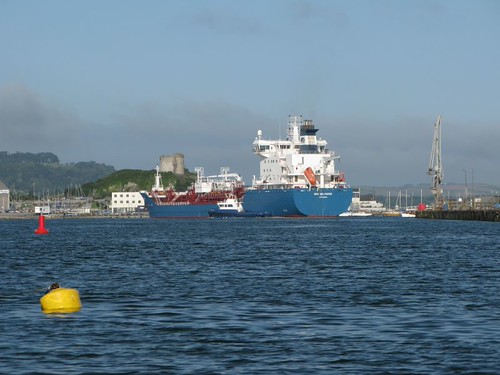
A blast on a ship’s horn and the bow of Bro Deliverer, registered in Goteborg, appeared from behind the sheds – adding a different shade of blue to the scene and totally changing the perspective. A tug and the pilot boat tripped alongside her.

0756

She nosed into the turning area and came around stern first. The tug scurrying around while the pilot boat stood off with an air of dignified watchfulness.

A yacht motored briskly out of the Yacht Haven, promptly eased off and drifted gently, waiting for the ship to slip up river stern first.

0800

A few minutes later, a pleasure boat left its berth on the outside of the Yacht Haven pontoons and hurried around her bow to pick up its first passengers of the day.

Meanwhile, Bro Deliverer came level with the wharves and, with a little help from the tug, eased sideways into her berth. Lines were thrown and she came to a stop, dwarfing the cranes and sheds.

0815

All was over in 20 minutes or so – a well rehearsed routine, neatly accomplished by the ships crew, the crews of the tug and pilot boat as well as the shore crew.

My brother rang at this point to say he was five minutes away. Time to row ashore.

On Steeple Point – prevailing wind

AA comments:

It has been proved that the weather is unpredictable in the short term. One more reason for Britain lying directly below a jet stream delivering storms from the Atlantic. (If only Fitzroy knew that 🙂 )We can only establish some long term (seasonal) trends.
For example, in Greece it is known that “The ‘weather’ always comes from the West” whereas over here (UK) the direction is SW….There is evidence for this on the way that older trees are bent.

Do you mean bent like this? 🙂

Stowe Barton, Christmas 2009