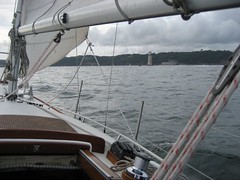
Five things good. five things less good

Five things I was pleased with last trip:

1. We left the mooring neatly with a new crew.

2. We hoisted the mainsail without catching the battens in the lazy jacks. (How easy was that?)

3. I really enjoyed sailing with this crew too. In the past three weeks I have sailed with eleven different crew members – all family, only three of whom had been in the boat before. Being with family is great – skippering them could be something else. In the event, all was well.

4. We returned to the mooring with everyone knowing what to do – and doing it, even though I was the only one who had done it before. The system works!

5. Curiously an accident proved a blessing. A lifejacket was dropped in the water and auto-inflated. Well, now I know they work! And I now know how to reset them.

 Five things I could have done better:

1. I went below without checking whether any boats were closing on us, and was called up in a hurry to find a 20 foot closing fast on the port tack to our starboard tack. He seemed not to notice. I should have been more vigilant for the new crew.
IMG_0512
2. The tide was taking us down onto the Shag Stone and we ended up starting the engine to weather it. We could have made it under sail with a little more forethought.
IMG_0506
3. I couldn’t make up my mind how best to set the sheets on the genoa – when to run them inside or outside the shrouds. I think we could have sailed more effectively to windward. May be that would have made the difference at the Shag Stone.

4. I had planned to keep a detailed log as a navigational exercise even though it was a day sail – and didn’t. I do need the practice.

5. I also need a checklist for leaving the boat – this was the second trip running I left something on board and had to row back to the mooring to fetch it.

The Folksong 26 (sic)

Blue Mistress back on mooring 1
The main reason I started this blog was to find out about the origins of the Folksong class, and hence my own boat ‘Blue Mistress’. I have learnt a great deal and met some good people from doing so, but after nine months I still only had part of the Folksong story. 

On Saturday, thanks to a small note in Sailing Today, I found a new website www.yachtbrochures.co.uk, run by Mike Davies. Included in a very long list of class names is “Folksong, Eric Berquist, 1983”. Search over.  Mike replied almost immediately to my email and the transaction was completed within a few minutes. An excellent service. Thank you. 

So I have received a brochure written for the Southampton International Boat Show, Mayflower Park, 17-24 September 1983 (Stand B10).  From this I learn that the Folksong was originally sold as “a thoroughbred cruiser/racer you can afford”. 

“Based on the lines of the Folkboat, the FOLKSONG embodies the three principle virtues of that classic boat – looks, performance and economy.”

The builder was Eric Bergqvist, Boatbuilder, The Square, Lymm, Cheshire. 

“Specifications: LOA: 25ft 2in;  LWL: 19.8ft;  Beam: 7ft 3in;  Draft: 3ft 9in;  Ballast: 2500lbs; Hull: GRP, 7oz from deck to waterline, 11oz below; Deck: glass fibre sandwich construction with built-in non-slip surface; Cockpit: self-draining;  Sail area: 280 sq ft;  Engine: provision for an outboard well or an inboard engine.” 

“The Folksong is based on the lines of the Folkboat which was designed in 1941 for a Swedish Yachting Press competition. Over 2000 Folkboats have been built embodying the traditional virtues of a long keel, conventional outboard rudder and seven eighths rig with a sailing performance to match. Although the Folkboat design was intended for wooden construction, clinker and carvel, three fibreglass versions have since been moulded. The Folksong is the only one designed specifically for home completion.

In order to retain both the classic lines and the excellent performance of the craft no attempt has been made to cater for standing headroom. If necessary though, this could be achieved with the use of a spray dodger. The accommodation is not spacious but the layout is flexible. With thoughtful planning and use of timber and fabrics you can create an interior which is warm and comfortable as well as practical.

Twenty five feet is the minimum length of yacht generally considered capable of continental cruising without bravery or heroics. The Folksong is an uncomplicated yacht – economical but with no compromise on safety.” 

There’s more. If you own a Folksong and would like to discuss it, please contact me. Alternatively, I recommend Mike Davies’ website.

A Good Afternoon Out

With a single reef in the mainsail and the No.1 jib, (a former mainsail cut to size), Blue Mistress sails beautifully.  

There was a grey cloudy sky yesterday afternoon, with rain to come. The forecast said the wind would lessen as the afternoon wore on. But Charles and Annette were on holiday and wanted to sail and Peggy said she’s come too – (none of them wanting to sail more than I), so we went. 
A good afternnon out
We put our nose out round the Breakwater into the teeth of a long swell and decided that, with the wind lessening, it would be more fun to sail inside the Breakwater.  And it was when we had tacked and eased the sheets slightly into a close reach across relatively calm waters that the boat came alive. It’s difficult to describe but there was a moment when the rhythm of the boat stepped up a notch. It was the sort of unlooked-for feeling you get ‘in your bones’. Maybe it was the movement through the water as we picked up speed, maybe the various sounds changing, maybe it was the set of the sails or the feel of the wind on my cheek, but I found myself knowing precisely why I am pleased with Blue Mistress and why the wait for the work on her to be completed has been worth it. 

As we headed towards the bridge between Drake’s Island and the Mount Edgcumbe estate to enter the Tamar, a fleet of Lasers swept down on us. A few minutes before they had been a mile away over towards Cawsand, now the leaders were on us and there was that tricky moment of how to avoid them. They seemed to be everywhere – enthusiastic youngsters seriously racing.   

Once on the Tamar, with a light drizzle and the wind dropping, it was time to shake out the reef – and the genoa might have helped but the wind was dropping fast and it fell altogether as we came level with Millbrook Lake. 
Millbrook

So a chance to recharge the batteries and enjoy a gentle motor up river past the naval dockyards before returning to the Plym.  

The drizzle stopped as we were directed inshore towards the Mayflower Marina to avoid another warship plus its attendant tug, police boat and various ribs.  
by Mayflower Marina
It’s only the second season I have sailed in Plymouth and I am still ‘green behind the ears’, so maybe I am a little naïve, but, as my Dad used to point out, when you’re on the water, there’s always something happening and always something to see. Don’t miss it. It’s particularly true here.
The pleasure of being on the water

Post Refit Review

One of the problems last year was the hatches in the stern. Firstly, they leaked, and, secondly, the tiller got in the way when opening them. So the new design had to solve both those problems and still leave two lockers with openings large enough to take, for instance, a spare fuel can, meths etc that we don’t want to store below, plus immediately accessible warps, fenders, a fishing line and so on. It also needed to be lockable. This is the result. They lock from the inside – (answers on a postcard, please!).    
Stern Lockers

Also, the false cockpit floor had taken a battering with large crew members for ever stepping heavily onto it. By putting in floorboards – (two for ease of removal), the load has been spread. Also, the slight problem we have with the small amount of water coming back through the cockpit drain has been reduced (not yet solved) by the extra height of the boards. And, finally, it looks good. 
New floor boards
The third improvement, apart from the new halyard winches, is the option to put a polystyrene weatherboard in the companionway. It gives a clear view through to the cockpit from the cabin. When not in use, it stows in a smart Velcro-ed foam pocket to prevent scratching. I opted for the double weather board because I found the single one that was there previously difficult to stow when not in use. With the new lower one installed, I can still get in and out of the hatchway without having to remove it – (just!). There is another upper board that locks in place.
IMG_0360

Trial sail

We finally went to sea on Saturday afternoon – Pete and I. A run to stretch the sails and check the rigging.  

I had planned to go on Friday but the weather dictates – and this year it is dictating more than average. It seemed that most of the boats in Plymouth were taking advantage of the sunny day. 


Uncluttered deck
The deck proved good to work on. The Folksong deck is uncluttered anyway, but painting it this colour with an uninterrupted non-slip surface makes it seem large. 


New grab rails
Also, placing the grab-rails around the edge of the coach roof has kept the coachroof free to walk on. They make good toerails when sitting full on the deck, and are not too high to sit inboard with feet on the toerails proper.


No.2 jib
The wind was dropping as the afternoon wore on. It was really a genoa wind but I wanted to try out the No.2 jib. This is a heavier sail and cut differently from the others. It also stretches the full height of the forestay, whereas the luffs of the other sails are shorter and their tacks can be raised with a strop to make visibility easier.


Plymouth Breakwater - high tide
Blue Mistress handled well but it kept her speed down and I felt a hint – (just a hint), of a need to compete when we joined the line of yachts returning in the early evening. We had sailed gently along the outside of the breakwater towards them, gybing round the lighthouse on its western end, just as a Contessa 26, a boat I remember admiring last year, powered by with spinnaker set. 

We have a lot more to do before we can look in that direction.

Back online

Finally, I am back online.

A crashed laptop screen and a move to a new laptop – this time installed with Windows Vista rather than Windows XP.Unfortunately not as simple as they would have you believe, as the complexities of both systems do not tie in without, what to me, was considerable frustration. As much as I am interested in computers, it’s what I can do with them rather than what I have to do to them that turns me on. I can’t help feeling that, when it comes to the whole digital thing, more is being promised than can be delivered. Maybe it will be there in the future, but it’s not quite there yet. I wanted to install the RYA/Admiralty chart plotter which worked perfectly on Windows XP. I spent ages trying to get the charts uploaded, and then more time looking for help. In the end, both the Tamsin Vickery at the UKHO help desk and Rob Melotti, the news editor of New gear and Cruising at Practical Boat Owner came up with the answer simultaneously. My thanks to them – if only they could help me one or two other programmes. If you are interested, the answer is on this link to the Practical Boat Owner site – here. It’s fine now.

Outside again

What do you think?

I took these pictures yesterday, having spent the past two weeks in Greece (more of that another time).

This was my first chance to see Blue Mistress re-rigged in her new look.

So I walk round the corner and this is what I saw.

Outside the Hangar 1 13/06/07

Imagine how pleased I am – Richard, Andy and Robbie of Dicky B Marine have done a beautiful, professional job on her.

For Folksong owners I will try and fill in the detailed work on the deck later.

In the meantime, just enjoy the lines.

Outside the Hangar 2 13/06/07

Outside the Hangar 3 13/06/07
Perhaps the rudder is a little ‘overworked’, and I wonder whether a protective strip extending from the end of the keel might act to prevent a stray warp getting caught in it. I am assured it hasn’t happened yet, but . . . . . .

Have others had experience of this?

Do it myself? You’re joking.

Back in the winter, when I was thinking about taking off all the deck fittings, stripping and recoating the deck and then reseating the fittings, there were a few wild moments when I thought I ought to do it myself – perhaps with a little help. Thank goodness I saw sense. It would have been an unmitigated disaster.

First epoxy undercoat

Forget for a moment the stripping and reseating, the recoating of the deck alone has involved intensive preparation, an initial application of epoxy undercoat, extensive sanding and filling, followed by four further applications of epoxy undercoat, time for each coat to cure, followed by another two coats of the gloss and non-slip surface. My patience would have been exhausted long ago. I don’t doubt most people’s ability to learn on the job, but the amateur effort most of us would have put into the early stages would have made the final finish look very poor indeed by comparison with what is emerging now.

More undercoats and sanding

Thanks to Richard, Andy and Robbie, the result is highly professional, and Blue Mistress will be a pleasure to sail.

First gloss - non-slip to come First gloss

It will be worth the wait – even though April was the warmest since records began.  Boat out of the water – No chance of a sail – How frustrating was that??


A Warm, Dry Boat

Here is a very depressing experience: sitting in a damp boat in mid-winter, with a gale blowing, it’s getting dark, it’s raining hard and the deck-head lining has been removed to see if we can find where the water is coming through.
Leaking deck fitting December 2007

So, a couple of weeks ago, when I find a book entitled “A Warm, Dry Boat”, you can bet I will leap at it

I found it by Googling ‘heating for yachts’. This was the wrong topic to search on. It should have been ‘ventilation in boats’, but I only know that now because I’ve read the book.

So, is it to be A Cold, Damp Boat or A Warm,Dry Boat?

As you can tell, I highly recommend “A Warm, Dry Boat” by Roger McAfee. It took a little while to cross te Atlantic, but it has been well worth it.

Mr McAfee is Canadian and lives on the Pacific coast where it is colder and damper than the UK. So it’s  “put your pride aside, admit you haven’t got all the answers, find out from the people with experience.”

What have I learnt?

The refit was planned because various deck fittings were leaking and needed reseating. It was decided, because of the age of the boat and the distances that we might sail in her, it would be better to do the job properly and not skimp it.

I now know that merely replacing fittings is not enough to solve the problem. Moisture will still build up in the air inside this now water-tight (as far as possible) hull – moisture from body heat, moisture from any water in the bilges, moisture from damp clothing, mositure from the air – moisture that then condenses into droplets on cold surfaces and starts the process all over again.

If all that is done to alleviate this is to add a heater to give warmth, the first thing that will happen is that more moisture will be absorbed into the air, the greater will be the difference in temperature between the outside of the boat and the inside and the more condensation will occur. (How much moisture will depend on the heating system). This problem can be greatly reduced by moving the air that is high in moisture out of the boat and replacing it with fresh air, i.e. it is movement of air we are looking for.

In other words, a boat needs to breathe.

So we have to find ways of moving air, and, initially, because of the size of the boat, we will try to do this passively.

Fore Hatch

The fore hatch, which previously (as in the image above) hinged with the leading edge opening forward, is being refitted with the hinges forward.

Two reasons: a) It is safer – an unlocked hatch cover facing forward on the foredeck can scoop water into the boat at an alarming rate.

b) On the mooring, with the hatch propped open (the exact opening will depend on wind strength), the flow of wind from forward lifting over the hatch should create a potential vacuum at the opening, dragging air out of the forecabin. This should create a flow of air from the main cabin forward. By controlling the air into the boat from further aft, the movement can be maintained and the air exchanged.

In Blue Mistress, the companionway is fairly small, so we are dividing the drop boards into two so that the air intake through the companionway can be controlled by varying the combination of drop boards and the position of the sliding hatch.

Also, a large fuel tank that occupied the starboard quarter berths has been removed and both quarter berths are now open. There are further plans for these for next year, but, in the meantime, two small hatches in the sides of the cockpit aft can be opened and, with the companionway shut, air can now flow the full length of the boat.

It is also possible to have a spare drop board with a fan fitted to it (perhaps run by a solar panel). During the winter, this could be installed with a hose led to the bilge so that the air is ventilated directly from the dampest part of the boat, rather than allowing this moisture to flow into the cabin first.

That’s the theory. Now we need to get the boat back in the water to see whether the plan works. More of this later.