On sailing a Folksong – Ossian

Ossian

Ossian

Eddie writes:

“Only had the boat 7 months, previous owner had her based at Loch Melford near Oban, spent the first three months of the year traveling backwards and forwards every weekend getting her ready for the water.

Once launched we sailed around to the Loch Crinan then through the canal to Ardnishaig  then 54 NM dash down the Clyde to our home port of Irvine.”

As you know, I’m biased – but what a good-looking boat.

I’m particularly interested in the furling headsail – difficult to get my head round the ease of use against having a choice of sails.

As I get older, the prospect of the plunge forward becomes less appealing – on the other hand . . .

On sailing a Folksong – A ‘come-in’ for Blue Mistress

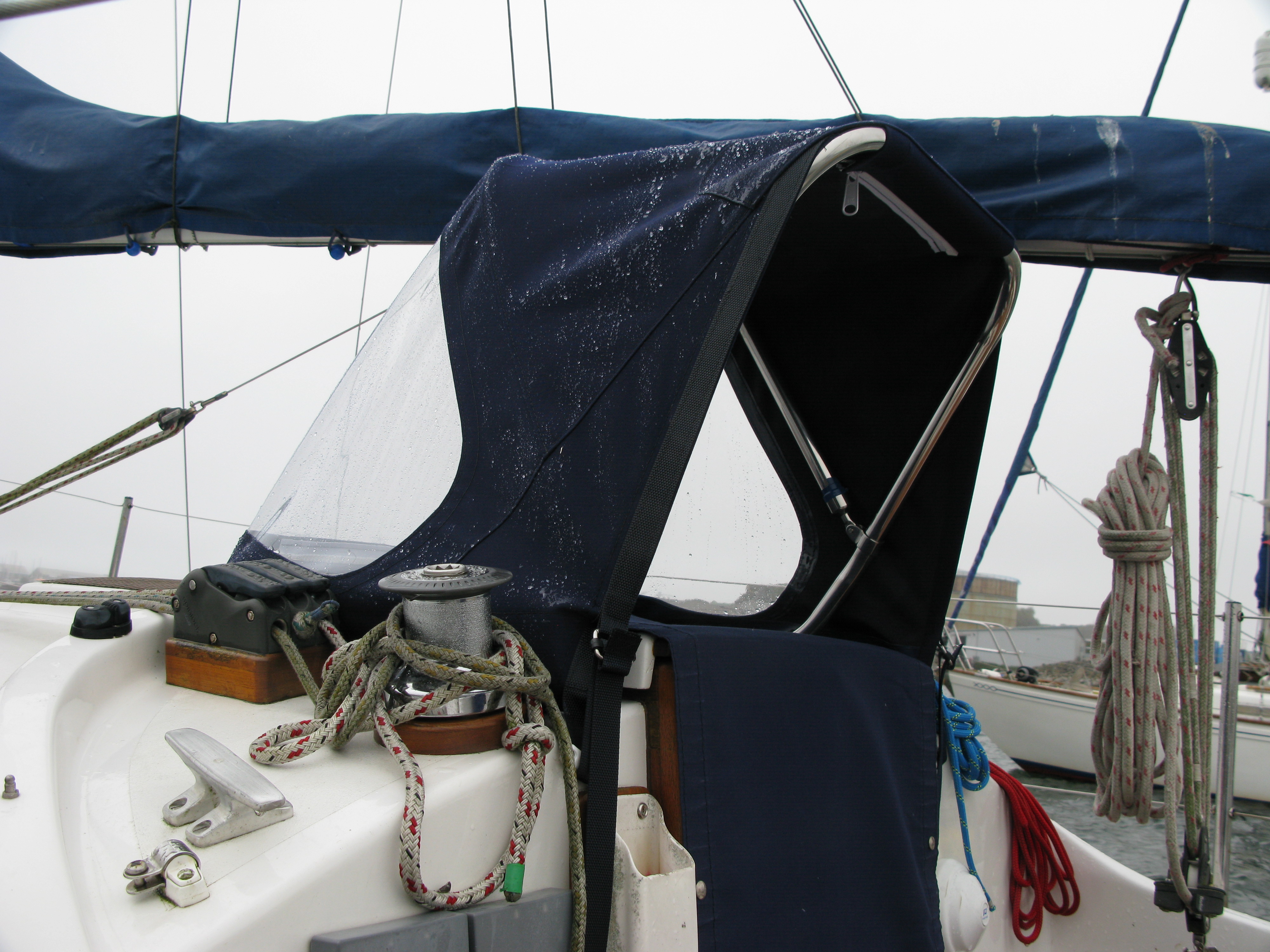
I have had a small ‘come-in’ fitted on Blue Mistress.

This is not the large, curved, ‘extra-room’ spray-hood seen on most modern cruising yachts but a small, upright pram hood over the companionway. I believe this design is called a racing spray-hood, but I prefer ‘come-in’ – (a description I came across in a book written in the 1950’s),  for the comfort of the name.

I can now sit in my favourite spot out of the weather – on the companion way sill with my feet on the engine housing and a good view forward.

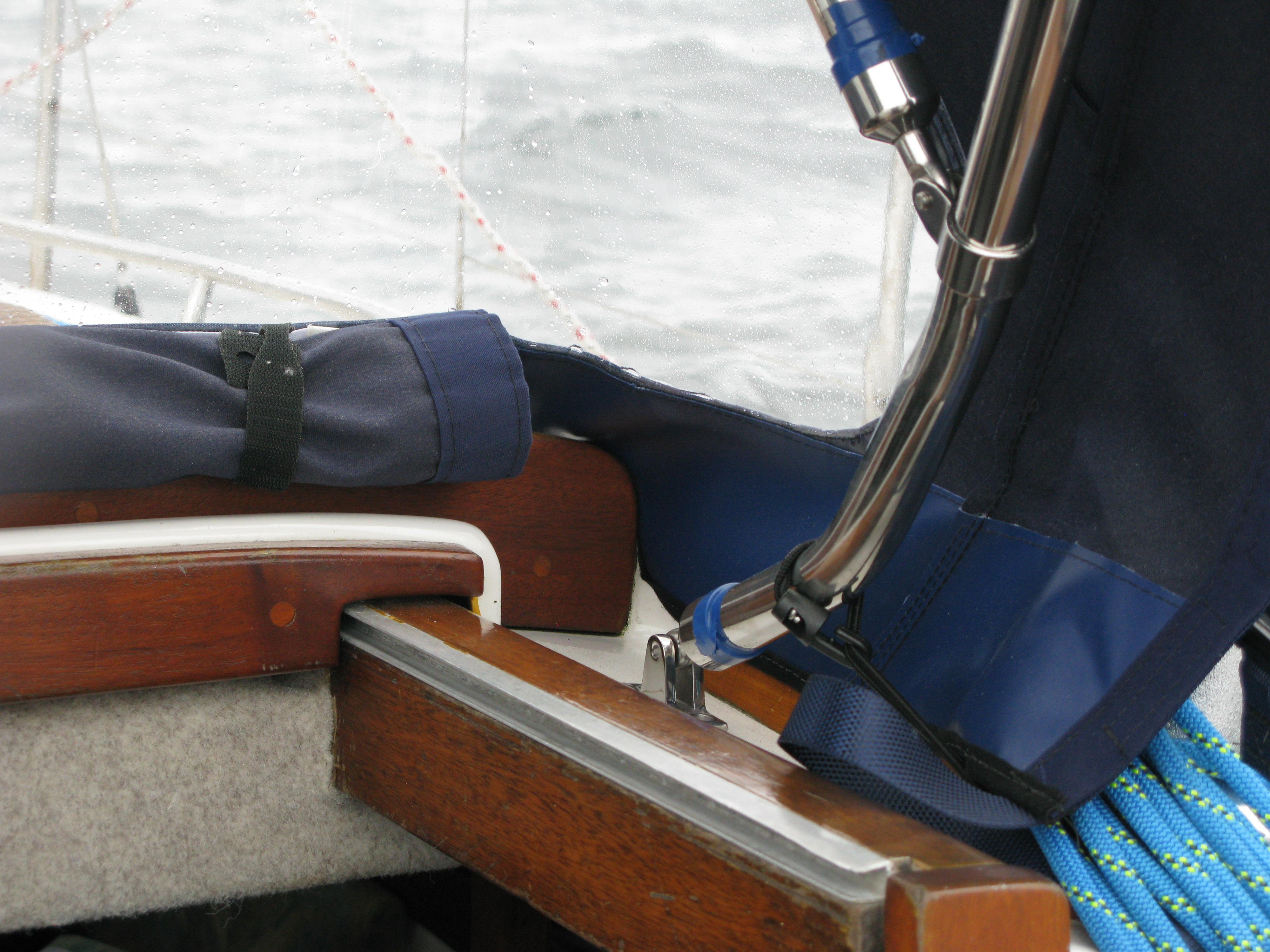
The frame is well-constructed and robust (Dicky B Marine). It is designed to fold flat onto the deck with an angle to clear the wooden bar at the front end of the hatch. In the upright position, it is secured firmly onto the bulkhead either side of the companionway with straps.

The canvas zips onto the frame and is attached to the aforementioned bar with studs – it can be shipped in a trice. The original design had the attachment further forward to give it an elegant slope and also create some room to stow a camera etc. This would have involved fitting a new batten across the hatch housing. However, bolts through the deck here would have stopped the hatch sliding forward. In the event,  it has been kept as small as possible.

The opening is just too small for me to enter and leave without having to push the trailing edge forward about six inches. Initially that meant lowering it completely every time I went below. The problem has been solved with two short lengths of shock cord stretched from the angle at the bottom of the frame to the point where the retaining straps are fastened. These straps are very secure but it is fiddly to keep releasing and tightening them. The shock cord does the job perfectly.

I particularly like this design because it leaves the winches and lines clear. I can go forward easily without tripping over it.

Also, the window is big enough not to block the view forward from the tiller.

. . . I’ve yet to trial it in a gale

. . . and get used to the interruption to the lines of the boat!

On sailing a Folksong – The timing could have been better

The day job is demanding at the moment – and the holiday was abroad, therefore I have not spent enough time on the boat.

So, I thought, why not lift her now that most boats are back in the water and get a couple of jobs done.

This includes removing layers of anti-fouling that weren’t removed properly in her early years. There are patches where it flakes off easily under a hose.

And there are a couple of innovations on Blue Mistress (more on these later) that have been in the pipeline for some time.

She was last lifted was eighteen months ago. There was limited but great sailing during the winter, but it has taken its toll on her hull.

So we lifted her . . .

– and guess what. We have now had a prolonged stretch of beautiful weather – the best for a long while.

My hands are itching to feel the tiller, the pull on a sheet, the rise of the bow on a swell.

I stood in the cockpit yesterday, my feet seeking the vitality of a boat on the water and, you know what?, she felt solid and lifeless.

However elegant, a boat out of water is little better than a glorified shed.

On sailing a Folksong – Betsy

The last I heard of Betsy, she was fitting out for a trip from the Algarve to Lisbon.

I look forward to hearing how they got on.

~~~

In terms of maritime history, this is a coast of great importance, the early Portugese navigators leaving a legacy that is still relevant to us today.

Looking through the links, I came across this report – The Wreck Report for ‘Hantoon’ and ‘Rothesay’ 1882, which occurred some 50 miles north of Cape St Vincent. Although it doesn’t compete with the early use of astronomical tables for navigation (or even events like the Battle of Cape St Vincent), for those  interested in seamanship, particularly where the Collision Regulations are concerned, it’s worth reading – and remembering even though it happened over a century ago, it could have been yesterday.

On sailing a Folksong – Sheet to tiller self-steering

Catching up on my reading.

I see that Webb Chiles posted on sheet to tiller self-steering last month.

With the sails balanced, Blue Mistress will usually sail herself for long enough for me to go forward, do whatever is required and come aft again. In stronger winds I put a line round the tiller.

Of course, moving forward alters the balance and I cannot rely on her maintaining a course for too long.

So I will try this and let you know how I get on.

On sailing a Folksong: an engine anode

I’m not an engine man, preferring to sail and enjoy the vagaries of wind and sea to the precision of  metal parts and fuel consumption.

On the other hand, I know the relief of the engine starting first time and the expectation of being back on the mooring in time for tea.

I look on it as a useful friend which will get me out of trouble if I really need it.

I keep it clean,  can change the oil and oil filter, and know more or less what this part or that part does – but have no overall grasp of it. In fact, I consider it a bit of a challenge.

So, realising that it was time for a proper service, I got the engineer from the Yanmar dealer in and watched him work. (It’s a Yanmar GM10)

A pleasure to see a job done well.

As you would expect – he worked methodically, step-by-step through the process.

And I recognised most of what he was doing, even if some of the bits were not quite where I thought they were.

But when he unbolted the alternator and moved it out the way, I knew I had done the right thing.

What was behind there? Well, the anode of course.

OK . . . . . so I didn’t know there was an anode in the engine. Makes perfect sense. Of course there is. Different metals sitting together in a wet environment.

This is what it looked like.

All you need to know is that a new one is over twice the size of this and a rather elegant dome shape.

I guess it hadn’t been changed for a long time – certainly in the time I have owned the boat.

Anyway, I’ve learned the lesson – and won’t forget it.

On sailing a Folksong – Self-steering gear

A comment this evening:

“I have just bought a Folksong and plan to do some extended single-handed voyages in her. I was wondering if you know of any folksong’s that have had self-steering gear installed on them, and if so which system / model has been used with success.”

Lo Shu

Sho Fu is the only Folksong I know of to carry self-steering gear – and this hazy image is the only one I have and I know nothing else about her.

Looking at her again, I notice the spray hood is similar to a design I have in mind. I might use this one.

I use a Raymarine ST1000+ for shorter trips, but would not want to undertake  a longer voyage with this system alone.

When I bought Blue Mistress I spent some time researching self-steering gear with the intention of fitting it fairly quickly. As happens, priorities changed and deadlines came and went and I still haven’t done it.

However, I did think that a system like the Windpilot Pacific Light might work.  (To see one fitted to the stern of a Folkboat, click here and here).

Nick Jaffe made it to Australia in his Contessa 26, Constellation, with this set up.

Here is Blue Mistress crying out for self-steering gear – and an owner with the means to go a lot further than he has so far.

If you have strong thoughts on this, let me know.


On sailing a Folksong – just checking

This post is for fellow Folksong owners – knowing you would understand.

On the way to St Ives, we detoured to check on the boat.

Around 1230, it was raining hard – big drops with more to come.

All seemed secure, so we drove on – south west, meeting the heavy weather on the road, half of me wondering how things were on the mooring now.

Folksong conversation – “Blue”?

“Blue”? “Blue”? Who’s Blue? My name’s Blue Mistress!

Yea, I know but . . .

Do you know that a person’s name are the most important words to them in the whole world?

Well, yes, I do. But you’re not a person, you’re a boat.

Same difference. It’s unlucky to change a boat’s name. Do you know about the ceremonies to do that?

OK. Let’s be real about this. I want to add another element to this blog – a conversation about boats, built around Folksongs.

I don’t want it to be a rant or a rave or me dictating what should or shouldn’t be – just a dialogue between me and whoever – in this case you, Blue. It gives me a chance to write in a different way and broaden the topics.

Sounds doubtful to me. Talking to a boat? They’ll think you’re nuts.

Maybe. But this blog is four years old. There’s plenty of stuff in it to say I may not be nuts. Anyway, it’s not an ‘official’ blog, it’s my blog.

So why can’t I still be Blue Mistress in this section?

Firstly, ‘Blue’ is short, easy and friendly. Secondly, the women in my family take your name literally – they think the time, energy and money I’ve put into you are similar to having a real mistress. I thought I’d try wild women and whisky for a year or two to show them how that works. I could get used to it – but only if they came sailing.

There was a move to rename you Blue Mist a couple of years ago to take the (st)ress out of you – (get it?).

But you need a positive reason to change a name. After all, once the change has been made, the new one is the important one. To be called Blue Mist “because-a-few-people-were-wary-of-Blue-Mistress” would have been all wrong. And look what it might have involved – here, here or here.

Ok. I’ll hold off – but only for four posts. It better be interesting.

We shall see.

On sailing a Folksong – spinnaker preparation

I went aboard during the slack tide to do a few jobs – strengthen the mooring lines, make it easier to drop the pick-up line and also the anti-chafe plastic piping on the stern lines had slipped and need re-securing. I ran the engine and remembered how much it needs a service.  And there was very little water in the boat – one pull on the hand-pump was enough.

~~~

When I bought Blue Mistress, I inherited a spinnaker that had seen better days and, having written it off, I have been content to sail without one. However, I have recently acquired a nearly-new spinnaker from a Folkboat –  (North Sails), so am now looking at ways of setting it.

The idea is to prepare the ground for doing it single-handed and then, for the first few times have a crew, to test out the the theory.

By sewing tags onto the spinnaker bag at the forward ‘angles’, I can tie it to either side of the pushpit forward of the stanchions. It will be held open by the line to the forestay and fixed at the base to the bow roller. The bungee cord can be tightened or loosened to control the size of the opening and keep the sail in the bag until needed.

Having worked that out and found the halyard was not long enough to feed back to the cockpit, which could be a problem –  (and dropped the bag back into the dinghy to bring home for sewing), I looked at the pole.

I wanted to decide on lengths – length of sheet/guy and downhaul.

By shackling a block forward, and feeding the downhaul back to the cockpit, I can control it from there.

The sheet/guy can be fed to the second track aft of the main sheet track and brought round the winch to the usual cleat, (Blue Mistress does not have self-tailing winches – doesn’t seem to need them).

I know it’s possible to do this single-handed because it happens on Fram.

In theory, given a good day and light winds, I could probably manage this sail – but, hey, that’s theory and I have a way to go yet. (All suggestions gratefully received).

~~~

By the time I came to leave, the flood tide was well under way and it carried the dinghy back to the slipway.

Just the two of us on this trot at the end of February – Blue Mistress and Charisma.