Yesterday I experienced what everyone who has ever owned a boat must feel – that moment when the elaborate and expensive shed you have spent the winter accessing via a wobbly metal ladder reenters the water and comes alive. Continue reading
coasts and harbours
We took the train to St Ives . . .
. . . a birthday treat. The train meandered through Devon – Newton Abbot, Totnes, Plymouth, and on to Cornwall, threading it’s way down the county, stopping everywhere – Saltash, Liskeard, Bodmin Parkway, Lostwithiel, Truro, Par, St Austell, Redruth, Camborne and Hayle, before we changed at St Erth, with time for a coffee in the tiny station cafe. And then Lelant Saltings, Carbis Bay and finally St Ives, to step from the platform into a world discovered by artists long before the holidaying public came to stand and stare, to eat pasties and ice creams and tempt hungry seagulls that know no better.
Paihia to Opua- a walk
A post from Webb Chiles in Opua brought memories of a walk we made from Paihia to Opua in April last year.
The walk follows the bays, first across rocks and along a beach, on through mangroves and then along a sometimes wider, sometimes narrower, sometimes rough, sometimes smooth path. We walked comfortably through bush or along the water’s edge beneath the low and somewhat fragile cliffs.
Jeanne Socrates
To my last post I added the comment that the qualities single-handed sailors had in common were determination and perseverance. On Wednesday evening I met Jeanne Socrates. I haven’t changed my mind.
The Folksong ‘Harrier’
In a recent post, Bill Serjeant has reminded us of his Folksong (Zeta), which he passed on to Julian Mustoe. The latter bought her for a specific voyage, totally rebuilding her coach roof and renaming her Harrier. It’s Bill’s story and I will let him tell it – (link below).
‘Ethel May’ – a great grand-daughter remembers
The following arrived during the week:
“I was thrilled to find, by chance in your collection, a photo of my Great Grandfather’s boat. The Ethel May was built at Rhyl, North Wales, in 1878 (65 tons) owned by John Kearney of Co. Down. I am assuming it was a schooner? My Great Grandfather, Richard Coppack was her captain. My Aunt was named after the boat, although she always felt it should have been the other way around.
A short cycle ride
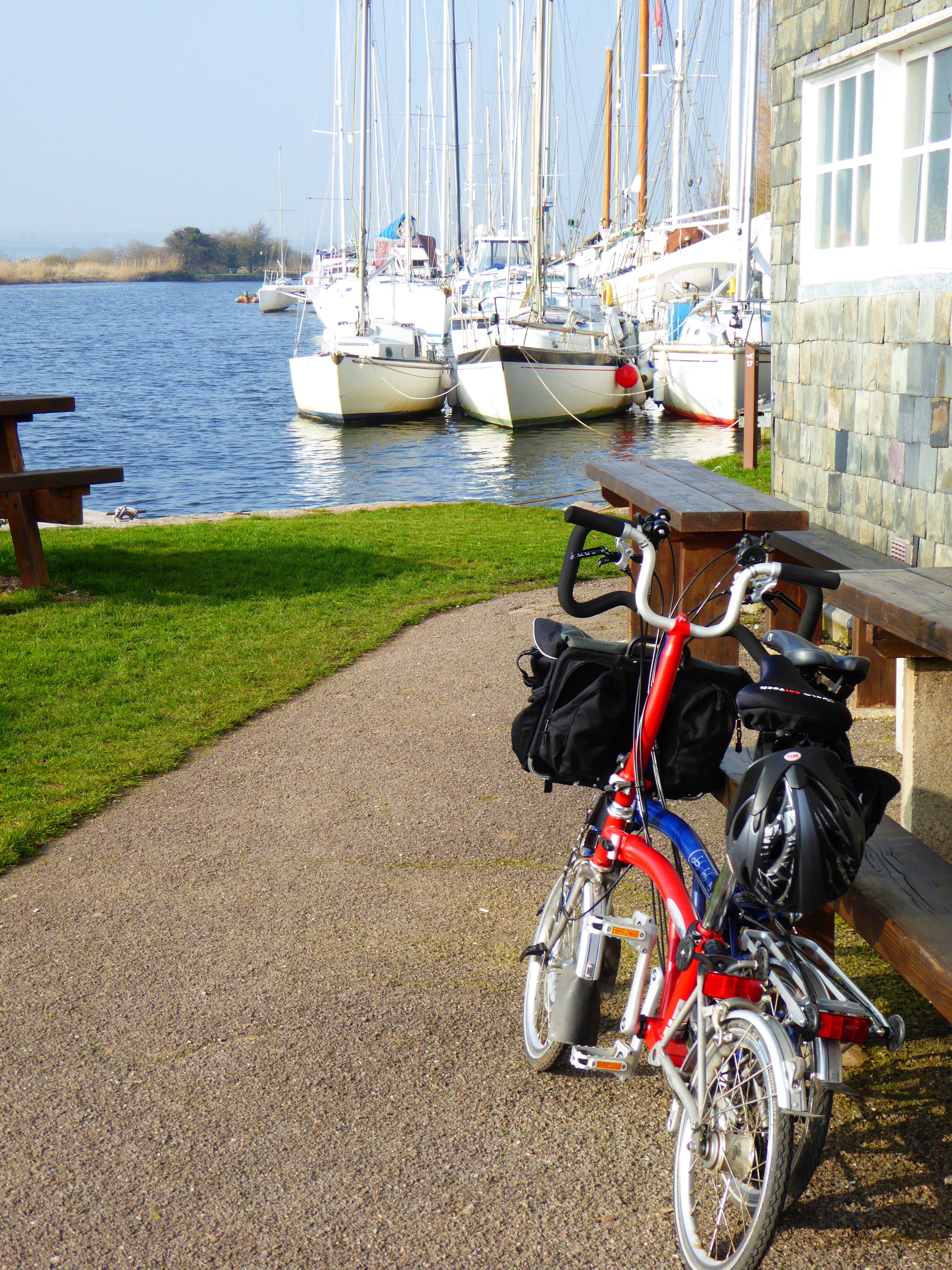 We cycled along the bank of the Rive Exe in the afternoon – a gentle preliminary for a longer ride planned for next month. The tide was low revealing the wide mud flats and the winding channel.. We stopped at the Turf for a coffee before going on towards Exeter.
Brush strokes – good enough – sometimes
Blue Mistress is slowly coming together.
Because we won’t be back in the water before Easter, I have had time to tackle the planned jobs and some unplanned ones as well – like painting the floors of the quarter berths.
I now know why I avoided this for so long. It meant forcing my 42 inch chest five feet down two 38 inch holes – cleaning, sanding and then one, two, three coats – shoulders hunched, arms outstretched, pushing an open paint-pot before me, having to work out how to use my right hand accurately and then how to worm my way backwards without touching the fresh paint.
Vanuatu – Cyclone Pam
The New Zealand Herald has a report from one of their reporters in Vanuatu this morning – here. The video clip shows the destruction in Port Vila. Sadly, there has been loss of life. I understand wind speeds were in the 300km/h mark.
Yesterday, Webb Chiles carried a photograph of the damage in the harbour and a first hand description of the harbour itself – here
Speak up for the horses
You carefully pilot your ship into harbour at the top of the tide. You wait until the tide goes out and there is clear ground around the ship. Then you bring the horse and a cart to offload into. The cargo is heavy – coal, or slag, so you harness two horses in tandem to haul the load across the beach and up to the stores.
 Beyond Steeple Point